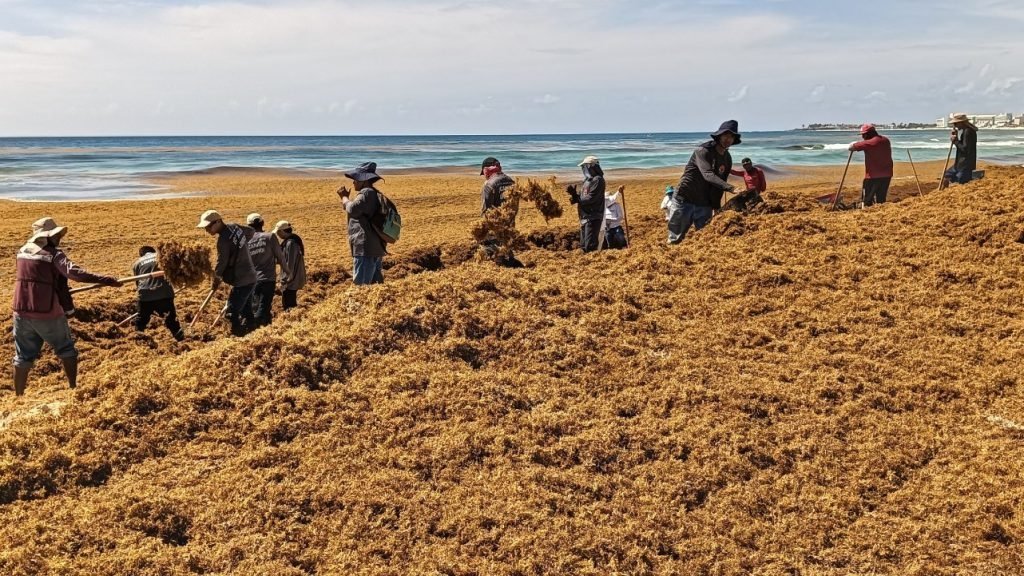
Playa del Carmen, Quintana Roo — The Mexican Navy, in coordination with federal, state and municipal authorities, the private sector and local communities, has collected more than 39,500 metric tons of sargassum from the sea and beaches of Quintana Roo so far this year.
The operation covers the municipalities of Isla Mujeres, Benito Juárez, Puerto Morelos, Cozumel, Playa del Carmen, Tulum and Mahahual in Othón Blanco.
To carry out the removal, the Navy has deployed 13 surface vessels, including one oceanic sargassum-collection ship, 11 coastal vessels and one amphibious sargassum skimmer, as well as 18 smaller support boats. More than 7,605 meters (about 4.7 miles) of containment barriers have been installed, monitored by underwater work personnel.
On the beaches, naval personnel, along with state and municipal workers, use rakes and wheelbarrows to manually remove the seaweed.
The Navy said it continues to implement the Sargassum Attention Strategy, aimed at mitigating the negative effects of the macroalgae on the Caribbean Sea environment. The strategy relies on tools and institutions such as the Oceanographic Institute of the Gulf and Caribbean Sea, which monitors the arrival of sargassum via satellite.
More Environment
- Judge Halts Trump Border Barrier in Big Bend National Park
- US Coast Guard Seizes Cargo Ship Accused of Smuggling Fuel to Cuba
- Playa del Carmen to Renew Eight Blue Flag Beach Certifications, Eyes Two More
- Cancún Sets October Dates for Free Dog and Cat Sterilization Clinics
- Sargassum Influx Triggers Two Types of Wildlife Die-Offs in Quintana Roo
More Quintana Roo
- Quintana Roo Remains Far from Electronic Voting, INE Official Says
- Experts Highlight Social Memory as Key to Disaster Prevention in Quintana Roo
- Quintana Roo to Launch World’s First Formal Sargassum Fishery With 840 Fishermen
- INE Opens 2026-2027 Federal Electoral Process in Quintana Roo, Vows to Tackle Voter Apathy
- Quintana Roo High School System Aims to Install Cameras at All 44 Campuses