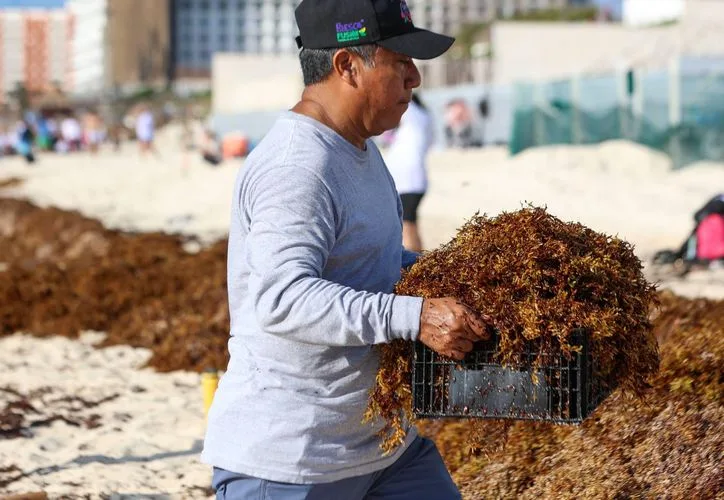
Cancún, Quintana Roo — A biofertilizer made from sargassum collected on the beaches of the Mexican Caribbean is expanding into international markets, with shipments now reaching the United States, South America, Europe and North Africa.
From Mexican fields to global markets
The product is developed by Sarga Agriscience, the agricultural division of Carbonwave, and is produced from macroalgae harvested along the coasts of Quintana Roo. After a process of mechanical decontamination and filtration through molecular exclusion membranes, the company obtains a concentrated liquid extract free of heavy metals, suitable for foliar application and registered with Mexico’s Federal Commission for Protection against Sanitary Risks (Cofepris) and the Secretariat of Agriculture and Rural Development (Sader).
Mexico was the launch platform for the bioproduct in high-value crops, where it proved effective before scaling up for export. “We started in Mexico, not the United States. We knocked on doors in many regions of Mexico, mainly in Jalisco, Sinaloa and the lowlands, where high-value crops like berries are grown and treated foliarly,” said Sebastián Aguilar de Alba, the company’s director of innovation and technology.
The fertilizer is currently applied to berry, avocado, tomato and cucumber plantations in the Bajío region, Michoacán and Jalisco, with additional trials underway on sugarcane near Chetumal.
Export growth
Buoyed by results at home, the company connected with international distributors focused on sustainability and regenerative agriculture. It closed its first bulk shipment of 23,000 liters of concentrated fertilizer — equivalent to processing about 230 tons of fresh sargassum — to producers in the U.S. Midwest and California, backed by a five-year contract targeting an annual volume of 500,000 liters.
“We connected with these large companies in the U.S. … They are very interested because they care about regenerative agriculture,” Aguilar de Alba said. The company also has consolidated sales and active orders in South America, including a 10,000-liter supply to producers in Ecuador, commercial presence in Colombia and field trials in Brazil.
In Europe and North Africa, the strategy centers on evaluating the biofertilizer in extensive crops, grains and vegetables as a sustainable alternative to synthetic inputs. “In Europe, we are focusing on grains and cereals. We ran trials in Hungary with sugar beets. We’ve also tested barley in England,” he said. Additional applications are being carried out in Morocco.
Logistical challenges
Aguilar de Alba said the main obstacle to sustaining international growth is not demand but the logistics of collecting, storing and processing the raw material quickly along the Caribbean coast. “Sargassum is 85% to 90% water. If it isn’t processed quickly, it begins to degrade and produce hydrogen sulfide, which is extremely toxic,” he warned.
To address this, the company is promoting a scheme of mechanical dehydration in the field at several points along the coast of Quintana Roo, which it says will optimize transport and preserve the nutritional properties of the biomass to meet global demand.
More Environment
- Playa del Carmen Unveils Recycled-Plastic Lifeguard Tower at Playa 72
- Chankanaab Park Eyed as Site for Cozumel’s First Dolphin Sanctuary
- Tulum Launches Credentialing Program for Parque del Jaguar Tourism Workers
- Cancún to Host National Climate Change Colloquium in October
- Riviera Maya Hotels Offer Free Nights When Sargassum Blocks the Beach
More Quintana Roo
- Quintana Roo Warns Against Unchecked Hotel Growth as It Courts Brazil and Colombia
- Four Years After Decriminalization, Quintana Roo Feminists Say Abortion Access Still Falls Short
- Quintana Roo Congress Approves Single-Nationality Rule for Top Elected Offices
- Mexico’s Senate Approves ‘Anti-Meme’ Law With Five-Year Prison Terms
- Quintana Roo Ranks Third Nationally in Corruption of Minors With 182 Cases