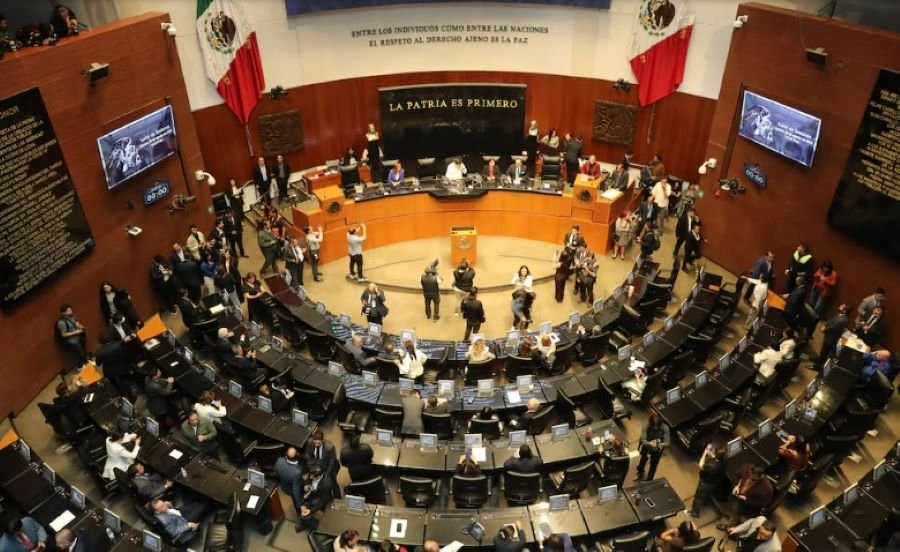
Mexico City — Mexico’s Senate approved a controversial reform dubbed the “anti-meme law” on Wednesday, imposing prison terms of one to five years and fines of up to 10,000 UMA for certain uses of the graphic identity of public institutions.
The changes to the Federal Criminal Code and the Federal Law for the Protection of Industrial Property passed with 72 votes in favor and 34 against, and now go to the Chamber of Deputies for the next stage of the legislative process.
The new Article 403 Bis punishes anyone who uses, reproduces, imitates or incorporates, on a commercial scale, the institutional graphic identity, electronic domains, documents or official symbols of public institutions in order to mislead or deceive with the intent of committing a crime.
Penalties Reduced During Committee Review
The original proposal called for three to seven years in prison. The bill was amended in committee to reduce the range to one to five years, along with fines of 1,000 to 10,000 UMA, Mexico’s inflation-indexed unit used to calculate penalties.
Although the reform does not explicitly list memes, political satire or cartoons as punishable conduct, senators from the PAN, PRI and Citizens’ Movement (Movimiento Ciudadano) warned that the wording could open the door to restrictions on free expression and journalistic content.
During the debate, PAN Senator Lilly Téllez carried a pair of handcuffs to the podium and accused the ruling party of trying to “criminalize laughter,” while other opposition lawmakers displayed examples of satire and political cartoons to question the reform’s scope.
Alejandra Barrales of Citizens’ Movement said the dispute is over control of what is expressed on social media and questioned whether the reform could be used to restrict digital content.
Morena Denies Targeting Memes
Lawmakers from the ruling Morena party rejected claims that the reform is intended to jail people who make memes, parodies or political cartoons.
Senator Javier Corral said the changes target piracy, counterfeiting and the fraudulent use of official elements, particularly when someone uses government logos, domains or documents to deceive others and commit a crime.
President Claudia Sheinbaum also denied that the legislation is meant to ban memes, saying the provisions relate to the protection of intellectual property and the commercial use of official symbols.
The opposition continued to insist that the legislation should expressly state that journalism, satire, cartoons, parody and political criticism are exempt from criminal penalties when there is no fraudulent intent.
Beyond the provisions on institutional identity, the reform toughens penalties for other conduct linked to piracy, trademark counterfeiting and violations of intellectual property rights.
The bill now goes to the Chamber of Deputies, where it must be debated and voted on before it can become law.
More Courts
- Quintana Roo Congress Approves Single-Nationality Rule for Top Elected Offices
- US Lawmakers Press Mexico to Resolve Vulcan Materials’ Calica Dispute
- Playa del Carmen Launches Survey Work to Legalize San Judas Tadeo Neighborhood
- Quintana Roo Lawmakers Propose Up to 15 Years in Prison for Corrupting Minors
- Mexico Investigating 17 People After New Review of Phone Calls in Ayotzinapa Case
More Quintana Roo
- Quintana Roo Warns Against Unchecked Hotel Growth as It Courts Brazil and Colombia
- Four Years After Decriminalization, Quintana Roo Feminists Say Abortion Access Still Falls Short
- Quintana Roo Ranks Third Nationally in Corruption of Minors With 182 Cases
- Quintana Roo Opens 2026 Poetry Contest for Indigenous and Afro-Mexican Girls
- Riviera Maya Hotels Offer Free Nights When Sargassum Blocks the Beach