Cancún, Quintana Roo — Quintana Roo is closing out 2026 with an aggressive international promotion push across the United States, Canada and Latin America, while its tourism promotion chief warns that the state should not keep approving new hotels simply for the sake of building them.
Pablo Casas Gómez, deputy secretary of tourism promotion at the Quintana Roo Tourism Department (Sedetur), said the state and the Tourism Promotion Council (CPTQ) are targeting the markets that matter most while keeping domestic travel in the mix. “We are promoting our 12 tourist destinations and we are betting on strengthening the domestic market, the United States and Canada, and in the southern part of the continent we are betting on Argentina, which has surprised us a lot, as well as Brazil and Colombia,” he said in an interview.
A packed trade-show calendar
Casas Gómez said the state’s final stretch of the year is built around the industry’s largest gatherings. “We went to Top Resa in Paris, where we had representation from the Tourism Promotion Council; then came FIT in Argentina at the end of September; in early October it is ABAV in São Paulo, followed by WTM in London, and at the same time the DEMA Show in New Orleans. Those are basically the big, best-known fairs with which we close the year,” he said.
After those come a wave of smaller, niche events, he added — in Las Vegas, Los Angeles, Chicago and New York, focused on MICE travel and on the romance and wedding segment.
Brazil’s electronic visa draws strong demand
Asked about Brazil’s response to the rollout of the electronic visa, Casas Gómez said early demand was heavy. “The visa demand our embassy in Brazil reported was around 800 visas a day when it started; we would have to check that number again now, but two weeks after the electronic visa launched, Brazilian tourists were applying for around 800 visas a day to travel to Mexico,” he said.
He said the process has been well received. “It is a fully electronic visa: you upload your documents and you don’t have to appear at the consulate unless the system tells you to, and there is a high approval rate — I think 95% approvals. That obviously makes it a little easier for Brazilian tourists to reach our destinations,” he said.
Colombia stabilizes as wait times fall
On Colombian arrivals to the Mexican Caribbean, Casas Gómez said the decline has stopped. “We have seen a stabilization in the Colombian market; we are no longer falling. We have had a slight rebound thanks to the lobbying and the efforts Governor Mara Lezama made with the federal authority, the National Migration Institute,” he said.
He said entry processing has improved markedly. “Now the wait is much shorter — we are talking about 9 to 10 minutes — plus a non-rejection rate of 95%. That benefits all arriving tourists and especially the Colombian market, which had been dealing with difficulty entering the country.”
Sargassum now shapes booking decisions
The deputy secretary acknowledged that seaweed has become part of how travelers choose a destination. “Sargassum has definitely become a factor in travelers’ decisions. As for how many stop coming for that reason, I don’t have the exact figure, but it is a factor in the travel decision,” he said.
To help the trade respond, he said, the state sends weekly updates. “What we do with our tour operators and wholesalers, working hand in hand with them through the CPTQ and the Tourism Department, is send them weekly reports on which beaches are affected and how the sargassum is behaving, to make their decisions easier. And the truth is we have had a good response,” he said.
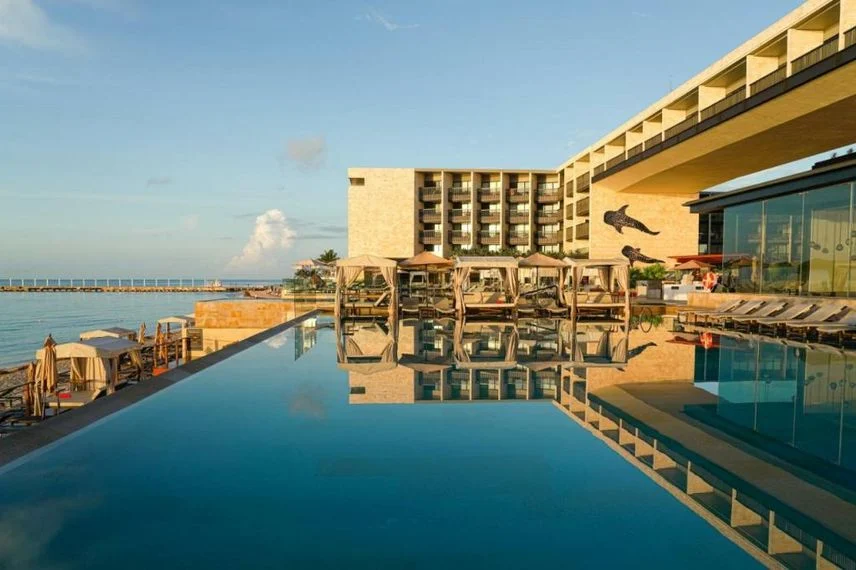
He added that beach quality is not always the deciding factor for the market’s biggest source of visitors. “Although we are the leading sun-and-beach destination, tourists — mainly Americans — like to see the beach, they like to know the beach is there, but they prefer pools. In fact, last year we held a contest for the best pools in the Mexican Caribbean and it was a great success, with a good reception from tour operators and wholesalers.”
Tulum pushes a comeback
Casas Gómez described Tulum as the state’s second-strongest brand and said recovery work is under way with the federal government. “Tulum is and remains our second most important brand after Cancún, regardless of the perception created by different factors. We have been working hand in hand with the entire sector and have held a number of meetings to outline a recovery strategy, obviously alongside and led by the federal government, which has already implemented its Tulum Renace strategy,” he said.
Federal authorities are reaching agreements with airlines and tour operators, he said, while the state is promoting its own event agenda. “We are pushing an events agenda for Tulum that we call Tulum 365, where we plan to hold relevant, important events to reposition the destination — wellness, gastronomy, sports — to show that Tulum is still there, that it is being reborn and moving forward, now with the actions at Parque El Jaguar,” he said.
He said the early signs are encouraging. “A few weeks ago I was there and Parque El Jaguar already shows quite notable signs of recovery; visits to the archaeological zones too, you can see movement. So we are going to have a good close to the year. Tulum hoteliers are already telling us that on future bookings they are seeing an increase toward the end of 2026 and the beginning of next year.”
Airbnb paying tax, leveling the field
On regulation of vacation rental platforms, Casas Gómez said the state has kept close contact with the companies. “We have been very much in touch with those companies, mainly Airbnb, the largest in Mexico. They are already reporting and paying a tax; that brings them somewhat into order regarding the level playing field hoteliers have been asking for, and it is definitely something that keeps us busy and that we are following up on,” he said.
Yes to growth, but with order
Asked about calls to curb indiscriminate hotel construction after a difficult season for the destination’s roughly 140,000 rooms, Casas Gómez agreed. “Totally agree. As our governor said at some point: yes to growth and investment, but with order and respect for the environment. That is what we as the state government are seeking — yes to investment, yes to growth, but always controlling and reviewing how much the market can absorb,” he said.
He said the state wants to make those calls with investors and hoteliers. “I think that is what matters: that we work alongside investors and hoteliers to analyze what is best for us as a destination, and not open hotels just to open them, because afterwards the problem is filling that hotel. The problem isn’t building it, it’s filling it, and now with the competition we are seeing with the Caribbean islands, there is much more supply available. That is good for the tourist because they have more to choose from, but we as a destination do have to keep reviewing how much the market can absorb.”
More Tourism
- Tulum Hosts Nine US Universities and Team Mexico at NCAA Division II Golf Shootout
- Playa del Carmen Unveils Recycled-Plastic Lifeguard Tower at Playa 72
- Tulum Residents Identify Five Sites Where Homeless People Gather
- Chankanaab Park Eyed as Site for Cozumel’s First Dolphin Sanctuary
- Fake Priests Target Hotel Weddings in Cancún, Diocese Warns
More Quintana Roo
- Four Years After Decriminalization, Quintana Roo Feminists Say Abortion Access Still Falls Short
- Quintana Roo Congress Approves Single-Nationality Rule for Top Elected Offices
- Mexico’s Senate Approves ‘Anti-Meme’ Law With Five-Year Prison Terms
- Quintana Roo Ranks Third Nationally in Corruption of Minors With 182 Cases
- Quintana Roo Opens 2026 Poetry Contest for Indigenous and Afro-Mexican Girls