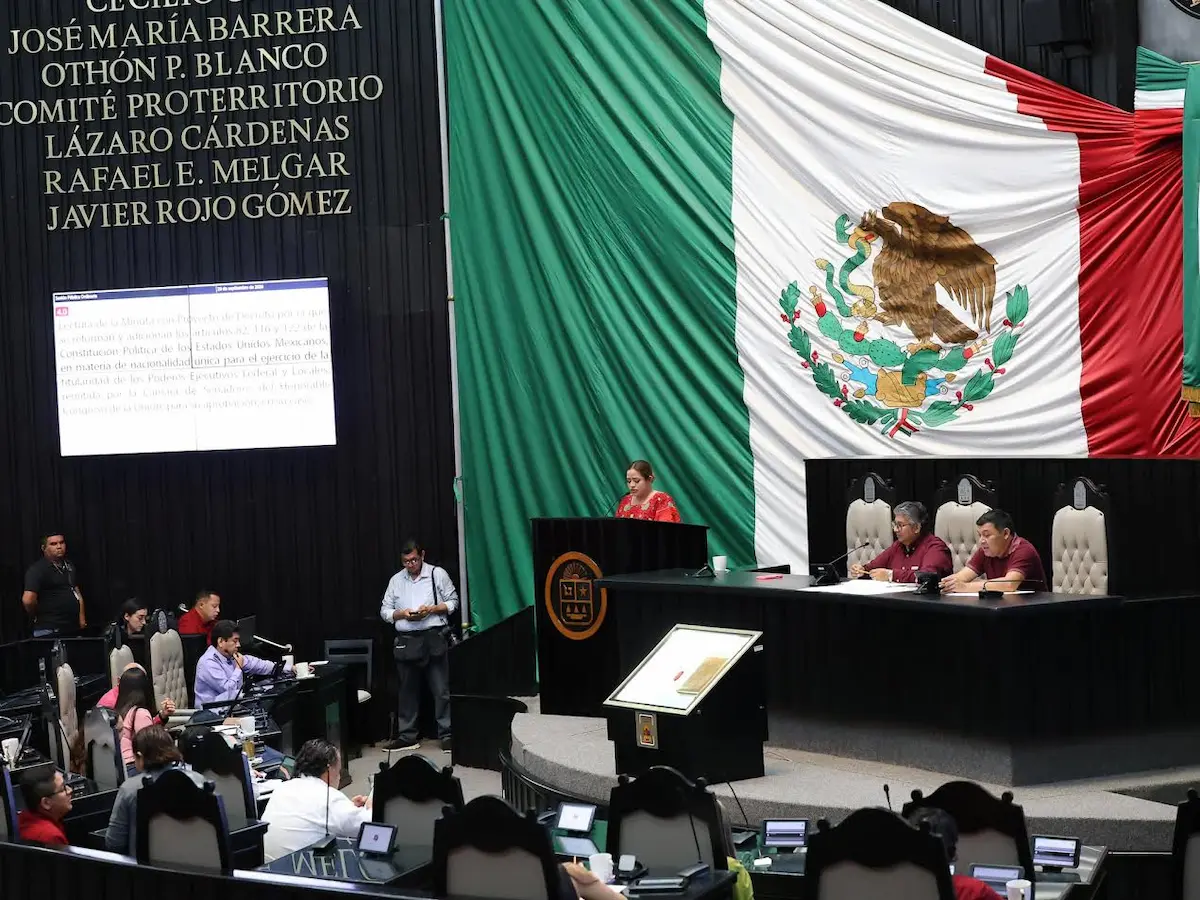
Chetumal, Quintana Roo — The Quintana Roo Congress voted by a wide majority to approve a constitutional reform requiring candidates for Mexico’s presidency, state governorships and the Mexico City government to hold only Mexican nationality, fast-tracking a measure already passed by the federal Congress.
The 18th Legislature approved changes to Articles 82, 116 and 122 of the Constitution, which state that anyone aspiring to those offices must be “a Mexican citizen by birth, in full possession of their rights, the child of a Mexican father or mother; must not hold or acquire another nationality and, if they do hold one, must renounce it before applying to register as a candidate under the terms set by law; and must have resided in the country for at least 20 years.”
The reform adds that anyone holding such an office may not acquire or apply for another nationality, nor invoke a nationality other than Mexican before a foreign authority.
The prohibition also covers the use of a passport or identity document issued by a foreign state, the exercise of political rights tied to that citizenship, and recourse to its diplomatic protection.
Violations would be sanctioned under Title Four of the Constitution, meaning impeachment proceedings that could lead to removal from office and a ban of up to 20 years from public service.
The change does not eliminate the recognition of dual nationality for other Mexicans, according to arguments presented during the debate.
Fast-track approval draws objections
Deputy César Santiago Frías Canché asked that the proposal be approved as a matter of “obvious and urgent resolution,” bypassing committee analysis and drafting, arguing that it does not affect Mexicans generally but only places limits on those who seek to govern the country or a state.
The request passed by majority, with 16 votes in favor and three against, sending the measure through the legislature on a fast track.
Deputy José Luis Pech Várguez called the constitutional change unnecessary, saying existing law already defines the nationality requirements for candidates seeking federal or state office.
He said the reform tells Mexicans living abroad who return home “that they are second-class Mexicans … it is a regression for the 32 million Mexicans living in the United States. We tell them to help build the house, but that they have no right to live in it.”
Amnesty law initiative and anniversary session
The Congress also accepted an initiative from Deputy Jorge Sanén Cervantes to amend Quintana Roo’s Amnesty Law so it uses gender-inclusive language and gives greater visibility to the role of women in the state’s public life.
Congress president Inés Mis Martínez called a solemn session for Thursday, Oct. 8, at 10:30 a.m. at the legislative building in Chetumal to mark the 52nd anniversary of Quintana Roo as a free and sovereign state.
More Politics
- López Obrador Reappears With Video Message as Sheinbaum Marks Two Years
- Mexico’s Senate Approves ‘Anti-Meme’ Law With Five-Year Prison Terms
- Morena Polls Confirm Gino Segura’s Lead in Quintana Roo as Marín Trails Ana Paty
- Quintana Roo Anti-Corruption Agency Reports 82 Sanctions, Mostly Temporary Disqualifications
- Pemex Will Need $10 Billion a Year in Government Support Through 2031, Moody’s Says
More Quintana Roo
- Quintana Roo Warns Against Unchecked Hotel Growth as It Courts Brazil and Colombia
- Four Years After Decriminalization, Quintana Roo Feminists Say Abortion Access Still Falls Short
- Quintana Roo Ranks Third Nationally in Corruption of Minors With 182 Cases
- Quintana Roo Opens 2026 Poetry Contest for Indigenous and Afro-Mexican Girls
- Quintana Roo Lawmakers Propose Up to 15 Years in Prison for Corrupting Minors