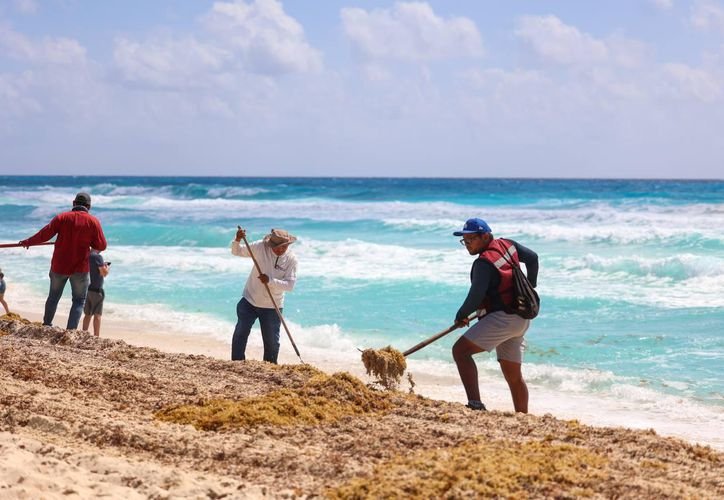
Cancún, Quintana Roo — Sargassum arrivals on Mexico’s Caribbean coast have fallen about 25 percent in recent weeks, according to Esteban Amaro Mauricio, coordinator of the Environmental and Sargassum Monitoring Center.
The seaweed has not disappeared. Instead, as summer advances, currents are pushing it toward the Dominican Republic, Puerto Rico and farther north. “That happens every year as summer progresses, thank God,” he said.
By Aug. 18, crews had collected roughly 109,800 tons, though daily figures vary. The accumulated amount remains historic — four times more than in 2018 and 2022, previously considered record years, and 26.8 times the average recorded since 2011.
Amaro Mauricio said the seasonal peak is now passing. May, June and July are the hardest months; from August onward, sargassum begins to decline, and the reduction becomes clearer by the start of autumn on Sept. 22. That is why he believes investing more resources now makes less sense. “We were already on our way out. The idea is to have a cushion for next season, which will surely also be strong,” he said.
Looking ahead to 2027, monitoring off Africa’s coast — a sargassum barometer — shows similar amounts or up to 5 percent more than this year. But atmospheric and oceanographic changes are so numerous, he warned, that “nothing is written.”
The phenomenon originates in the Gulf of Guinea, between Nigeria and Ivory Coast. From there, sargassum crosses the Atlantic, strengthens off Brazil with nutrients from the Amazon River, and reaches the Caribbean pushed by currents and winds. Rising sea temperatures — 2 to 3 degrees higher than in the past — and human pollution have disrupted the entire system.
For now, 11 coastal vessels, two ocean-going vessels, about 30 support boats and 350 to 500 Mexican Navy personnel rotating between the north and south remain deployed. But for these weeks at least, the sargassum is heading north.
More Environment
- Cancun’s Tourism Reset: Regenerative Travel Takes Center Stage
- Quintana Roo Moves to Power Public Buildings With Clean Energy
- Hurricane Season 2026: What Quintana Roo Faces Before It Ends Nov. 30
- Mexican Navy Prepares 2027 Sargassum Strategy With 17 New Vessels
- New MARAP App Opens Anonymous Environmental Reporting in Playa del Carmen
More Quintana Roo
- Quintana Roo Schools Shut Oct 30 Creating a Four Day Weekend
- Quintana Roo Lawmakers Move to Curb Political Use of Social Programs
- Heavy Rains Flood Streets and Homes Across Quintana Roo, Cutting Power and Commerce
- INE Launches 2027 Elections in Quintana Roo Without Candidate Background Checks
- Quintana Roo Education and Training Chiefs Resign to Seek Morena’s Chetumal Nod