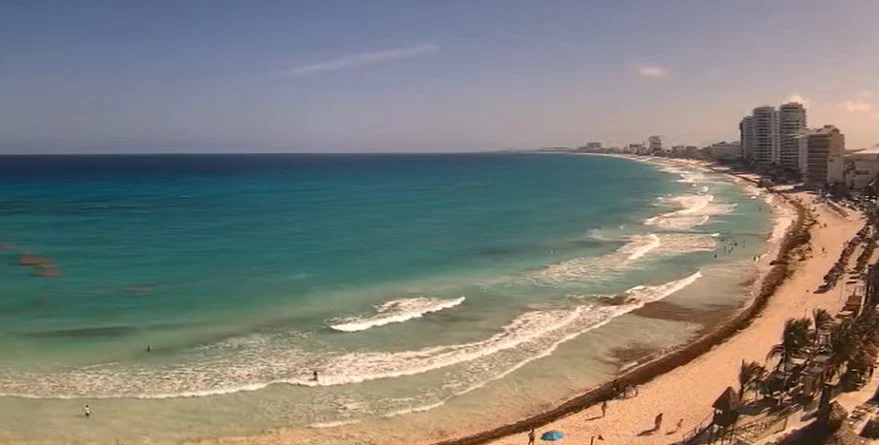
Cancún, Quintana Roo — The massive arrival of sargasso seaweed is generating costs for the hotel sector that, on peak days, rival electricity bills, according to the head of the Mexican Caribbean Hotel Council.
The leader, who spoke on condition of anonymity, acknowledged that the natural phenomenon remains a major challenge for Quintana Roo, comparing it to snowstorms that disrupt tourism in other destinations. “It always has been, and probably will be increasingly so, depending on the amounts of sargasso we receive,” he said.
He noted that last year the region received about five times more sargasso than the worst previous year, and this year is also testing the industry. “There is a coordinated effort, and it is important that everyone does their part,” he added.
The hotel sector bears a significant portion of the cost of removing and cleaning the macroalgae. The medium- and long-term solution, he said, lies in effective transformation, valorization, and commercialization of sargasso, as well as containing it in shallow and deep waters before it reaches the beaches.
Progress is being made, though not as quickly as many would like. “There are many advances, but they are not very tangible yet. A development hub is being created where those who want to transform sargasso can do so effectively, with tax incentives. It is not a reality today, but a lot of work has gone into this project, and I trust it will make a difference in the medium term,” he said.
Proposals include creating schemes similar to those used for film or sports, where a portion of income tax is allocated to these efforts.
The leader stressed the importance of communicating that sargasso does not affect all destinations, all beaches, or all days. “Fortunately, sargasso does not arrive at all destinations or all beaches, and that must be properly disseminated. We don’t have sargasso every day on every beach; it is seasonal. Our destinations offer much more than just sun and beach,” he said.
He compared the situation to a snow destination where a storm hits — things that cannot be controlled. “One day we have a lot of sargasso, and the next day the current changes and everything is beautiful,” he added.
While containment efforts have been and will continue to be a major undertaking, the goal is to find medium- and long-term solutions to redirect the investment currently spent on cleaning the coastline.
The cost varies depending on the amount of sargasso arriving. For some hotels, the expense has been comparable to their electricity bill, revealing the magnitude of resources required. “It is difficult to calculate and budget, but it is a significant amount of money. I wish it were invested rather than spent,” he said.
Despite the challenge, the leader noted that important advances have been made in management and containment over the years. This year is complicated, but he cautioned against generalizing that there is a widespread impact.
Regarding occupancy projections, he said the sector is moving forward. While he did not provide specific numbers, he noted that the region has 140,000 hotel rooms and it is not easy to fill them. However, events like the FIFA World Cup will contribute, especially for Cancún, which has the infrastructure and connectivity to 16 host cities. “We won’t have full occupancy or an early summer, but it will contribute, and that is important,” he said.
More Cancun
- Cancún Evicts Homeless From Old General Hospital to Make Way for New Maternal and Child Facility
- Cancún Airport ‘Pirate’ Transporters Accused of Intimidating Tourists Over Uber and Didi
- Cancún’s Second Government Report Cites 995.9 Million Pesos in Public Works as Residents Question Results
- Activist Searching for Missing Brother Sentenced to 80 Years for Cancún Kidnapping
- Cancún Officials Urge Residents to Protect Pets After Reported Puma Sighting in Cuna Maya