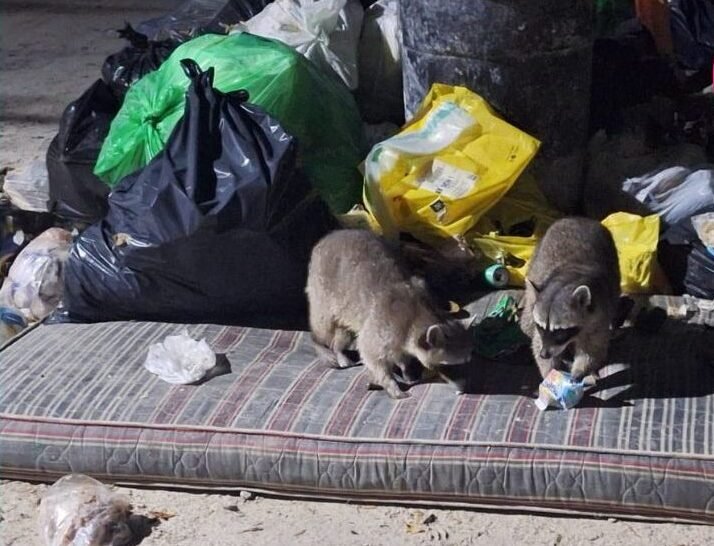
Holbox, Quintana Roo — An uncontrolled surge in the raccoon population on the island of Holbox has become an environmental and public health problem, according to environmentalist Juan Manuel Rico Santana. The animals are invading homes, attacking pets, and preying on sea turtle nests.
Rico Santana said that urban expansion and loss of natural habitat are driving raccoons closer to the community in search of food. They commonly enter patios and kitchens, and tear open garbage bags to feed.
“It can already be called a plague,” he said, noting that the species’ population has grown significantly in recent years.
Sea Turtles at Risk
One of the most serious environmental impacts is the predation of sea turtle eggs. Rico Santana recalled that in the past, authorities focused on preventing humans from taking eggs, but now raccoons pose the greater threat.
When turtles come ashore to lay eggs on Holbox’s beaches, raccoons locate the nests, dig them up, and consume nearly all the eggs, hampering the reproduction and conservation of these protected species.
Lack of Natural Predators
The environmentalist attributed the raccoon boom partly to the disappearance of their natural predators. He noted that about 40 years ago, the last jaguar was recorded in the Ensenada de Holbox area — a species that helped maintain ecological balance by preying on raccoons.
“With the jaguar gone, the raccoon population lost its natural predator, which favored its growth,” he explained.
Rico Santana urged environmental authorities to implement a species management strategy, such as sterilization campaigns or relocation of raccoons to areas where ecological balance can be restored.
He also warned that raccoons could pose a health risk as potential carriers of diseases like rabies, and have repeatedly attacked dogs and other pets.
Finally, he blamed part of the problem on the island’s disorganized urban growth, which has reduced natural spaces for wildlife and increased contact between raccoons and people. He expressed concern that attacks on children could occur in the future.
More Environment
- Puerto Morelos launches weekly sargassum watch until 2026
- Quintana Roo Seeks Geographic Indication to Protect Melipona Honey
- Dengue Cases in Quintana Roo Jump 152 Percent
- Quintana Roo Hoteliers Push Regenerative Tourism Amid Beach Access Disputes
- Greenpeace Finds Contamination at 17 Yucatán Wells and Cenotes as Maya Communities Demand Action