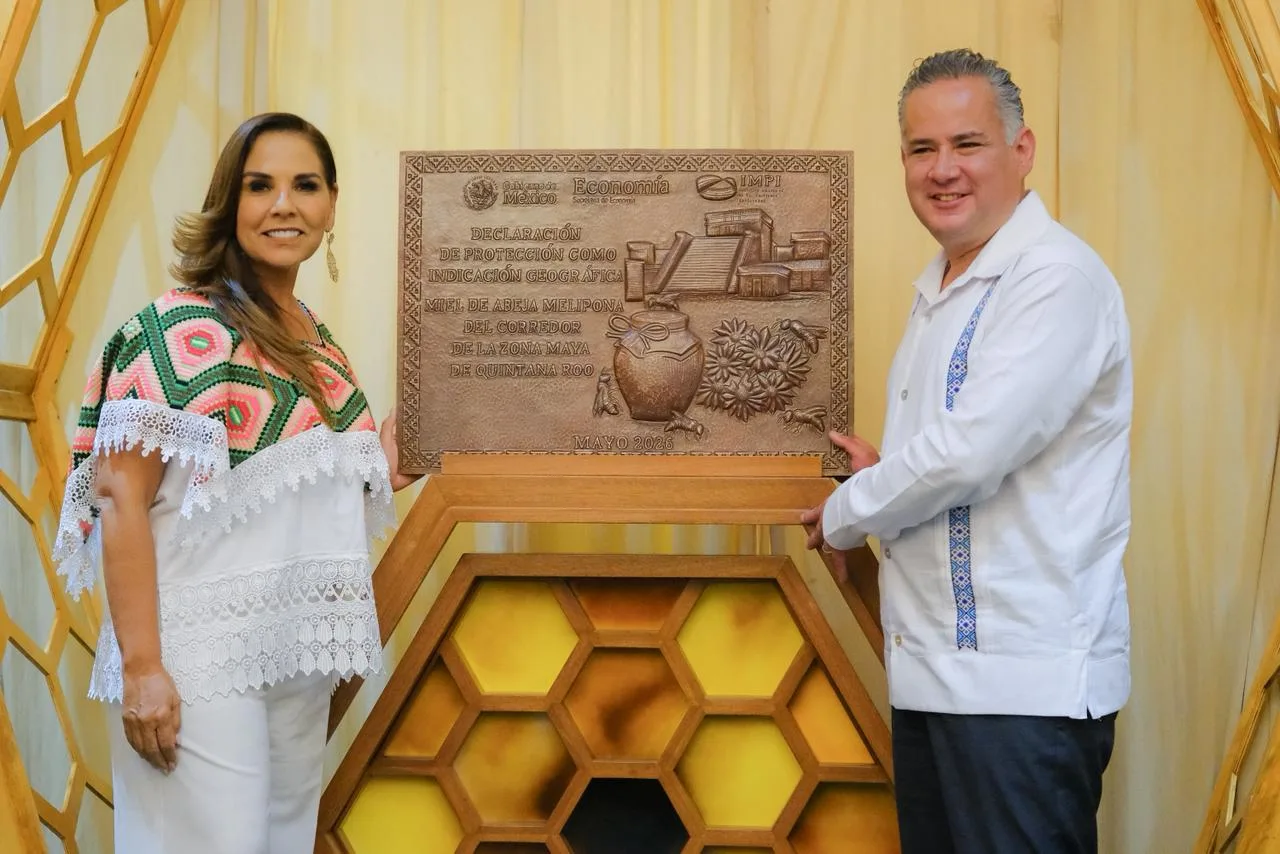
Felipe Carrillo Puerto, Quintana Roo — Melipona honey from Quintana Roo’s Maya zone has received federal protection as a Geographical Indication, a major recognition for one of the region’s most culturally important traditional products.
The declaration, published in Mexico’s Federal Official Gazette on May 12, protects the name “Miel de Abeja Melipona del Corredor de la Zona Maya de Quintana Roo.” The process began in December 2024, when the state government, through the Ministry of Government led by María Cristina Torres Gómez, submitted the application to the Mexican Institute of Industrial Property, known as IMPI.
The designation covers honey produced by stingless bees, primarily Melipona beecheii, known in Maya as xunán kab, often translated as “lady bee” or “royal lady bee.” The bee has been cultivated by Maya communities for centuries and is deeply tied to traditional medicine, foodways, ceremony, and local ecology. Mexico’s Agriculture Secretariat describes Melipona beecheii as the “sacred Maya bee,” a stingless species long managed by Maya peoples for its honey and cultural value.
Unlike conventional honey from European honeybees, Melipona honey is produced in much smaller quantities and has a thinner texture, higher moisture content, and a more acidic, floral profile. Its rarity is part of its value. Local reporting notes that a melipona apiary may produce only five to six kilos per year, and that Melipona honey represents just a small fraction of Quintana Roo’s overall honey production.
The protected area includes the municipalities of Felipe Carrillo Puerto, José María Morelos, and Tulum. Together, these communities form the recognized “Corredor de la Zona Maya,” where traditional meliponiculture remains part of local identity and household economies.
The Federal Official Gazette describes the honey as a product of high biological and cultural complexity, derived from nectar and plant secretions of regional flora and transformed by stingless bees through enzymatic processes and maturation inside their nests. That language matters because it ties the value of the honey not only to the bee, but to the territory itself: the local plants, the climate, the forest, the knowledge of producers, and the traditional methods used to care for the hives.
The new Geographical Indication gives Quintana Roo territorial rights over the production and commercialization of the protected name. In practical terms, this means only honey produced within the designated area and under the recognized conditions can legally use the name. It also allows authorized producers to use the official ® or MR marks, helping prevent imitation, misuse, or unfair competition.
State officials say the recognition directly benefits 175 meliponiculture families in 73 Maya communities. That is especially important because the product is both culturally significant and economically vulnerable. Without legal protection, producers risk seeing the name or image of Melipona honey used by sellers outside the region, including products that may not follow traditional practices or even come from Melipona beecheii bees.
The designation could also improve market access. Protected geographical status can help small producers build stronger brands, command better prices, develop certification systems, and enter higher-value markets in gastronomy, wellness, and cultural tourism. For English-speaking visitors, this is similar in concept to why Champagne must come from Champagne, or why certain Mexican products such as tequila and mezcal are protected by origin.
The recognition also reinforces the environmental value of meliponiculture. Stingless bees are important pollinators for native flora, and supporting their traditional management can encourage forest conservation. In a region under pressure from development, deforestation, and climate change, protecting the bee’s habitat is inseparable from protecting the honey itself.
The IMPI rules require the state government to renew the protection every ten years to keep the designation valid. That means the recognition is not just ceremonial. It creates an ongoing responsibility to maintain standards, support producers, and defend the integrity of the name.
For Quintana Roo, this is more than a label on a jar. It is legal recognition of a Maya tradition, a regional ecosystem, and a product that carries the story of the forest in every small batch.
More Business
- López Obrador Reappears With Video Message as Sheinbaum Marks Two Years
- Two Extortionists Sentenced to 22 and 15 Years in Cancún
- Tulum Hosts Nine US Universities and Team Mexico at NCAA Division II Golf Shootout
- Quintana Roo Warns Against Unchecked Hotel Growth as It Courts Brazil and Colombia
- Tren Maya Lost 5 Billion Pesos in Six Months as Operating Costs Soar
More Quintana Roo
- Four Years After Decriminalization, Quintana Roo Feminists Say Abortion Access Still Falls Short
- Quintana Roo Congress Approves Single-Nationality Rule for Top Elected Offices
- Mexico’s Senate Approves ‘Anti-Meme’ Law With Five-Year Prison Terms
- Quintana Roo Ranks Third Nationally in Corruption of Minors With 182 Cases
- Quintana Roo Opens 2026 Poetry Contest for Indigenous and Afro-Mexican Girls