
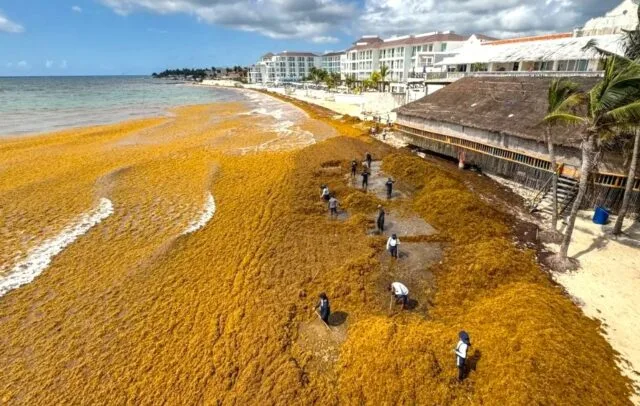
Cancún, Quintana Roo — Sargassum workers on Quintana Roo’s beaches are being exposed to hydrogen sulfide gas at concentrations well above the limits considered safe for an eight-hour workday, according to a new study by the Institute of Marine and Limnology at Mexico’s National Autonomous University (UNAM).
Researchers fitted 35 sargassum collectors in Puerto Morelos, Playa del Carmen, and Mahahual with portable gas sensors. They found that workers were exposed to an average of 1.8 parts per million (ppm) of hydrogen sulfide, with peaks as high as 50 ppm. Under Mexican standard NOM-010, the maximum allowable exposure for an eight-hour shift is 1 ppm.
Rosa Rodríguez, a researcher at the institute, warned that the risks extend beyond the workers themselves. “Obviously, the more sargassum, the more decomposition, the more gas,” she said. “It’s not only the sargassum workers — tourists and residents on the coastline have chronic exposure.”
Hydrogen sulfide can irritate the upper respiratory tract and damage the central nervous system, according to the Mexican standard. Workers commonly report skin irritation, red patches, burning sensations, vomiting, dizziness, and fever. One collector said medical visits often fail to connect these symptoms to sargassum work.
“You get these red patches and a burning sensation on the skin; there’s vomiting, dizziness, high fever,” the worker told Imagen Noticias. “When you get sick, you go to the doctor, and they tell you it’s something else. They don’t tell you it’s because you work with sargassum or because you’re breathing this in, so people don’t really know what they’re getting sick from.”
The study comes as Quintana Roo grapples with a record sargassum season. Brandon Mex Martínez, the state’s director of special waste management, said collections on beaches and at sea have already reached 104,700 tons — a historic high that has strained the tourism-dependent region.
More Environment
- Playa del Carmen Unveils Recycled-Plastic Lifeguard Tower at Playa 72
- Chankanaab Park Eyed as Site for Cozumel’s First Dolphin Sanctuary
- Tulum Launches Credentialing Program for Parque del Jaguar Tourism Workers
- Cancún to Host National Climate Change Colloquium in October
- Riviera Maya Hotels Offer Free Nights When Sargassum Blocks the Beach
More Quintana Roo
- Quintana Roo Warns Against Unchecked Hotel Growth as It Courts Brazil and Colombia
- Four Years After Decriminalization, Quintana Roo Feminists Say Abortion Access Still Falls Short
- Quintana Roo Congress Approves Single-Nationality Rule for Top Elected Offices
- Mexico’s Senate Approves ‘Anti-Meme’ Law With Five-Year Prison Terms
- Quintana Roo Ranks Third Nationally in Corruption of Minors With 182 Cases