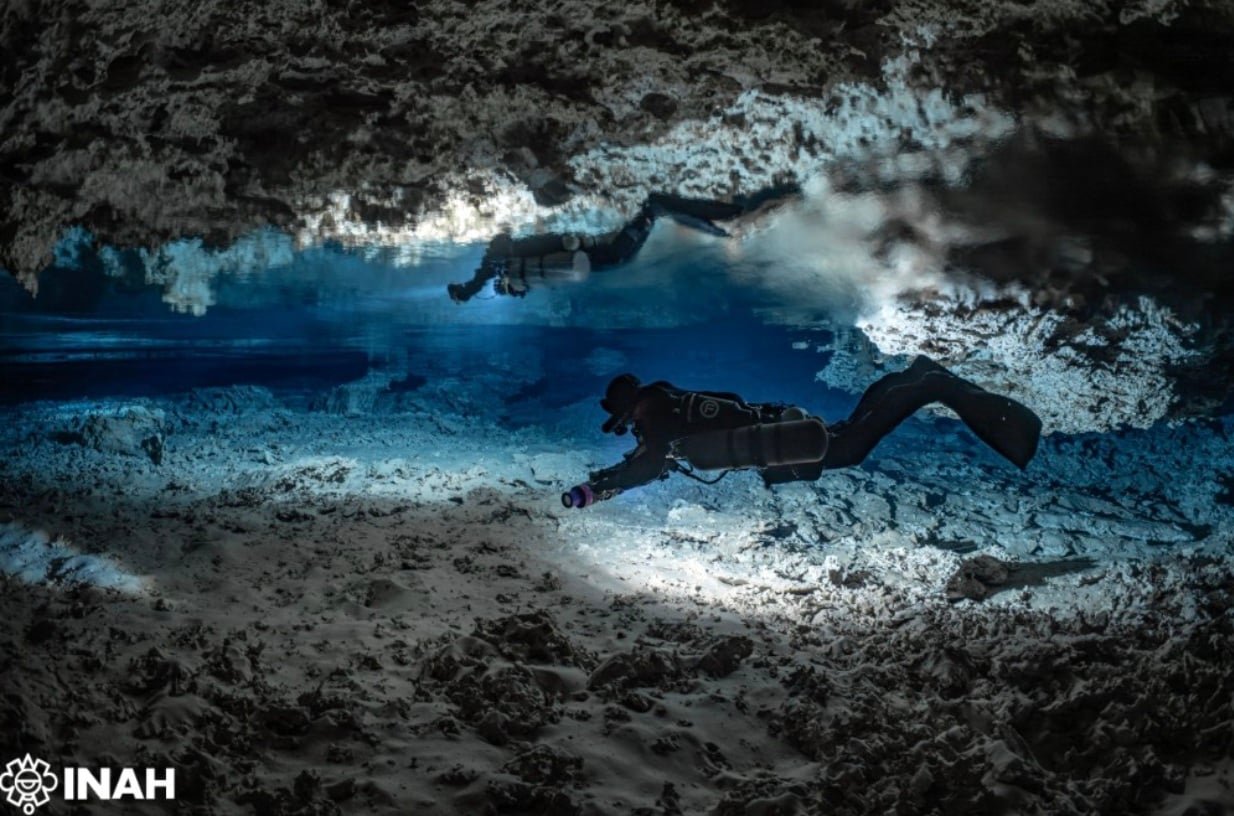
Mexico City — The National Institute of Anthropology and History (INAH) has signed a collaboration agreement with the Center for the Investigation of the Aquifer System of Quintana Roo (CINDAQ) to strengthen underwater archaeology and preserve Mexico’s submerged cultural heritage.
The agreement, formalized through INAH’s Underwater Archaeology Branch (SAS), provides a framework for ongoing cooperation on conservation of cultural assets in flooded archaeological sites. Roberto Junco Sánchez, head of SAS, said the deal “formalizes a relationship built over more than two decades of trust, shared fieldwork, and scientific collaboration.”
CINDAQ has long contributed specialized cave-diving skills, training, equipment, expedition logistics, surveying, photography, photogrammetry, geographic information systems (GIS), and data management. These resources have helped archaeologists and other specialists access, document, interpret, and protect hard-to-reach sites.
One prominent project benefiting from the alliance is “Prehistory of the Yucatan Peninsula through its evidence in caves and cenotes,” led by SAS researcher Silvina Vigliani. She noted that the CINDAQ team has been essential in exploring environments that would otherwise remain hidden. “With nearly three decades of experience, they are unconditional support in fieldwork because of their knowledge of karst systems,” she said. “They also provide courses, mapping, and images from their explorations, making them first-line informants.”
Another major effort is the Hoyo Negro underwater archaeological project in Tulum, which began in 2011 and remains active. It received the Best Practices award from UNESCO in 2023, according to Junco Sánchez.
The partnership has also extended to archaeological zones such as Chichén Itzá and Ek’ Balam, where university partners helped produce aerial maps, photogrammetric models, panoramic images, and other digital records supporting research, conservation, and virtual access.
The new agreement establishes a solid institutional base for work involving cave and cenote exploration, archaeological documentation, LiDAR, photogrammetry, artifact conservation, data exchange, public education, and responsible management of the nation’s submerged cultural heritage. It will also support the Underwater Archaeological Atlas of Cenotes, Flooded and Semi-Flooded Caves, and Other Continental Water Bodies of Mexico, led by archaeologist Helena Barba-Meinecke.
CINDAQ is accredited as a non-governmental organization under the 2001 UNESCO Convention on the Protection of the Underwater Cultural Heritage and is recognized by the Nautical Archaeology Society in the United Kingdom.
The agreement also honors the legacy of archaeologist Pilar Luna Erreguerena (1944–2020), a pioneer in underwater archaeology whose work helped highlight the contributions of cave-diving communities. Sam Meacham, CINDAQ’s director, said, “Her vision, openness, and trust helped establish the foundations of collaboration with CINDAQ.”
More Culture
- Puerto Morelos to Host Mar de Almas Janal Pixan Festival for Day of the Dead
- Fake Priests Target Hotel Weddings in Cancún, Diocese Warns
- Quintana Roo Opens 2026 Poetry Contest for Indigenous and Afro-Mexican Girls
- Extortion Cases Hit Several Playa del Carmen Churches in 2026
- Direct Sales Open Path to Formalization for Mexican Artisans, Says Luz Valdez
More Quintana Roo
- INE Opens 2026-2027 Federal Electoral Process in Quintana Roo, Vows to Tackle Voter Apathy
- Quintana Roo High School System Aims to Install Cameras at All 44 Campuses
- Biometric CURP in Quintana Roo: Where to Apply, What to Bring and Whether It’s Mandatory
- Maya Council and Xcaret Push Supreme Court to Drop Indigenous Symbols Case
- Cancún Hosts 45 Nations at EU-Caribbean Summit on Sargassum