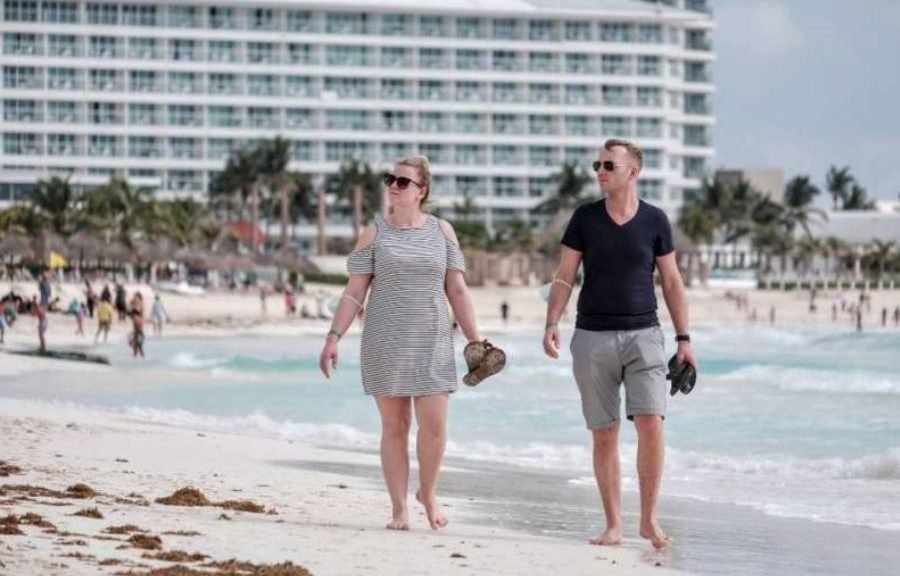
Cancún, Quintana Roo — Quintana Roo’s tourism industry is experiencing a marked slowdown in August 2026, driven by an unprecedented influx of sargassum onto its beaches, a 10% drop in airline seats from the United States, and weaker international arrivals. The trend has forced business groups to tighten operations ahead of the low season to avoid widespread layoffs.
Despite the challenges, the Mexican Caribbean has shown resilience, with average hotel occupancy ranging from 67% to 75% during the summer holiday period.
Connectivity and Key Markets Hit
Airline capacity from the United States to Cancún has fallen 10%, a decline attributed to higher global jet fuel costs and economic uncertainty. The drop is compounded by the absence, for nearly eight years, of Mexico’s federal tourism promotion agency, the Tourism Promotion Council, which was eliminated under former President Andrés Manuel López Obrador. Competing destinations such as the Dominican Republic, Costa Rica, Jamaica, and Turkey have been drawing travelers who might otherwise have visited Quintana Roo.
International arrivals have contracted significantly, with visitor numbers from the U.S. down 5.05%, France down 12.9%, and Colombia plummeting 36%.
Sargassum and Employment Concerns
The unprecedented volumes of sargassum have driven away conventional beach tourists at several points along the coast. In Cancún, Playa del Carmen, and Tulum, business leaders anticipate a particularly difficult period between September and November. The Business Coordinating Council (CCE) is already coordinating strict operational adjustments to limit job losses.
Bright Spots in Tourism
Not all indicators are negative. Cruise tourism grew 3.26%, led by the port of Mahahual, which saw a 14.9% increase, and by the continued strength of Cozumel. Visits to archaeological sites rose 7.5%, supported by recent infrastructure improvements and reopenings. Quintana Roo also remains unique in Mexico as the only state with four functioning international airports: Cancún, Tulum, Cozumel, and Chetumal.
Destination-by-Destination Performance
Twelve of the state’s 13 main tourist destinations have seen declines in visitor numbers:
- Isla Mujeres: -13.45%, the steepest drop.
- Chetumal: -5.46%, hurt by weaker border and regional tourism.
- Riviera Maya: -4.56%, a moderate decline but with heavy hotel weight.
- Cancún: -3.55%, a slight overall dip but stable during the summer.
- Costa Mujeres: growing, the only micro-destination bucking the negative trend.
Export Boom Fails to Lift Mexico’s Economy
In a separate report, economists at Deloitte Econosignal warned that Mexico faces an economic paradox: despite a historic export boom this year, economic growth is expected to be among the lowest in Latin America, hampered by trade uncertainty and a challenging geopolitical environment.
The increase in exports has not translated into greater domestic value added, because the sectors benefiting most have low levels of national content. Deloitte forecasts Mexico’s economy will grow just 1.2% this year, reflecting also weaker investment.
The manufacturing sectors contributing most to economic activity are automobiles, trucks, and auto parts. The national content of Mexico’s manufacturing exports in high-demand segments such as machinery and equipment stands at around 44%, a level comparable to 2015.
The report, led by Daniel Zaga Szenker, Deloitte’s chief economist partner, said tariff changes and rising Asian imports have caused declines in industries such as automotive and, more recently, servers, computers, and peripherals. In contrast, electronic components and aerospace have posted annual growth of 10.6% and 16.2%, respectively. However, that dynamism has been accompanied by a sharp increase in imports of high-value goods, mainly from Asia, including computers, medical equipment, and telecommunications gear.
Employment trends have been mixed. The automotive sector, which accounts for 16% of manufacturing employment, has been in decline; INEGI data show a 2.1% annual drop in May, the 39th consecutive month of contraction. In contrast, employment in servers, computers, and peripherals grew 3.2%, even as output in that segment fell between January and May 2026. Employment in electronic components began to rise during 2026.
Foreign direct investment totaled $23.6 billion in the first quarter, down 4% from the same period in 2025. Outflows reached $2.047 billion, $1.1 billion more than in 2024. The value of capital goods acquired — buildings, machinery, and equipment — slipped 0.1%, reflecting weaker appetite among local investors.
Deloitte emphasized that uncertainty over the future of the USMCA trade agreement will continue to weigh on manufacturing, especially the automotive sector, limiting its performance. Meanwhile, the triangulation of high-tech goods from Asia has boosted exports even as domestic activity weakens.
Regional Variations
The impact of external shocks will vary by state. Nuevo León, Tamaulipas, and Hidalgo are projected to grow more than 2%, above the national average, while Campeche, Morelos, and Coahuila are expected to expand by less than 1%. Northern states and others with strong high-tech exports have seen a slowdown in total manufacturing production. In most of these states, weaker output was tied mainly to a contraction in automotive-related exports, as in Coahuila, Guanajuato, and Jalisco, though Baja California and San Luis Potosí were exceptions.
Notably, Coahuila, Chihuahua, and Jalisco saw significant growth in exports of servers, computers, and peripheral equipment despite the manufacturing slowdown.
More Tourism
- Playa del Carmen Takes Artisans to Guanajuato Day of the Dead Festival
- Playa del Carmen to Renew Eight Blue Flag Beach Certifications, Eyes Two More
- 20 Community Tourism Projects in Quintana Roo Seek to Formalize Their Operations
- Rains and Port Restrictions Cut Cancún Nautical Tourism to 60%
- Xcaret Festival of Life and Death Returns for 20th Edition With Guanajuato as Guest State
More Quintana Roo
- Quintana Roo Remains Far from Electronic Voting, INE Official Says
- Sargassum Influx Triggers Two Types of Wildlife Die-Offs in Quintana Roo
- Experts Highlight Social Memory as Key to Disaster Prevention in Quintana Roo
- Quintana Roo to Launch World’s First Formal Sargassum Fishery With 840 Fishermen
- INE Opens 2026-2027 Federal Electoral Process in Quintana Roo, Vows to Tackle Voter Apathy