
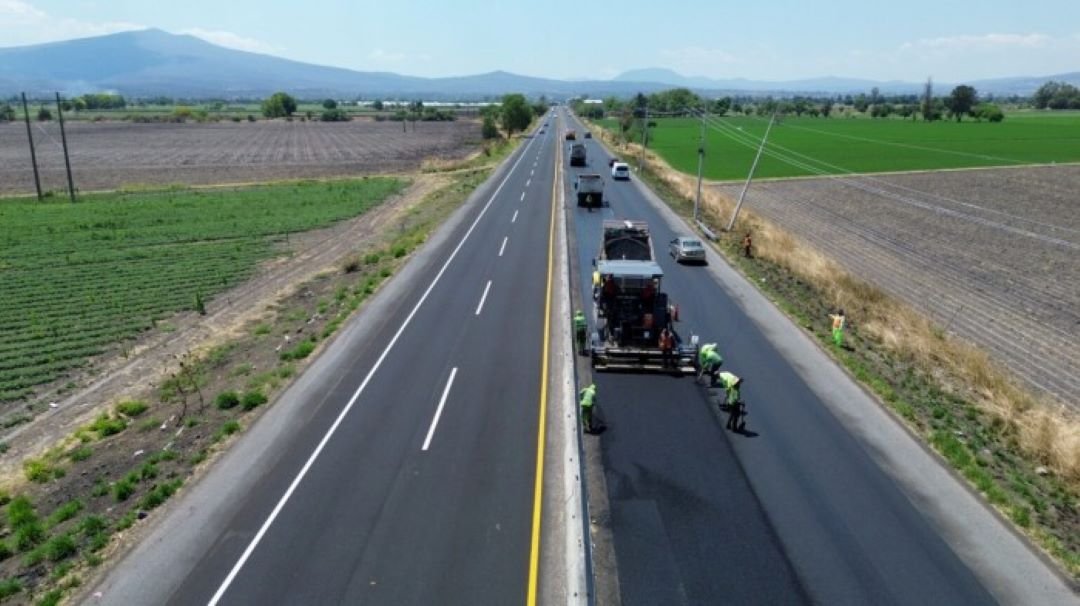
Chetumal, Quintana Roo — Quintana Roo has been left out of the federal government’s new “Paving Trains” program, which this year will repair 5,000 kilometers of toll-free federal highways across 16 Mexican states.
The Ministry of Infrastructure, Communications and Transport (SICT) announced the progress of the program, which uses 20 state-of-the-art paving trains, with plans to acquire 11 more.
Notable works include repairs in Michoacán, where 68.5 kilometers are being addressed on five highway stretches such as Zitácuaro-Ciudad Altamirano and Morelia-Guadalajara, as well as work in 10 municipalities in the State of Mexico.
The closest beneficiary state to Quintana Roo is Campeche, where the Escárcega-Champotón highway is 80% complete.
According to the SICT, the paving trains use cutting-edge technology to remove deteriorated road surfaces and apply a new, safer, and more durable asphalt layer in the shortest possible time. The equipment optimizes resources and reduces intervention and maintenance costs by up to 30%.
To date, the program has paved 2.9625 million square meters using more than 340,000 tons of asphalt mix, with the support of 360 workers, the SICT detailed.
The reasons for Quintana Roo’s exclusion from the project, which highlights the application of this new paving technology, remain unknown.
Quintana Roo’s toll-free federal highway network consists of nine main stretches, including Highway 307 (Reforma Agraria – Puerto Juárez) and Highway 186 (Francisco Escárcega – Chetumal). Both were severely damaged during the construction of the Tren Maya.
More Politics
- Judge Halts Trump Border Barrier in Big Bend National Park
- Quintana Roo Remains Far from Electronic Voting, INE Official Says
- Quintana Roo Governor Urges Youth to Help Draft New Rights Law
- INE Opens 2026-2027 Federal Electoral Process in Quintana Roo, Vows to Tackle Voter Apathy
- Mexico Edging Closer to New US Trade Deals, Ebrard Says
More Quintana Roo
- Sargassum Influx Triggers Two Types of Wildlife Die-Offs in Quintana Roo
- Experts Highlight Social Memory as Key to Disaster Prevention in Quintana Roo
- Quintana Roo to Launch World’s First Formal Sargassum Fishery With 840 Fishermen
- Quintana Roo High School System Aims to Install Cameras at All 44 Campuses
- Biometric CURP in Quintana Roo: Where to Apply, What to Bring and Whether It’s Mandatory
