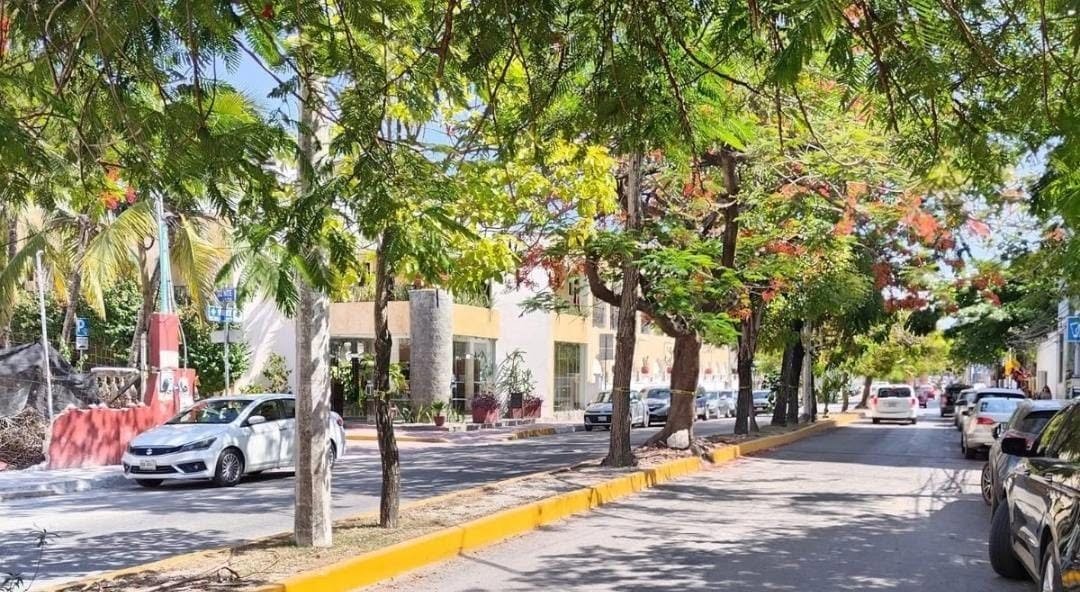
Playa del Carmen, Quintana Roo — A permanent urban maintenance program began today in central Playa del Carmen, with municipal crews assigned to repair sidewalks and curbs, repaint public infrastructure and improve landscaped areas.
Mayor Estefanía Mercado said the work will initially concentrate on the city’s downtown core before expanding into nearby neighborhoods. The program is expected to operate weekly rather than as a single cleanup or renovation campaign.
“The center is our face, and we want to leave the city looking beautiful,” Mercado said while announcing the project.
The municipality has not yet published a detailed work schedule identifying the first streets to be treated. No separate budget, completion date or measurements for the amount of sidewalk and public space to be repaired have been released.
The absence of those details makes the program’s first weeks important for determining its scope. Routine painting, landscaping and minor sidewalk repairs can be carried out by municipal maintenance departments, while larger reconstruction projects generally require separate budgets, contracts and construction schedules.
The new initiative is distinct from the municipality’s broader public-works program and from infrastructure projects being coordinated with the Quintana Roo and federal governments.
Playa del Carmen entered 2026 with 43 municipal public works projects either underway or planned, according to the municipal infrastructure program. The list includes a new southern entrance arch, the Mirador del Mar, the “Aquí Inicia la Quinta Avenida” park and road, sports and drainage projects in different parts of the municipality.
Downtown streets have also received separate capital improvements. In May 2025, the municipality began a 19.9-million-peso repaving program covering 15th Avenue South between Juárez Avenue and Calle Aviación, along with Calle 2 North, Calle 2 North Bis and Calle 6 North.
That project covered more than 13,000 square meters of roadway and included new pavement, road markings, signs and accessibility ramps, according to municipal construction records.
The latest maintenance campaign is focused more narrowly on the appearance and condition of everyday public infrastructure. Sidewalk repairs could also address accessibility problems in a downtown area where pedestrians regularly encounter uneven pavement, utility equipment, restaurant furniture and other obstructions.
Business Groups Seek Faster Municipal Procedures
Mercado announced the downtown program following a meeting with representatives of local business chambers and associations. The discussions covered public safety, civil-protection requirements, municipal regulations and the administrative procedures required to open and operate businesses.
One proposal was the expansion or improvement of a centralized service window that would allow business owners to complete several municipal requirements through one point of contact.
Playa del Carmen already operates a one-stop service for qualifying low-risk businesses through the Rapid Business Opening System, known as SARE. The existing system combines the commercial land-use certificate, Civil Protection approval and municipal operating license. When an application is complete and the required fees have been paid, the municipality lists a maximum resolution period of three business days.
The system is limited to businesses included in the municipality’s low-risk activity catalog. Applications currently require an in-person visit, although preliminary document reviews and guidance can be requested by email. Details are available through the municipality’s SARE information portal.
The proposal discussed with business leaders therefore appears to involve broadening or improving an existing process rather than creating Playa del Carmen’s first one-stop business office.
Business representatives also requested updates to municipal regulations, particularly rules administered by the Civil Protection Department. Those requirements cover matters such as emergency exits, fire extinguishers, evacuation plans, staff training and inspections, with the precise obligations varying according to the size and risk classification of each establishment.
Mercado said the administration would meet with the business groups again in approximately 20 days to review progress. No formal regulatory amendments have yet been presented to the City Council.
Tourism Slowdown Adds Pressure On Downtown Businesses
The meeting took place as hotels, restaurants and retailers contend with a weaker period in the local tourism cycle.
Mercado urged businesses not to treat every drop in visitor numbers as a crisis, arguing that seasonal fluctuations are expected in tourist destinations. She said the administration anticipates stronger activity during upcoming vacation periods.
Official figures nevertheless show a marked difference between peak and slower weeks. Quintana Roo’s tourism monitoring system reported Riviera Maya hotel occupancy of approximately 54% during the week of July 4 through 10. By comparison, the destination began 2026 at close to 89% occupancy during the New Year holiday period.
The figures represent the wider Riviera Maya hotel market and do not necessarily reflect conditions at small independent hotels in central Playa del Carmen. Occupancy can vary considerably between large all-inclusive resorts, vacation rentals and smaller downtown properties.
For downtown businesses, the municipal strategy brings together two related concerns: the physical condition of the commercial district and the time and expense involved in meeting government requirements. The next steps will depend on whether the weekly maintenance produces visible improvements beyond cosmetic work and whether the promised regulatory review leads to measurable reductions in processing times.
More Government
More Playa del Carmen
- Two Women Arrested on Drug Dealing Charges in Playa del Carmen
- Prosecutors Seek Public’s Help to Find 24-Year-Old Missing Man in Playa del Carmen
- Facade Chunks Fall Onto Playa del Carmen’s Quinta Avenida, Prompting Closure
- Playa del Carmen New Urban Development Plan Approval Slated for Early 2027
- Quintana Roo Hands Two Artisan Carts to 33 Craftspeople in Playa del Carmen