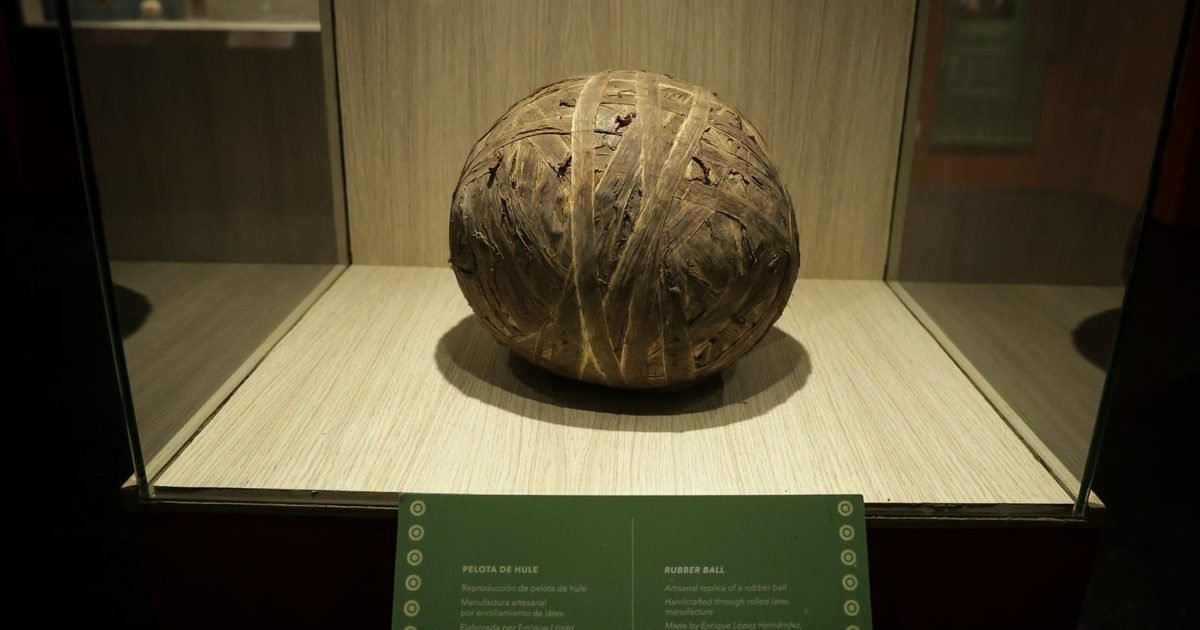
Teotihuacan, State of Mexico — The star piece of the newly inaugurated Museum of Teotihuacan Grandeur does not come from the archaeological site itself. It is a 3,600-year-old rubber ball from the Olmec civilization, unearthed in the swamps of El Manatí, Veracruz, and will be on display for three months as part of a renovation tied to the 2026 World Cup.
The sphere, about 30 centimeters in diameter, is one of 14 found at the El Manatí site in the lower Coatzacoalcos River basin. In February 1988, local farmers carrying out communal work discovered the objects and alerted authorities, leading to the first research project.
Officials from the Ministry of Culture and the National Institute of Anthropology and History (INAH), along with archaeologists, announced the details during a press tour of the renovated Site Museum, the Museum of Murals, and the new Museum of Teotihuacan Grandeur. The three venues received a combined investment of 37 million pesos (about $1.85 million) under the federal Social World program linked to the 2026 FIFA World Cup.
Unlike the popular notion of balls as mere sports equipment, the Olmec rubber balls from El Manatí were part of complex ritual practices. The Olmecs deposited 14 balls — weighing between 180 grams and 4.8 kilograms — along with wooden staffs and sculptures as offerings.
According to specialists, nearly 3,000 ball courts have been identified in Mexico, with Cantona in Puebla having the most at 27. Thousands of balls were produced, but only about 30 survive today nationwide. The El Manatí ball, measuring 33 centimeters in diameter, is exceptional for its state of preservation.
The ball is displayed in a climate-controlled case. Its preservation is due to the unique mineral environment of the El Manatí salt dome, constant humidity, acidic pH (2–3.5), fine sediments, and lack of oxygen.
Juan Manuel Garibay López, INAH’s national coordinator of museums and exhibitions, explained the decision to feature an Olmec artifact from Veracruz in a Teotihuacan museum. “The concept of grandeur relates to the conformation of the Teotihuacan and Mesoamerican cosmos, from the ritual plaza to the divine realm, the underworld, and the earthly realm,” he said. “The first meaning of that concept has to do with the integrality of the cosmos. In El Tajín this scheme is also reproduced, but it has to do with the integrity of concepts, the richness and diversity of the Teotihuacan iconographic universe, a meeting of Mesoamerican realms that converged here.”
The ball’s journey from swamp to museum case is marked by key conservation milestones, as detailed in a timeline at the museum. However, the timeline is one of the few exhibits with dates, as Garibay noted that new museological trends often omit them. “Initially we want to offer the public a perspective of chromatic and plastic comprehension. That information (dates) will be available via QR codes, but current museological criteria indicate that the public moves through the room at a certain speed. This is an immersive space for the archaeological zone, offering a first approach.”
The Olmec ball, nearly four millennia old, has drawn attention not only for its preservation but for its sociocultural message: the grandeur of the Olmec civilization. While the museum also features architectural elements from the Pyramid of the Sun, serpent heads, and a theater-type incense burner, the rubber ball remains the standout piece.
Timeline of the El Manatí Rubber Balls
- 1700–1500 BC (Manatí A phase): Olmecs deposit the first balls as offerings.
- 1500–1200 BC (Manatí B phase): Fine, moist swamp sediment begins to seal the balls without oxygen.
- 1200–900 BC (Macayal phase): Balls reach their maximum ritual complexity.
- 900 BC–1988: The balls remain in a “long sleep under water,” protected by lack of light, oxygen, and stable humidity.
- 1988–2000: Rubber balls are documented and conservation interventions are carried out.
- 2000–2026: Balls are kept in controlled environments with minimal handling to avoid fragmentation. For the first time, one is exhibited in Mexico City.
The Olmec sphere, on display at the Museum of Teotihuacan Grandeur, is well worth the trip to the archaeological site, even if it underscores the institutional need to “complete” a site’s history with treasures from another, and the pressure to link an artifact — however historically distant — to the current World Cup.
More Culture
- Cueva Popotitos: New Underwater Cave System Found South of Cozumel
- Tren Maya Archaeological Finds Won’t Be Displayed in Chetumal, INAH Says
- Cumbia, Rock and Pop Headline Plaza de Toros Cancún Concert Series
- Cabaret Show Brings 1920s Glamour to Cancún’s Teatro de la Ciudad
- Cancún Music Festival Opens Second International Classical Guitar Competition