
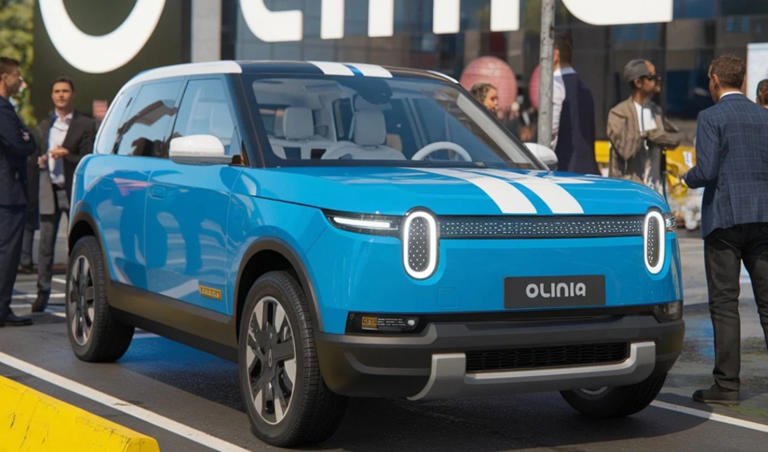
Mexico City — Mexico’s government-backed Olinia electric vehicle project has taken a step toward commercial production after President Claudia Sheinbaum showed the first video footage of the car during her morning press conference on May 13, 2026.
The project, which already has a functional four-door prototype, aims to produce affordable electric vehicles for urban mobility, light cargo, and daily transport, with prices significantly lower than other electric brands in Mexico.
Olinia is not designed to compete with premium manufacturers like Tesla or BYD, but rather to offer a national alternative for students, workers, delivery drivers, and small business owners.
What is Olinia and why is the government promoting it?
Olinia is an electric mobility project developed with public institutions, Mexican universities, research centers, and automotive engineering experts. It is part of the government’s strategy to ensure Mexico not only assembles vehicles but also participates in the design and development of its own automotive technology.
President Sheinbaum has said the project represents an opportunity to strengthen national capabilities in innovation, manufacturing, and sustainable mobility.
How will the Olinia electric car look?
The first publicly shown prototype is a compact four-door vehicle with a top speed of approximately 50 km/h (31 mph). The project is still in the industrial validation and functional testing phase. The final model is scheduled for official presentation on June 7, 2026, when technical details such as battery range, charging time, cargo capacity, and manufacturing features are expected to be revealed.
How many models will Olinia have?
The government has confirmed three variants for different urban uses:
- Personal mobility model: A compact vehicle for commuting to work, school, or daily urban trips.
- Light urban transport model: Designed for short trips within neighborhoods and communities, potentially used for local passenger transport or light cargo.
- Logistics and delivery model: Aimed at delivery drivers, courier services, small businesses, and urban distribution. A version focused on this segment will be presented on June 6, 2026.
How much will the Olinia electric car cost?
According to project coordinator Roberto Capuano, the models will cost between 90,000 and 150,000 Mexican pesos (approximately $4,500 to $7,500 USD), depending on the version and equipment. This price range places Olinia well below most electric vehicles currently available in the Mexican market.
When will production begin?
The industrial plan calls for serial production to start in 2027, with an initial output of 20,000 units, gradually scaling up to 50,000 vehicles per year. The government also aims to strengthen national supply chains and increase Mexican content in the car’s manufacturing, with potential exports to Latin America.
What does the Olinia logo mean?
The official logo, presented by Sheinbaum on August 13, 2025, features a hare in the style of an alebrije (a Mexican folk art creature), inspired by elements of Mexican worldview. According to the official explanation, the emblem represents intelligence, energy efficiency, freedom, and national technological innovation. The logo will be placed on the front and rear of the vehicle.
Which institutions are involved?
The project is coordinated by the Secretariat of Science, Humanities, Technology and Innovation, with participation from the National Polytechnic Institute (IPN), the National Autonomous University of Mexico (UNAM), the National Technological Institute of Mexico, and public research centers. The IPN leads areas including exterior and interior design, the vehicle’s operating system, testing infrastructure, quality management, and charger development.
More Lifestyle
- Taco Social Run to Bring Recreation, Live Music and Street Tacos to Cancún’s Avenida Yaxchilán
- Playa del Carmen to Renew Eight Blue Flag Beach Certifications, Eyes Two More
- Cancún Sets October Dates for Free Dog and Cat Sterilization Clinics
- Quintana Roo Governor Urges Youth to Help Draft New Rights Law
- Playa del Carmen Reviews Parking Meter Concession Over Alleged Violations
