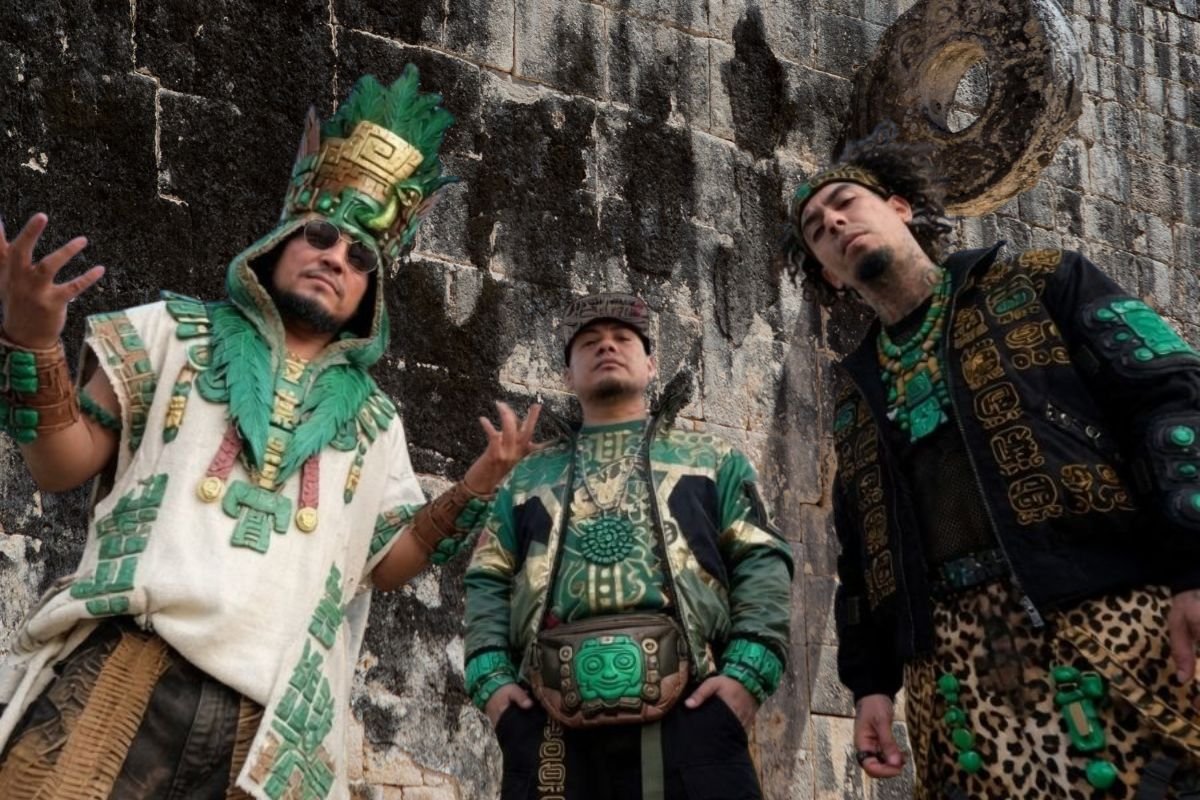
Felipe Carillo Puerto, Quintana Roo — As World Cup fever spreads across Mexico, a group of Mayan rappers from Quintana Roo is asking a different question: what would a World Cup of Pok ta Pok look like?
Mayan rapper Pat Boy, together with Julkin Chablé and Iván P., has released “Hasta la cima”, a new music video that uses artificial intelligence to imagine the ancient Mesoamerican ball game on a global stage. The project blends rap, digital tools, Indigenous language, and cultural memory to bring attention to Pok ta Pok and the broader legacy of Mayan culture.
The video was released around the World Cup, using the global excitement around soccer as a way to reframe another kind of game, one rooted in Mesoamerican history rather than modern stadium culture.
“With this exercise using new technologies, we seek to highlight some of our Mayan culture and roots, and to see the scope and how these new technologies work,” Julkin Chablé said.
The song includes the phrase, “Pok ta Pok is the game of the masters of time,” a line that captures the project’s purpose: to present an ancestral tradition not as something frozen in the past, but as something that can still speak to younger generations.
Pok ta Pok, also known as the Mesoamerican ball game, was played across ancient Mesoamerica for centuries and held deep ceremonial, political, and symbolic meaning. Ball courts have been found across the Maya region, including major archaeological sites such as Chichén Itzá, Cobá, Uxmal, and Ek Balam. While versions of the game varied across time and place, players generally used their hips, forearms, or other body parts to keep a heavy rubber ball in motion, often without using their hands or feet.
The game was more than recreation. In many contexts, it represented cycles of life and death, fertility, conflict, renewal, and the relationship between the human and spiritual worlds. At some sites, the ball court served as a ceremonial space where power, ritual, and community identity came together.
That layered history is part of what makes “Hasta la cima” significant. The video does not simply use Pok ta Pok as a visual theme. It places the game in conversation with current technology and popular music, showing how young Indigenous artists are using modern platforms to tell their own stories.
Pat Boy has become one of the best-known voices in Maya-language rap, using music to promote pride in Mayan identity and language. His work has helped bring contemporary Indigenous expression to audiences far beyond Quintana Roo. In this collaboration, he is joined by Julkin Chablé and Iván P. in a production that connects heritage with experimentation.
The music video is available on Pat Boy’s digital platforms, including YouTube and Spotify. The production was recorded at ADN Maya Producciones, with support from Suenaglobal and RapLife Records.
The use of artificial intelligence also adds a timely layer to the project. While AI is often discussed in terms of business, entertainment, or risk, “Hasta la cima” shows another possibility: using the technology to visualize Indigenous futures, not only recreate Indigenous pasts.
A Pok ta Pok World Cup may be imaginary, at least for now. But the idea behind the video is real. Culture survives when it moves, adapts, and finds new ways to be seen.
For Pat Boy, Julkin Chablé, and Iván P., the goal is not just to entertain. It is to remind the world that Mayan culture is not a relic. It is alive, creative, and still reaching for the top.
More Culture
- Culture Ministry to Inspect Ceremonial Pole Ahead of Voladores de Papantla Return to Tulum
- Seña Fest to Bring Mexican Sign Language Events to Playa del Carmen on Sept. 26
- La Bamba por Playa 2026 Kicks Off With Community Peace Mural in Playa del Carmen
- Mexico to Ban Cellphone Use in Primary and Secondary Schools Starting November 3
- Mayan Council Urges Mexico’s Supreme Court: Don’t Decide About Us Without Us
More Zona Maya
- Felipe Carrillo Puerto Weighs Access Fee for Puerta al Mar
- Mayan Seeds in Quintana Roo Studied for Nutrition and Diabetes Potential
- Contemporary Maya Sculpture Installed in Sacalaca Cenote to Draw Community Tourism
- Farm and Cattle Expansion in Quintana Roo Squeezes Native Wild Bees
- UIMQROO to Build Student Dormitories With 19 Million Peso Investment