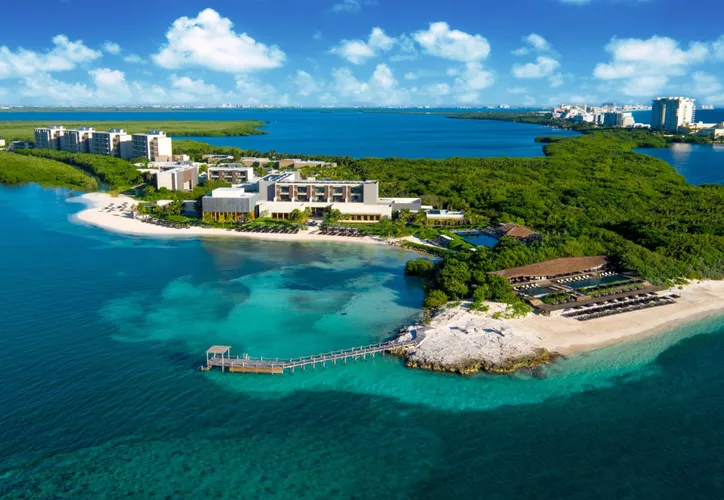
Cancun, Quintana Roo — Mexico’s environmental authority is reviewing a private proposal to restore 5,625 square meters of beach at Punta Nizuc, with an investment of 14 million pesos (about $700,000) from Banca Mifel.
The project includes beach recovery, construction of two elevated tourist walkways, and installation of seven wooden sunbathing platforms. Sand for the restoration would be dredged from the seabed directly offshore. According to the permit application filed with the Secretariat of Environment and Natural Resources (Semarnat), the walkways will be 44 meters long and 3 meters wide, built on stilts, with sections parallel to the coast reinforced by geotextile tubes. The seven sunbathing platforms will be made of wood and netting. To replenish the sand, 10,500 cubic meters will be extracted from the nearby sea. The applicant states the sand matches the color, grain size, and origin of Punta Nizuc’s natural beach.
The project aims to enhance the tourist area through private financing. The application, filed under number 23QR2026T0045, identifies 53 potential impacts, 60% of which are considered positive, but 29% are moderate and require strict mitigation measures.
This private intervention joins other similar projects in Quintana Roo in recent years, where hotels and developers have carried out artificial beach fills to maintain attractive shorelines for tourism.
Beach Recovery by Private Entities Could Accelerate Erosion, Experts Warn
Coastal dynamics specialists caution that such partial recoveries can be counterproductive. Filling only a specific stretch of beach creates a “headland” effect that alters currents and wave patterns, accelerating erosion on adjacent shores. The new sand tends to shift toward the ends, leaving the project boundaries more vulnerable and causing greater beach loss in neighboring areas within months or years. Without an integrated approach covering entire kilometers of coastline and restoring dunes and reefs, these local solutions remain temporary and generate new lateral erosion problems.
More Environment
- Polo strengthens to a Category 5 hurricane off Mexico’s Pacific coast in Record Time
- Cozumel Launches Rabies Vaccination Drive With 3,000 Free Doses for Pets
- Sargassum Collection in Quintana Roo Tops 133,000 Tons, Setting New Record
- Isla Mujeres Collects Over 160,000 Tons of Waste in Five Years
- Tulum Beach Cleanup Pulls 32 Kilos of Marine Debris From Playa del Pueblo
More Cancun
- Cancún: 3 Kidnappers Get 80-Year Sentences Each
- Erasmo Catarino Nearly Drowns at Cancún Beach, Rescued by Raúl Sandoval
- Three Raids in Playa del Carmen and Cancún Net One Detention and Suspected Drugs
- Cancún Enters Final Year With 2.3 Billion Pesos in Public Works
- Benito Juárez to Regulate Cancún Vacation Rental Boom With New Urban Development Plan