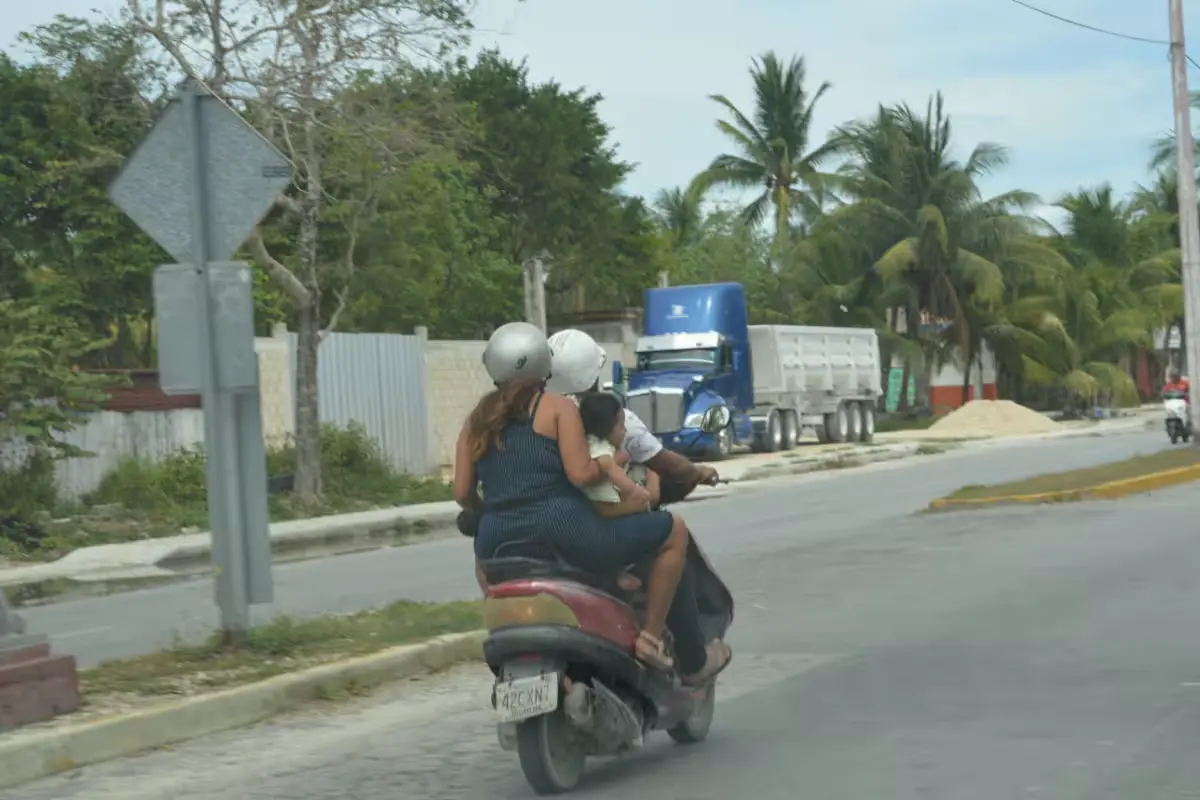
Cozumel, Quintana Roo — A lack of reliable public transportation has pushed thousands of workers and students in Cozumel to rely on motorcycles, a shift that has also driven a sharp increase in traffic accidents. Over the past few years, crashes have risen by 30 to 50 percent, according to local officials.
Data from the Municipal Traffic Subdirectorate shows that Cozumel records between three and five traffic incidents daily — more than 100 per month. Eight out of 10 involve motorcyclists, who also account for the highest number of injuries.
Currently, about 27,950 motorcycles circulate on the island, surpassing the 23,400 cars registered. Motorcycles now make up more than 54 percent of the municipality’s vehicle registry, one of the highest proportions in the country.
José Gasca, a driving school instructor, said that as long as public transport fails to meet residents’ needs, people will continue choosing motorcycles. He called for safe and efficient alternatives to reduce dependence on two-wheeled vehicles.
Karina Lagos, a tourism sector worker, said, “The motorcycle is the only way to get to work on time. The bus takes too long and doesn’t always go through our neighborhoods.”
Esteban Acevedo, a paramedic with emergency response experience, noted, “Most of the accidents we attend involve motorcyclists. Wearing a helmet correctly, obeying speed limits, and avoiding overloading can make the difference between a minor injury and a tragedy.”
Common safety violations include motorcycles carrying three or even four people, speeding, and riders without proper protective gear — all factors that increase the risk of serious injury.
Residents and experts agree that improving urban mobility requires expanding public transit routes, adding more buses, and extending coverage to fast-growing neighborhoods, alongside stronger traffic law enforcement and road safety campaigns.
More Development
- Cancún’s Route 17 Leona Vicario Draws More Than 16,000 Riders on First Free Day
- Quintana Roo Beaches Lose Up to 14 Meters of Sand a Year as Restoration Plan Advances
- Meliá Invests €50 Million in Paradisus Cancún Renovation
- Kukulcán Interchange in Cancún to Be Completed by Late 2026, SICT Says
- Puerto Juárez Market Set to Open October 30 With 12 Vendors
More Cozumel
- Cozumel Hosts First Pueblos Mágicos Triathlon as Evelyn Rejón and Flavio Morandini Win
- Quintana Roo Names Winners of 2026 State Craft and Embroidery Prizes
- Cruise Tourism Trust Fund Spends 1.27 Billion Pesos Across Quintana Roo
- CFE and Playa del Carmen to Review Plan for Submarine Power Line to Cozumel
- Cozumel’s Museum of the Island Opens Exhibition by Architect José Manuel Sáenz ‘Txepo’