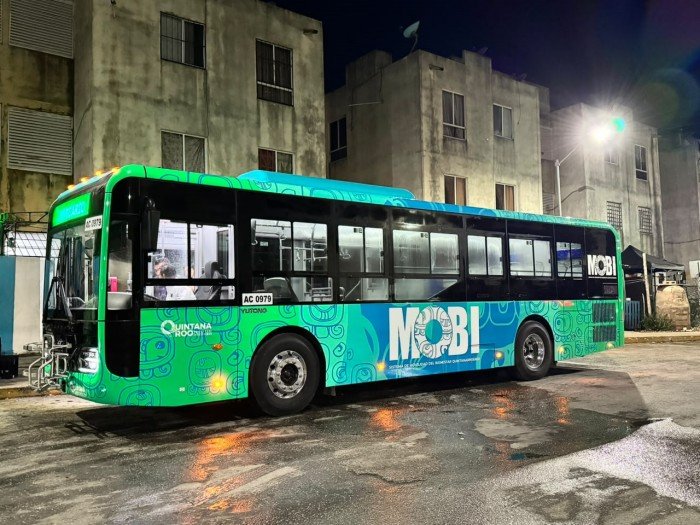
Cancún, Quintana Roo — More than 16,000 Cancún residents rode the new Route 17 Leona Vicario on its first day of free service, officials reported, as 30 buses joined the MOBI (Quintana Roo Wellbeing Mobility System).
It is the first MOBI route dedicated to urban trips inside Cancún. Buses began running at 4 a.m., and the first day of operation continued until 1:20 a.m. Tuesday. The route will keep that 21-hour daily schedule.
Rafael Hernández Kotasek, head of the Quintana Roo Mobility Institute (IMOVEQROO), inspected the service during the morning. Officials said the route links neighborhoods in the north of the city with schools, workplaces, stores and services.
Route serves 99 neighborhoods
The route covers 44.05 kilometers and 99 neighborhoods, reaching an estimated 242,821 residents. Its catchment area includes 85,796 homes, 148 schools and 8,634 businesses.
Buses start on Isla Hawái street at Arco Norte avenue and turn around at Plaza Las Américas. The route runs along Lak’in, Leona Vicario and Tulum avenues, giving riders access to the Universidad Politécnica, the Universidad Autónoma de Quintana Roo’s Cancún campus, COBACH high school Plantel 4, Mercado Lak’in 259, Multiplaza Kabah and the ADO bus terminal, among other destinations.
Buses are scheduled to arrive about every five and a half minutes during peak hours and every 12 minutes during quieter periods.
Fares and free service
The service will remain free through Monday, Oct. 26, so residents can try the new buses and become familiar with the route. Electronic payment and the transfer benefits begin Tuesday, Oct. 27.
The system allows up to four boardings within three hours of the first trip. Under the general fare, the first urban trip costs 15 pesos, the second boarding costs 7.50 pesos, and the second and third transfers are free.
Students and older adults holding a Tarifa Social card pay 10 pesos for the first trip and 5 pesos for the second, with the third and fourth boardings free. People with permanent disabilities who hold a MOBI social-fare card continue to travel at no cost.
To receive the discounts, riders must use the same electronic payment method on each boarding so the system recognizes the trip as a continuation. The benefit does not apply to debit or credit card payments.
Connections with other MOBI routes
Route 17 currently connects with Route 27 Kilómetro 0 at Lak’in avenue, the Glorieta del Ceviche and Plaza Las Américas, and with Route 27 Puente Nichupté at Lak’in avenue.
By December, as new services begin operating, the route will connect with five MOBI routes in total: Route 27 Puente Nichupté, Route 27 Kilómetro 0, Villas del Mar 3 Puente Nichupté, Villas del Mar 3 Kilómetro 0 and La Rehoyada.
The Villas del Mar 3 connections will meet at the intersection of Kabah and Leona Vicario avenues. The route will also connect with Villas del Mar 3 Kilómetro 0 at the Glorieta del Ceviche, and with La Rehoyada at that same point and at the intersection of López Portillo and Tulum avenues.
Where to buy and top up cards
Riders can use a network of 247 locations to obtain and top up cards: 101 sell and recharge the general MOBI card, while 146 offer recharges only. Cards can be bought and topped up at OXXO, Dunosusa, 7-Eleven and GoMart stores, while SIX and Súper Willys offer recharge service only.
Students, older adults and people with permanent disabilities can apply for Tarifa Social or Tarifa Cero credentials at the permanent IMOVEQROO offices in the Benito Juárez delegation and at IMDAI, Monday through Friday from 9 a.m. to 4 p.m.
Temporary registration modules will also operate from Oct. 26 to 30 at Mercado Lak’in, Región 259, manzana 104, lot 1, Villas Otoch Paraíso, from 9 a.m. to 4 p.m., and at CRIM Benito Juárez on calle 11, Supermanzana 222, next to Mercado Chetumalito, from 8 a.m. to 3 p.m.
More Community
- Hanal Pixán 2026 in Puerto Juárez: Four Days of Maya Day of the Dead Traditions
- Mattel Unveils Barbie Día de Muertos 2026 Doll Inspired by La Catrina
- Playa del Carmen Opens Registration for Audiovisual Workshops
- Tulum to Host Xibalba MTB Challenge 2026 on November 1
- National Geographic Names Maya Ka’an Among Top Destinations to Visit in 2027
More Cancun
- Quintana Roo Tops 152,000 Metric Tons of Sargassum as Playa del Carmen and Cancún Lead
- Mexican Navy Issues 130 Citations Against Unlicensed Boats in Cancún
- Meliá Invests €50 Million in Paradisus Cancún Renovation
- Cancún to Host Climate Change Colloquium With Experts From Mexico, Guatemala and New York
- Tourism Slump Forces 35% of Skål México Businesses to Borrow to Cover Payroll