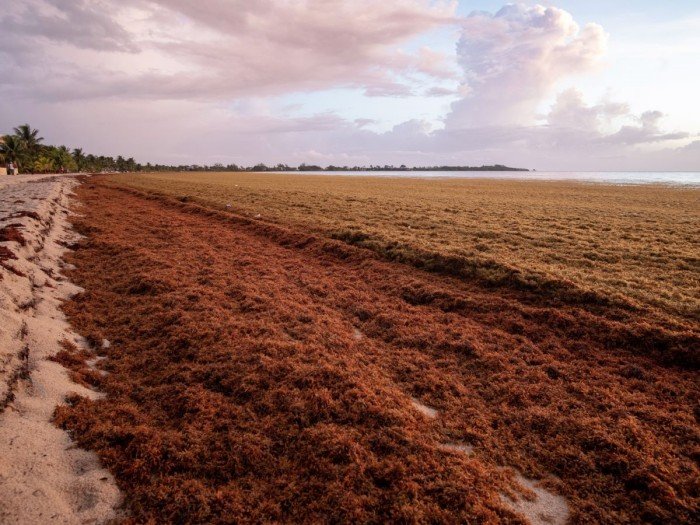
Mérida, Yucatán — Combating the massive sargassum blooms that wash onto Mexico’s Caribbean coast requires more than containment barriers, boats and beach cleanup, according to a vegan advocacy group that is calling for sustainable food systems to be included in Quintana Roo’s environmental strategy.
Generación Vegana said efforts to manage the seaweed should also address the climate factors that fuel its proliferation. Jessica González Castro, the organization’s executive director, argued that the problem begins long before the sargassum reaches shore.
“The problem doesn’t start when sargassum arrives at the beach. It starts much earlier, with the conditions that favor its growth,” she said in an interview.
The group points to scientific research linking climate change, altered ocean currents and excess nutrients to the expansion of the macroalgae. Rosa Elisa Rodríguez Martínez, a researcher at UNAM’s Institute of Marine Sciences and Limnology, has documented the influence of those factors, according to the organization.
González Castro said that means discussions about sargassum must also address the industries that contribute most to global warming. “One of those is the livestock industry,” she said.
Livestock production accounts for about 14.5 percent of global greenhouse gas emissions and is also tied to land use, water consumption and biodiversity loss, according to data cited by Generación Vegana. The group also references a 2018 study led by Joseph Poore of the University of Oxford, published in the journal Science, which found significant environmental differences between animal-based and plant-based food products.
The organization advocates a gradual shift toward more plant-heavy diets as a way to reduce the climate footprint associated with food consumption.
“Many times we don’t realize the impact our food choices have. Gradually reducing meat and dairy consumption already represents a contribution to cutting the emissions that fuel climate change,” González Castro said.
She stressed that the proposal does not require an immediate and radical overhaul of people’s diets, but rather gradual changes that reduce their climate impact.
Generación Vegana sees Quintana Roo’s tourism sector as a key player in that transition, given the huge volume of food prepared daily in hotels and restaurants. Its proposals include promoting lower-impact gastronomy at tourist establishments, developing campaigns that explain the link between food and climate change, and building alliances with universities and research centers.
The organization also suggests launching pilot projects to measure and reduce the carbon footprint of the tourism sector, as well as incorporating the food system into state climate policies.
“By the time sargassum is on the beaches, people start looking for solutions. But we aren’t talking about how to prevent the conditions that favor its arrival. We want to broaden that conversation,” González Castro said.
The group hopes to work with authorities, tourism companies, restaurants, universities and civil society groups to develop these initiatives.
González Castro added that Quintana Roo has an extra incentive to act because much of its economy depends on the health of its coastal ecosystems.
“If other countries are already promoting these kinds of changes, why couldn’t Quintana Roo do it? It’s a state whose economy depends directly on the health of its beaches and ecosystems,” she said.
The organization acknowledged that transforming food systems alone will not solve the sargassum problem, but it argues such measures should be part of a broader climate mitigation strategy.
“Protecting our beaches also means acting on the causes that are putting them at risk today,” González Castro concluded.
More Environment
- Puerto Morelos launches weekly sargassum watch until 2026
- Quintana Roo Seeks Geographic Indication to Protect Melipona Honey
- Dengue Cases in Quintana Roo Jump 152 Percent
- Quintana Roo Hoteliers Push Regenerative Tourism Amid Beach Access Disputes
- Greenpeace Finds Contamination at 17 Yucatán Wells and Cenotes as Maya Communities Demand Action