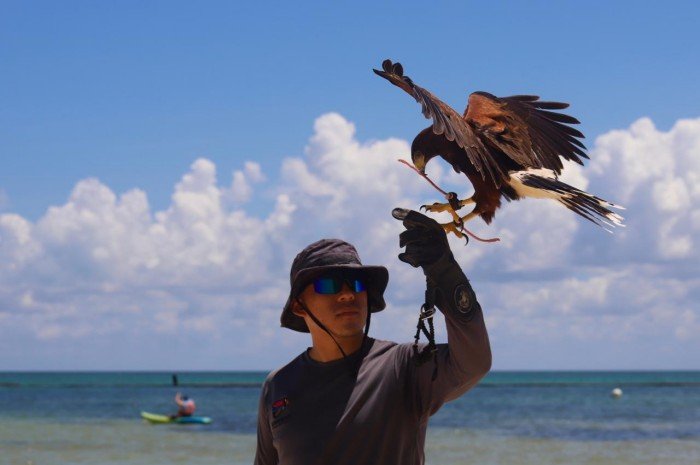
Playa del Carmen, Quintana Roo — Guests at some hotels and restaurants in Cancún and the Riviera Maya may notice an unusual member of the groundskeeping team: a trained bird of prey patrolling terraces, gardens and outdoor dining areas.
The raptors are being used to discourage gulls, grackles, pigeons and other birds attracted by food waste and easy access to meals. Supporters describe the practice as a nonlethal alternative to poisons, traps and other aggressive controls. Critics, however, question whether captive wildlife should be used commercially and whether moving birds from one property truly addresses the underlying problem.
Elaman Recillas Muñoz, of the company Kanan Koot, recently demonstrated the technique at Maroma Beach, part of Grupo Lomas. His team uses trained raptors, including Harris’s hawks, to make locations feel unsafe to birds that gather around restaurants and guest areas.
“It’s a deterrent method,” Recillas Muñoz said. He explained that the objective is not to kill the birds but to encourage them to find another feeding or nesting site.
That distinction is important, although “nonlethal” does not necessarily mean there is no risk. Hawks are predators, and an uncontrolled pursuit could injure or kill a smaller bird. The effectiveness and welfare of the program therefore depend heavily on the handler’s training, the species being targeted and how the raptor is managed.
Why resorts attract large numbers of birds
Hotels are particularly attractive to adaptable species because they provide dependable sources of food and water. Open-air restaurants, overflowing garbage containers, unattended buffet plates and guests intentionally feeding birds can quickly establish a regular feeding site.
Once birds learn where food can be found, they may return daily, gather in larger numbers and become increasingly comfortable around people. This can lead to droppings on dining tables and walkways, birds taking food from plates and conflicts with guests.
The problem is largely created by human behavior. Removing food waste, securing garbage, clearing outdoor tables promptly and asking guests not to feed wildlife are therefore essential parts of any lasting solution.
A hawk may clear an area temporarily, but birds can return if the attraction remains after the patrol ends. Research into bird control generally supports combining deterrents with changes to food availability and habitat rather than relying on one technique alone.
How raptor deterrence works
The method, often called falconry-based bird abatement, relies on the prey species’ instinctive response to a living predator.
A trained hawk or falcon is flown repeatedly through the problem area under the supervision of a handler. Smaller birds see its silhouette, movement and hunting behavior as a credible threat and leave the immediate vicinity.
Unlike a stationary plastic owl or repetitive sound device, a living raptor moves unpredictably. This can make it more difficult for other birds to become accustomed to its presence.
The technique has been used at airports, agricultural fields, landfills and industrial sites. A California study found falconry reduced nuisance-bird activity in leafy-green fields, although its authors said more research was needed in different locations and under different conditions. An earlier review prepared for the aviation sector found mixed results and concluded that falconry was not always cost-effective compared with other controls.
The work is labor-intensive. Raptors require experienced handlers, veterinary care, controlled diets, suitable housing and regular training. Flights can also be affected by wind, rain, extreme heat and the presence of guests.
Not everyone considers it an ecological solution
Animal-welfare advocates have long challenged some falconry practices, particularly prolonged tethering, restricted flight and the use of wild animals for entertainment or commercial purposes.
The RSPCA in Australia opposes long-term tethering because it restricts movement and may prevent birds from exercising, escaping extreme weather and engaging in normal behaviors. Its guidance says captive birds should have access to a flight aviary or regular opportunities to fly safely.
Falconry organizations offer a different view. They argue that properly managed birds fly regularly, receive carefully controlled nutrition and are trained through food rewards rather than punishment. Published welfare guidance emphasizes positive reinforcement, suitable housing and the avoidance of unnecessary stress.
There are ecological questions as well. Deterring birds from one hotel does not reduce their wider population; it moves them elsewhere. If neighboring properties continue to provide exposed garbage or easy meals, the birds may simply relocate a short distance.
Some bird advocates also object to labeling native wildlife as “pests” when the animals are responding to an artificial food supply created by tourism. From that perspective, the first responsibility belongs to hotels and their guests: manage waste properly and stop feeding wildlife before introducing another animal to control the consequences.
Wildlife use is regulated in Mexico
Birds of prey are wildlife, not ordinary domestic animals. Mexico’s General Wildlife Law establishes the federal framework for their possession, management, transport and lawful origin. Semarnat maintains registration and authorization procedures covering wildlife facilities, handlers and birds of prey.
Responsible operation requires documented legal possession, appropriate housing, veterinary care and any applicable Semarnat authorizations. Clear information about these safeguards would allow the public to better assess how the raptors are treated.
For resorts, trained raptors can provide a visually striking and potentially useful form of bird deterrence. But presenting the practice as entirely harmless or automatically sustainable oversimplifies the issue.
Its value depends on responsible handling, legal oversight and measurable results. Most importantly, it should complement strict food-waste management rather than serve as a dramatic substitute for it.
More Environment
- Greenpeace Finds Contamination at 17 Yucatán Wells and Cenotes as Maya Communities Demand Action
- Quintana Roo Tops 152,000 Metric Tons of Sargassum as Playa del Carmen and Cancún Lead
- Profepa Shuts Down Los Rápidos Swimming Spot in Xul-Ha Over Missing Environmental Permit
- Court Gives Profepa 72 Hours to Clarify Tren Maya Closure Order
- National Geographic Names Maya Ka’an Among Top Destinations to Visit in 2027
More Playa del Carmen
- Influencer Discards 2,500-Peso SpongeBob Cake at Nickelodeon Riviera Maya, Citing Bad Taste
- Playa del Carmen Opens Registration for Audiovisual Workshops
- Playa del Carmen Businesses Seek Later Closing Hours for Bars and Restaurants
- Grupo Xcaret Revives Mayan Sea Crossing Under New Name La Travexia
- Uber Begins Operating in Playa del Carmen and Tulum With First-Ride Discounts and Taxi Driver Recruitment