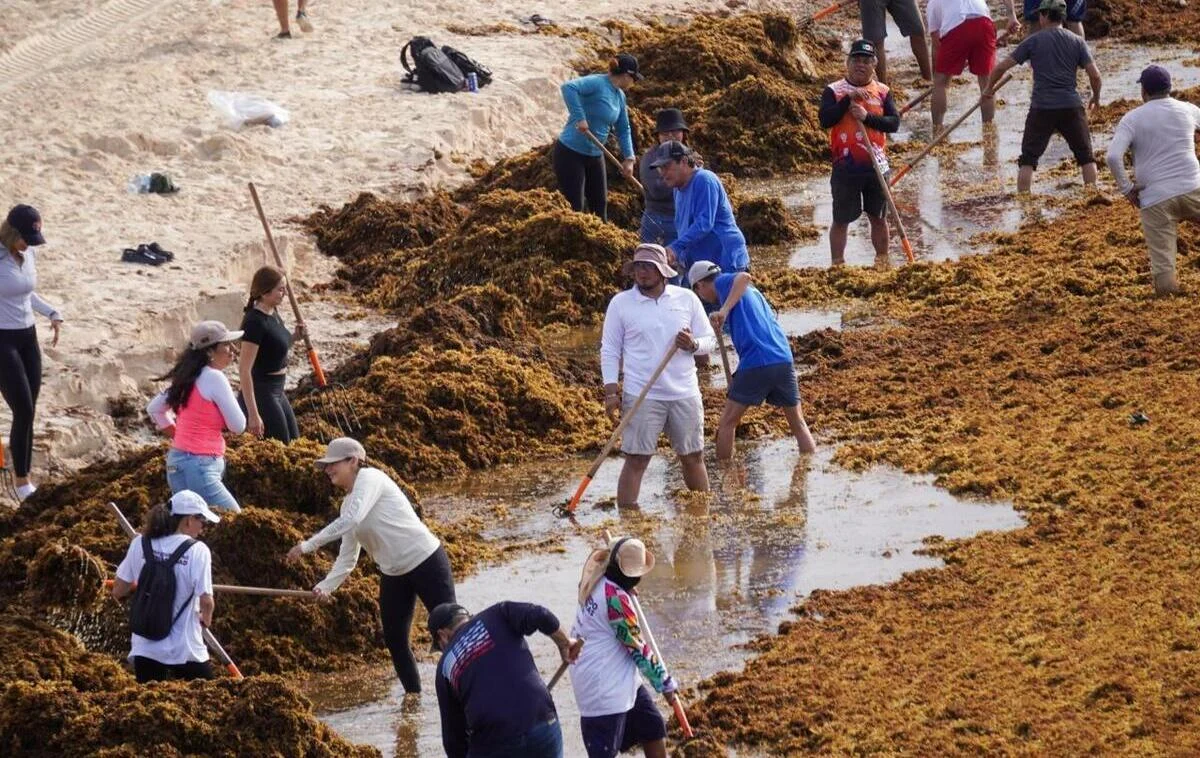
Santo Domingo, Dominican Republic — A 27-year-old Galician oceanographer has developed a method to turn sargassum, the invasive seaweed choking Caribbean coastlines, into valuable agricultural inputs, earning her a spot on Forbes’ list of Europe’s most influential young people.
Elena Martínez, trained at the University of Vigo and specialized in blue biotechnology in Valencia and France, moved to the Dominican Republic three and a half years ago to tackle the global ecological challenge. She told EFE that the ocean remains “understudied and underutilized” despite holding key compounds to solve current problems such as bacterial resistance.
Her approach breaks with the traditional view of the invasive algae as mere waste, presenting it as a versatile and sustainable raw material for various productive sectors.
The technological core of the initiative is a collection system developed in collaboration with the Massachusetts Institute of Technology (MIT). This tool transforms local fishermen’s artisanal boats into efficient collectors that capture sargassum before it reaches the shore. Martínez explains that the strategy creates a circular benefit: it protects the marine ecosystem from toxic gases released by decomposing algae and offers an alternative income for fishermen whose work stops during massive invasions.
Her company, BlueGea Group, already operates in Mexico, Puerto Rico, Antigua and Barbuda, and the Dominican Republic. Through its division SOS Biotech, the algae pass through a proprietary biorefinery where they are transformed into high-value products. The company currently markets three types of agricultural bio-stimulants that protect crops, regenerate overexploited soils, and reduce the need for synthetic fertilizers.
Although these products are already available in the United States and the Dominican Republic, Martínez is working on certification to begin distribution in Spain and the rest of the European market.
Forbes recognized her in the Social Impact category, validating a model where private enterprise drives environmental benefits. Martínez’s next goal is to apply this knowledge in her native Galicia. The project was selected by BF ClimaTech, an accelerator run by the regional government of Galicia and the company Viratec, to study its implementation on the Galician coast. The oceanographer says her collection system is scalable and could offer solutions against problematic species in Spain, such as the Asian algae Rugulopteryx okamurae.
More Business
- Mexico Extends Deadline for Electronic Customs Value Declaration to October 31
- Nacional Monte de Piedad to Reopen Chetumal Branches on October 7
- 20 Community Tourism Projects in Quintana Roo Seek to Formalize Their Operations
- Sargassum Influx Triggers Two Types of Wildlife Die-Offs in Quintana Roo
- Quintana Roo Development Agency Inherits Labor Disputes from Defunct Derimaya
More Quintana Roo
- Quintana Roo Remains Far from Electronic Voting, INE Official Says
- Experts Highlight Social Memory as Key to Disaster Prevention in Quintana Roo
- Quintana Roo to Launch World’s First Formal Sargassum Fishery With 840 Fishermen
- INE Opens 2026-2027 Federal Electoral Process in Quintana Roo, Vows to Tackle Voter Apathy
- Quintana Roo High School System Aims to Install Cameras at All 44 Campuses