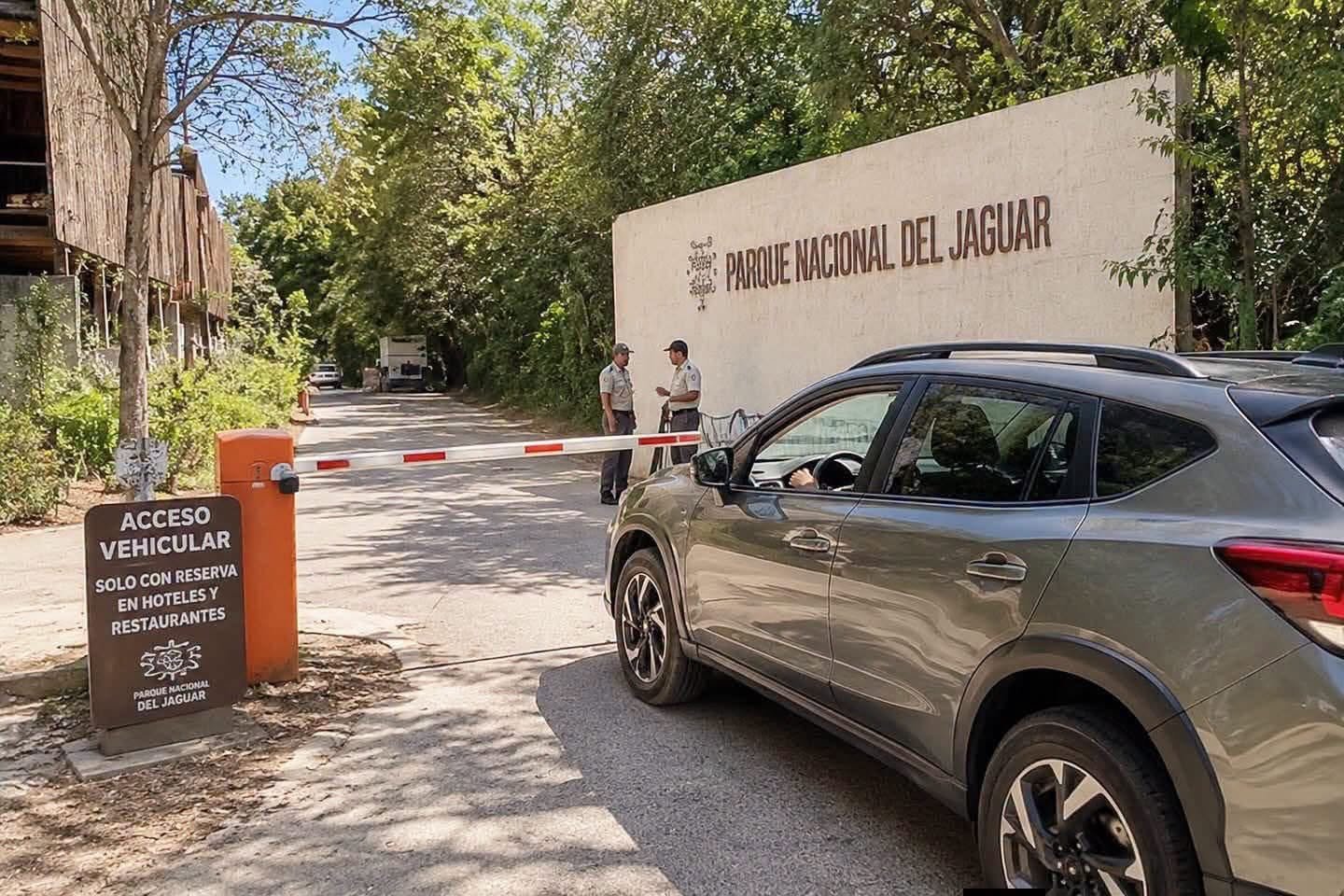
TULUM, Quintana Roo — The federal government’s new free-entry policy for Parque del Jaguar was intended to make one of Tulum’s most important coastal areas easier and cheaper to visit. But the first days of implementation have exposed a practical problem: getting into the park for free does not necessarily mean visitors can easily arrive by car.
The new rules took effect July 20, following President Claudia Sheinbaum’s visit to Quintana Roo and the publication of a federal decree setting updated fees for Parque del Jaguar, Tulum National Park and the Tulum Archaeological Zone. Under the decree, Mexican citizens may enter Parque del Jaguar free of charge, while foreign visitors pay 100 pesos. A combined ticket for Tulum National Park and the archaeological zone is now 80 pesos for Mexican visitors and 165 pesos for foreigners. Residents of Tulum municipality, minors, seniors, people with disabilities, students, teachers, pensioners, retirees and accredited tour guides may qualify for free admission under established requirements.
The fee reduction was part of the federal government’s broader Tulum Renace strategy, which aims to respond to complaints about high costs, beach access, confusing entry rules and the destination’s recent tourism slowdown. During the announcement, federal Tourism Secretary Josefina Rodríguez Zamora emphasized free access to the park for national visitors and free access to Tulum’s beaches for national and international travelers.
But a new report from Uno TV found that visitors arriving by private vehicle are still being told they need a reservation at a hotel, restaurant or beach club inside the park to pass through the vehicular entrance. According to the report, people without a reservation may be directed to leave their cars outside because there is no general visitor parking available inside the park.
In practice, that means a Mexican family may be able to enter Parque del Jaguar without paying an admission fee, but still face a transportation barrier if they want to visit the viewpoints, museum, lighthouse or beaches without consuming at a private business inside the park. Visitors who do not have a reservation may need to park outside and enter by another method, including walking, cycling, using public transport or paying for internal electric transportation where available.
The distinction matters because the federal government did not only promise lower prices. It presented the changes as part of a reset for Tulum’s visitor experience. Sheinbaum and Quintana Roo Governor Mara Lezama announced that the park would be free for visitors, that internal electric transport operated by Grupo Mundo Maya would be reduced to 20 pesos, and that access to the archaeological zone and protected natural area would become more affordable.
Federal tourism officials also said the plan includes improvements to public beach access, visitor mobility and the overall organization of the area. That is why the current vehicle-access complaints have quickly become more than a parking issue. For many residents and tourism operators, they touch the central question facing Tulum: whether the destination can become easier, clearer and more welcoming after months of criticism over cost and access.
The park itself sits at the intersection of several protected and high-value areas. The federal decree describes Parque del Jaguar as linked to the Tulum archaeological zone, Tulum National Park and the Jaguar Flora and Fauna Protection Area, which was created in 2022 and covers more than 2,249 hectares. The decree states that the new fee structure is intended to reduce the economic burden caused by overlapping charges and strengthen tourism in the area.
The challenge is that legal access and practical access are not always the same thing. Mexico’s federal government has repeatedly stated that beaches are public, and the Tourism Secretariat has highlighted free access to Tulum’s beaches as part of the new plan. But in Tulum, long stretches of coastline are reached through controlled entrances, hotel areas, beach clubs, protected zones or limited-access roads. That has made access one of the destination’s most persistent public complaints.
The current vehicle restriction may be intended to manage traffic and protect a sensitive natural and archaeological area. Parque del Jaguar is not a typical urban beach parking lot. It includes protected habitat, tourist routes, archaeological infrastructure and military-administered tourism facilities. Limiting cars inside the park could help reduce congestion and environmental pressure.
But without clear public parking, reliable low-cost transport and consistent instructions at the entrance, the policy can feel contradictory to visitors. Free entry loses some of its value if a family must still pay for transport, make a restaurant reservation, consume at a beach club or navigate unclear rules just to reach a public beach or viewpoint.
The issue is especially sensitive because Tulum is trying to repair its reputation. High prices, sargassum, complicated beach access and frustration with transportation have all contributed to concerns that the destination has become less competitive. El País reported last year that Tulum’s cooling tourism market coincided with several pressures, including sargassum, rising prices and the reorganization of visitor movement around major federal projects such as the airport and Parque del Jaguar.
For travelers, the immediate advice is practical: confirm the current access rules before driving to Parque del Jaguar. Free admission does not necessarily guarantee vehicle entry. Visitors planning to arrive by car should be prepared for the possibility of parking outside the park, using the internal electric transport, walking or showing a confirmed reservation if they intend to enter through a restricted vehicular access point.
For authorities, the next step is clarity. If vehicle access is limited for environmental, safety or traffic reasons, visitors need a clear public explanation, visible signage, official parking information and affordable transportation alternatives. Otherwise, the free-entry announcement risks being undercut by the experience at the gate.
The new federal rates are now official. The question is whether Tulum can make the arrival experience match the promise.
More Government
- Puerto Morelos launches weekly sargassum watch until 2026
- Why Mexico’s Treason Charge Over a U.S. Raid Matters
- Hells Angels Leader Arrested in Cancun Over Cartel Drug Trade
- Mexico’s Lower House Approves ‘Anti-Meme’ Law as Opposition Warns Over Free Speech
- Senate to Review Legality of IMSS Changes to Modality 40 Pension Scheme
More Tulum
- Mexico Tourism Secretary Acknowledges Tulum Crisis but Warns Alarmist Posts Deepen the Damage
- Tulum Shops Pin Hopes on Halloween and Day of the Dead for 70% Sales Boost
- Tulum Municipal Workers Protest Alleged Pay Deductions of Up to 1,500 Pesos
- Tulum to Host Xibalba MTB Challenge 2026 on November 1
- Uber Begins Operating in Playa del Carmen and Tulum With First-Ride Discounts and Taxi Driver Recruitment