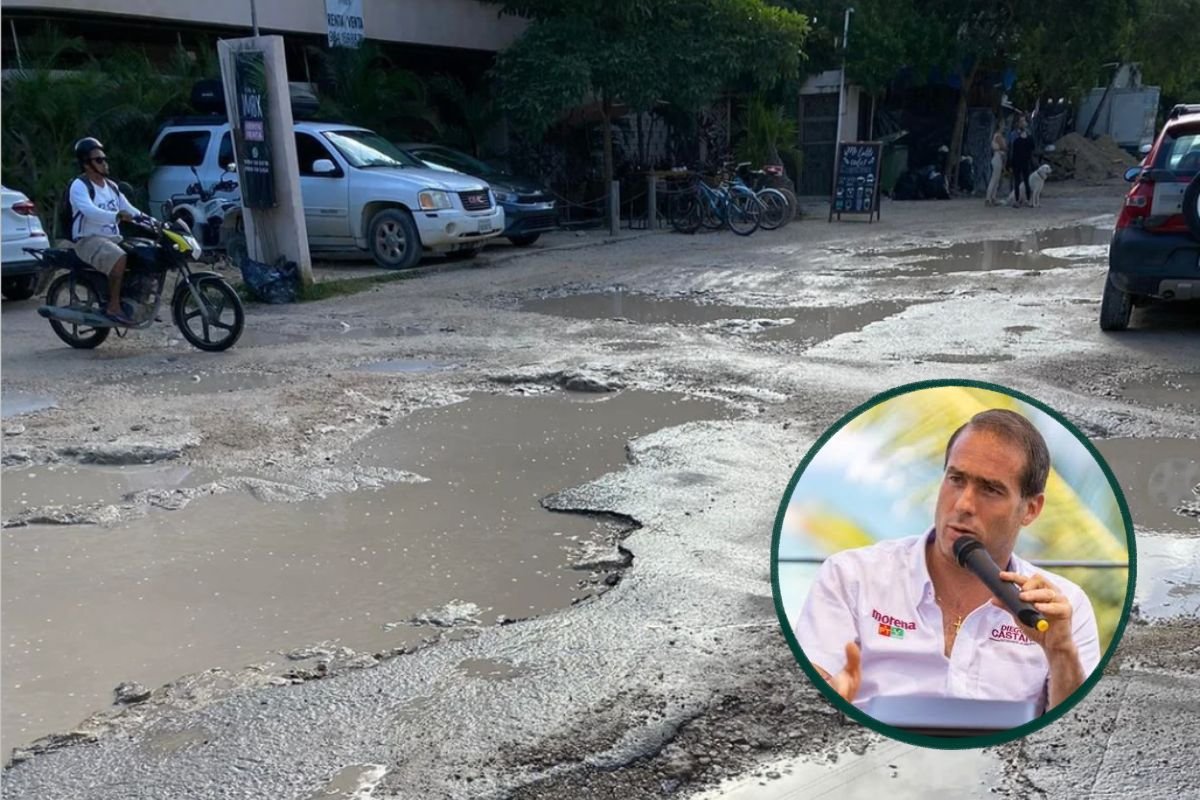
TULUM, Quintana Roo — A sharply worded editorial post accusing Tulum Mayor Diego Castañón Trejo of governing “by remote control” has placed new attention on a question that has been building for months: how much of Tulum’s current crisis can be traced to local management, and how much reflects the larger growing pains of one of Mexico’s fastest-changing tourism destinations?
The post makes several serious claims, including allegations that Castañón spends much of the week outside Tulum and travels frequently by private jet. Those personal claims have not been independently confirmed through official records or reliable public documentation. What is verifiable, however, is that Tulum is facing an unusually broad set of problems at the same time: a tourism slowdown, complaints from business owners, public frustration over beach access, sargassum pressure, transportation disputes, rapid urban growth and criticism of municipal services.
The federal government’s recent intervention through Plan Tulum Renace suggests that the situation has moved beyond routine local politics.
During President Claudia Sheinbaum’s July 17 visit to Tulum, the federal government announced free access to Parque del Jaguar for Mexican visitors, reduced fees for the Tulum Archaeological Zone and surrounding protected area, free beach access for national and international visitors, electric transportation inside the park, new public-access improvements and a broader strategy to revive the destination’s tourism economy. The official announcement framed the plan as a response to complaints over costs, access and the need to strengthen Tulum’s competitiveness.
That matters because Tulum’s crisis is not only about image. Local businesses have reported falling sales, weak visitor numbers and closures along the hotel zone and coastal area, with sargassum repeatedly cited as one of the most visible pressures. La Jornada reported this month that Tulum’s hotel and restaurant sector was facing one of its sharpest economic and tourism downturns in recent years, with business owners pointing to an unusually heavy sargassum season and a lack of diners in parts of the hotel zone.
The slowdown did not appear overnight. El País reported last year that hotel occupancy in Tulum fell from 66.7 percent in September 2024 to 49.2 percent in September 2025, a drop of roughly 17.5 percentage points. The report pointed to a mix of high prices, beach-access confusion, sargassum and infrastructure pressures that had cooled a destination once marketed as the bohemian jewel of the Riviera Maya.
Those pressures have been intensified by Tulum’s rapid transformation. The municipality was only created in 2008, when Quintana Roo’s legislature approved the decree establishing Tulum as a free and sovereign municipality with its municipal seat in the city of Tulum. By 2020, the municipality had 46,721 inhabitants, according to Data México, and its real population pressure is widely understood to be higher when workers, seasonal residents, informal settlements and tourism flows are considered.
That speed of growth has left basic services struggling to keep pace. Complaints over garbage, lighting, road conditions and informal dumping are not new. In January, residents of Colonia Cristal publicly denounced an illegal open-air dump in an area they said also lacked nighttime lighting, asking municipal authorities to improve surveillance, sanitation and public safety. The municipality has also published its own public-service channels and reports, showing that waste collection, street maintenance, lighting and enforcement against dumping remain regular municipal responsibilities.
Business complaints have added another layer. In June, local entrepreneur Walter Balam publicly denounced alleged excessive charges and administrative pressure connected to municipal business procedures, saying the situation was harming businesses during an already difficult tourism season. Separately, business owners and residents organized under the name Tulum Unido reported alleged corruption, extortion and excessive bureaucracy in municipal licensing and permitting processes, calling for clearer rules and less discretion in the way local paperwork is handled.
Those allegations remain allegations unless confirmed by competent authorities. But they are now part of the public conversation around Tulum’s recovery. When business owners say they are facing both weak demand and unpredictable administrative costs, the effect is not only political. It becomes an economic-risk issue for restaurants, tour operators, small hotels, shops and service providers.
Security has also shaped public confidence. During Sheinbaum’s Tulum press conference, federal officials highlighted that the municipality had gone two consecutive months, May and June, without homicides, and that July was also at zero homicides at the time of the presentation. That is an important official data point. But Tulum’s recent history includes high-profile violence, including the 2025 killing of José Roberto Rodríguez Bautista, then the municipality’s public security chief, after he was shot during an operation.
The result is a complicated picture. Tulum is not simply “abandoned,” as the editorial post argues, nor is it fair to attribute every problem to one mayor. The destination is dealing with the consequences of years of fast, uneven growth, luxury tourism pricing, weak infrastructure, coastal environmental pressure and competing layers of federal, state and municipal authority.
Still, the timing of the federal intervention is difficult to ignore. Sheinbaum’s visit brought federal secretaries, state officials and security leadership directly into Tulum’s tourism reset. The official Plan Tulum Renace included decisions on park fees, beach access, security coordination, transportation, tourism promotion and public services. Those are precisely the areas where local frustration has been most visible.
Local political reporting has also claimed that Castañón was left outside key presidential activities during the visit, though that characterization comes from local media and should be read as political reporting rather than an official statement. What is clear is that the federal and state governments are now publicly taking a more active role in decisions that directly affect Tulum’s tourism future.
For residents and business owners, the issue is less about political theater than results. Lower entrance fees at Parque del Jaguar will not fix potholes. Free beach access will not solve garbage collection. A tourism campaign will not restore trust if visitors still feel overcharged, confused or unwelcome. And improved homicide statistics will not fully calm business owners if they continue to report pressure or irregularity in local permitting.
Tulum’s problem is that its global brand rose faster than its public systems. The town became an international symbol of wellness, luxury and nature while many everyday services remained fragile. The new airport, Maya Train connections and Parque del Jaguar have made Tulum even more important to federal tourism strategy. They have also raised expectations.
That is why the current moment feels like a test. The federal government is trying to rescue the destination’s reputation, the state government is trying to stabilize confidence, and the municipal government is under pressure to prove it can handle the basics.
The editorial accusation that Tulum is being governed “by remote control” may rely on claims that have not been publicly verified. But the frustration behind it is real and increasingly documented. Tulum’s residents and businesses are not asking for another slogan. They are asking for cleaner streets, clearer rules, safer access, predictable transportation, fair inspections and a government that appears present in the daily life of the municipality.
For Tulum to recover, the next phase cannot be only federal announcements. It will have to be visible on the ground.
More Government
- Playa del Carmen Taps HR Directors to Boost Local Hiring
- Moderna COVID-19 Vaccine to Be Offered to Children in Cancún
- Trump Escalates Pressure on Mexico, Demands Action Against Cartel-Allied Officials
- Alleged Owner of Cancún Home Rented by Puerto Morelos Mayor Linked to Ultramar Fraud Case
- Paraguayan Tourists Challenge Asur Over $30 Exit Fee at Cancún Airport
More Tulum
- Tulum to Host Xibalba MTB Challenge 2026 on November 1
- Uber Begins Operating in Playa del Carmen and Tulum With First-Ride Discounts and Taxi Driver Recruitment
- Tulum Records Over 6,000 Sea Turtle Nests as Beach Furniture Threatens Hatchlings
- Free Mammograms Offered in Three Quintana Roo Municipalities
- Anyma Brings ÆDEN to Zamna Tulum for 10th Anniversary Show on January 4