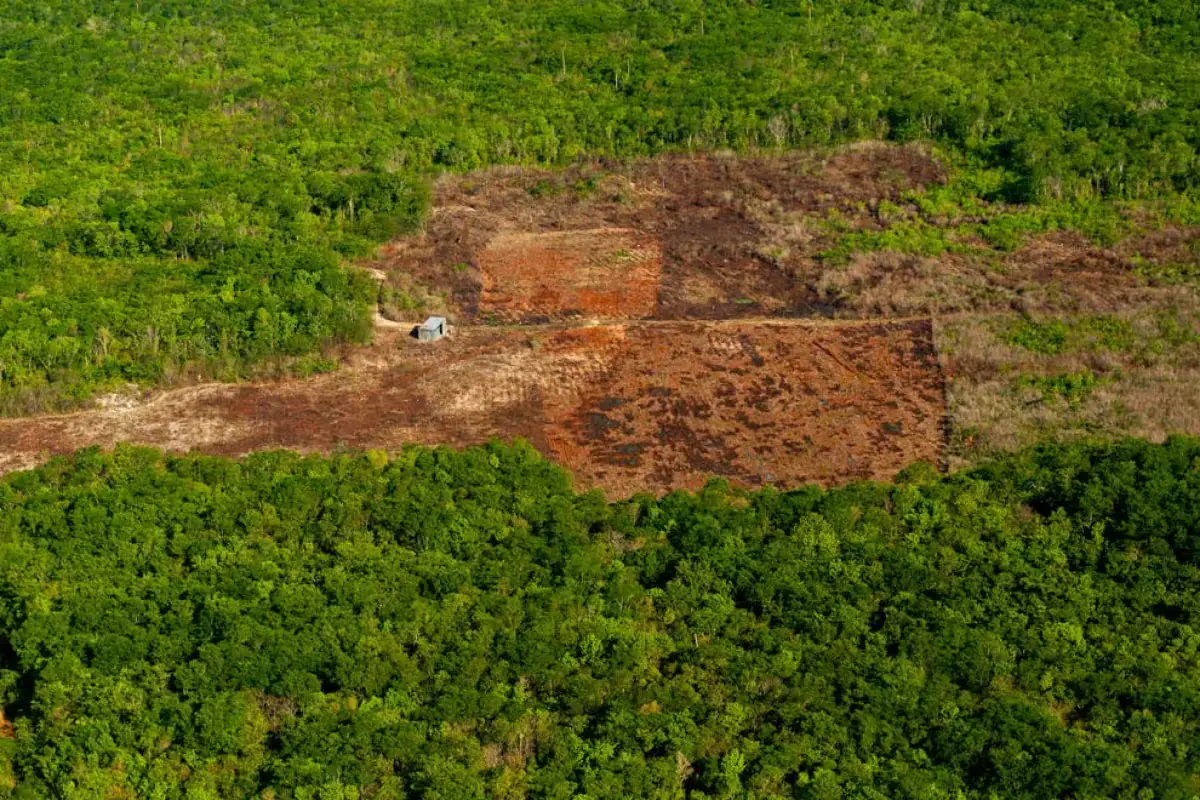
Mérida, Yucatán — Federal environmental inspectors who arrived at the Crío poultry farm in Hoctún in January found that the closure seals placed weeks earlier had been broken. The operation was still running. The company had cleared 8.9 hectares of native vegetation without authorization, and despite the federal sanction, no one had stopped the activity.
The Federal Attorney for Environmental Protection (Profepa) filed an additional criminal complaint with the Federal Prosecutor’s Office (FGR). The episode is not an exception — it is a pattern.
Between January and May 2026, Profepa carried out 24 punitive actions in Yucatán — including fines, total closures, and orders for environmental remediation — 16 more than in the same period last year. The accelerated pace of operations confirms that federal oversight has intensified, but also shows that the problem, far from being resolved, continues to expand.
Those 24 actions add to 13 criminal complaints filed with the FGR from environmental operations across the entire Yucatán Peninsula. Environmentalists, researchers, and affected communities keep asking the same question: When does a closure translate into actual repair of the damage?
The answer involves a dimension that administrative files rarely capture: the soil itself. Salvador Castell González, a biologist and founder of the civil association Va por la Tierra, explained that biodiversity is the main indicator of a terrestrial ecosystem’s health, and concentrating large areas in a single species creates imbalances that affect the soil’s microbiological, hydrological, and structural functionality.
“If we place many specimens, but of a single species, we commit an ecological error. Even in reforestation, if only pines or cedars are planted, instead of helping the environment we are harming it,” the specialist said.
A field subjected to intensive monoculture can take 20 to 50 years to recover naturally. With scientific ecosystem restoration techniques, that period can be reduced to an average of seven years, but that requires institutional will, budget, and continuity that do not yet exist in the state.
Agrochemicals in the Aquifer: The Damage Not Seen on the Map
Mexican regulations prohibit the use of fipronil — an insecticide classified as a Highly Hazardous Pesticide — in crops that pose a risk to pollinators. The prohibition has existed on paper since 2020, when the federal government issued a decree initiating its gradual withdrawal.
However, the National Commission for the Knowledge and Use of Biodiversity (Conabio), the National Council of Humanities, Sciences and Technologies (Conacyt), and the Ministry of Environment and Natural Resources (Semarnat) have documented that the chemical continues to be used on agro-industrial properties in southern Yucatán. The infiltration of this and other agrochemicals into the subsoil poses a particular threat in a karst region where there is no clay layer to isolate the aquifer: rainwater and compounds applied on the surface descend directly into the cave system that feeds community cenotes, wells, and springs.
In response, the National Institute of Ecology and Climate Change (INEC) is working with Semarnat on a decree to expand restrictions to other pesticides identified as causing mass pollinator deaths. The regulatory process, started in 2025, has not concluded. While the rule is being built, application continues.
Semarnat’s delegate in Yucatán, Guillermo Porras Quevedo, publicly acknowledged that the agency maintains constant monitoring to evaluate the consequences of intensive pesticide use, but clarified that its role is as a regulatory and accompanying authority, not a prosecutorial body. “We are working by giving them very specific follow-up,” he said, referring to agro-industrial activities that operate without the corresponding land-use change authorizations.
Land-Use Change: The Legal Loophole That Allows Clearing
The General Law of Sustainable Forest Development requires that any conversion of forest land to agricultural use have a federal authorization for land-use change in forest lands (CUSTF), issued by Semarnat. In practice, federal operations have repeatedly documented that clearing occurs before that authorization is requested or granted. The mechanism is always similar: clear the land, install crops and irrigation systems, and present the authority with a fait accompli. Closures come later, but the vegetation is already gone. At that point, restoration — both legal and ecological — becomes a much more complex process than the prevention that never happened.
Profepa has the power to close properties, impose economic sanctions, and file criminal complaints, but lacks its own mechanisms to force effective restoration of damaged areas. The environmental remediation orders that accompany closures depend on the offender’s willingness to comply and the state’s ability to verify compliance in remote areas. The result, documented by communities and civil organizations, is that many closed properties end up being regularized with definitive agricultural use: the closure functions as an operating cost, not a real deterrent.
The Maya Milpa: A Model Awaiting Its Turn in Public Policy
Faced with soil degradation and the insufficiency of the sanctioning framework, specialists and environmental organizations point out that the fundamental solution is not exclusively legal — it is also agronomic and cultural.
The Maya milpa — a system of simultaneous planting of corn, beans, and squash practiced for centuries on the Peninsula — has been recognized by the Food and Agriculture Organization of the United Nations (FAO) as a World Agricultural Heritage, along with the chinampas of central Mexico.
The distinction is not ceremonial: it recognizes the ability of these systems to maintain long-term soil fertility without intensive chemical intervention, through a symbiosis between species — the Mesoamerican triad — that nourishes the soil, strengthens biodiversity, and naturally regulates moisture.
The milpa and pre-Hispanic polycultures represent, in Castell González’s words, the ecological opposite of monoculture: they do not require “aggressive management” through agrochemicals, do not erode soil nutrients, and do not generate the imbalances that eventually contaminate the aquifer. However, their adoption as a productive alternative in areas affected by deforestation remains marginal.
As of June 2026, there is no state or federal program that systematically links the restoration of closed properties with conversion to traditional systems like the milpa. Yucatán’s soil, meanwhile, continues to accumulate an ecological liability whose payment will come — sooner or later — in the form of contaminated water, absent bees, and land that no longer produces.
More Environment
- Sargassum Barrier Reaches Puerto Aventuras as Navy Support Takes Shape
- Why Quintana Roo’s Sewer Gap Is Polluting Cenotes and Coasts
- Hotels in Cancún and Puerto Morelos Restore Coastal Dunes With Native Plants
- Dolphin Swims Continue in Puerto Aventuras as Cancún Dolphin Debate Simmers
- Punta Allen Lobster Fishermen Report 40 Tons Three Months Into Season