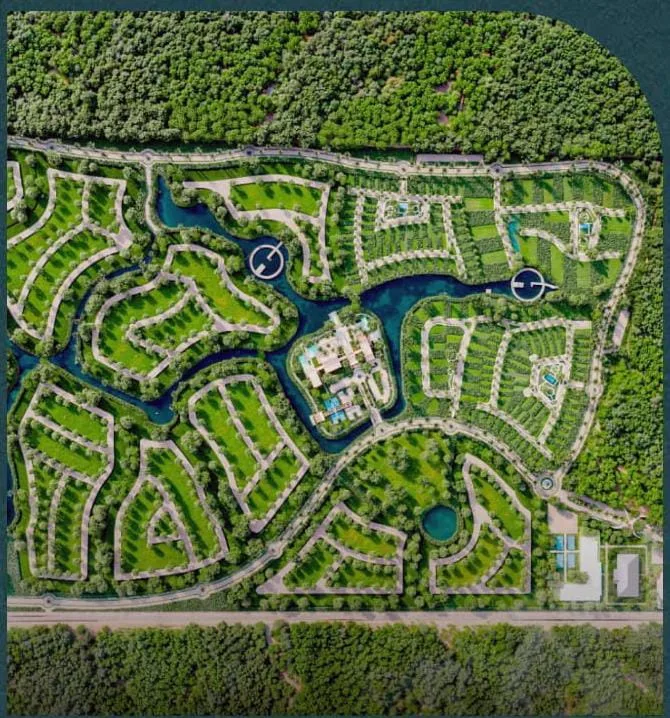
Playa del Carmen, Quintana Roo — Buyers looking at lots in NATIVA are being offered a vision of homes, cenotes and landscaped open space near Xcaret. What they cannot yet be offered is certainty that the project’s roads and utilities can be built: federal environmental officials are still evaluating the developer’s application.
ECB Desarrollos, S.A.P.I. de C.V., submitted the 90.9-hectare project to Mexico’s Environment and Natural Resources Secretariat, known as Semarnat. The proposed site lies west of Federal Highway 307, beside the federally protected Felipe Carrillo Puerto area. Semarnat’s project listing identifies the application as 23QR2026TD074, filed on Oct. 15, 2026.
The review is consequential because NATIVA is already being marketed. Reports on the development say lots are being offered with 20,000-peso reservations while Semarnat’s environmental impact division considers whether to authorize the work. A reservation, however, does not resolve the question of whether the proposed infrastructure can be built.
What would be built first
The application covers a property measuring 909,180.33 square meters. Plans describe lots for villas and apartments, a clubhouse, commercial space, a showroom, internal roads, landscaped medians, cenotes and an artificial lagoon.
The permission sought at this stage is for site preparation and urbanization, including electricity, drinking-water and drainage networks intended to connect to municipal systems. Individual buyers would be responsible for building homes on their lots. That distinction matters: approval of the current application would not, on its own, approve every future house or apartment building.
The developer estimates that preparing the site and installing its infrastructure would take 10 years, followed by an operating period of indefinite duration. For someone considering a lot, the timetable raises a practical question beyond the eventual price of construction: when would the roads and services needed to use that lot actually be ready?
The federal project listing adds a significant detail to the environmental picture. It describes the full 90.9 hectares as forested land and says the proposal seeks a change of forest land use for 239,851.89 square meters — nearly 24 hectares. That is the area for which the developer seeks permission to change the existing land use, rather than the footprint of every eventual home.
Why the location matters
The neighboring Felipe Carrillo Puerto protected area was established by federal decree in September 2024 and covers more than 53,000 hectares across the municipalities of Playa del Carmen, Cozumel and Tulum. NATIVA’s reported position beside it does not mean the development itself is inside the protected area. It does make the proposed removal of vegetation and the project’s effects on surrounding habitat central questions for Semarnat’s review.
The developer’s environmental study reports 28 species in risk categories under Mexico’s NOM-059 wildlife standard: 15 subject to special protection, 11 classified as threatened and two listed as endangered. It also identifies 14 species that could occur in the area and are endemic to the Yucatán Peninsula’s biotic region. The distinction between species recorded and those with potential presence is important; neither figure, by itself, determines whether the project will be approved.
Semarnat must evaluate the proposed land-use change and mitigation measures before deciding whether the urbanization can proceed and under what conditions. The filing of an environmental impact statement is the start of that review, not an authorization to begin work.
A proposal buyers should examine closely
NATIVA has drawn scrutiny before. An earlier application associated with the project was withdrawn in July; that was a withdrawal by the applicant, not a federal denial. The October filing lists ECB Desarrollos as the applicant, so the current proposal must be judged on its own documents and eventual ruling.
For a prospective buyer, the useful questions are concrete: which permits have been granted, which remain pending, what infrastructure is included in the purchase agreement, when it is promised, and what happens to a reservation payment if the project is changed or denied. Those answers should be in the written contract. Until Semarnat rules, NATIVA’s proposed roads, services and residential lots remain plans rather than an environmentally authorized development.
More Development
- Playa del Carmen halts poplar tree relocation
- Playa del Carmen subsoil study eyed for 2027
- Mexican Caribbean Leads Hotel Boom as Cancún and Riviera Maya Take Half of New Rooms
- Quintana Roo to Build Three Margarita Maza High Schools in Cancún by 2027
- Cancún Residents Say 3 Million Peso Park Won in 2023 Was Never Built
More Playa del Carmen
- Playa del Carmen Reviews Playaparq Concession
- Playa del Carmen Shark Point Welcomes Back 12 Bull Sharks
- Playa del Carmen Ejido Marks 89 Years and Honors Its 54 Founders
- Allegedly Drunk Driver Falls Asleep at the Wheel and Crashes Into Pole in Playa del Carmen
- Cancún, Playa del Carmen and Chetumal Account for 81% of Quintana Roo’s Disappearances