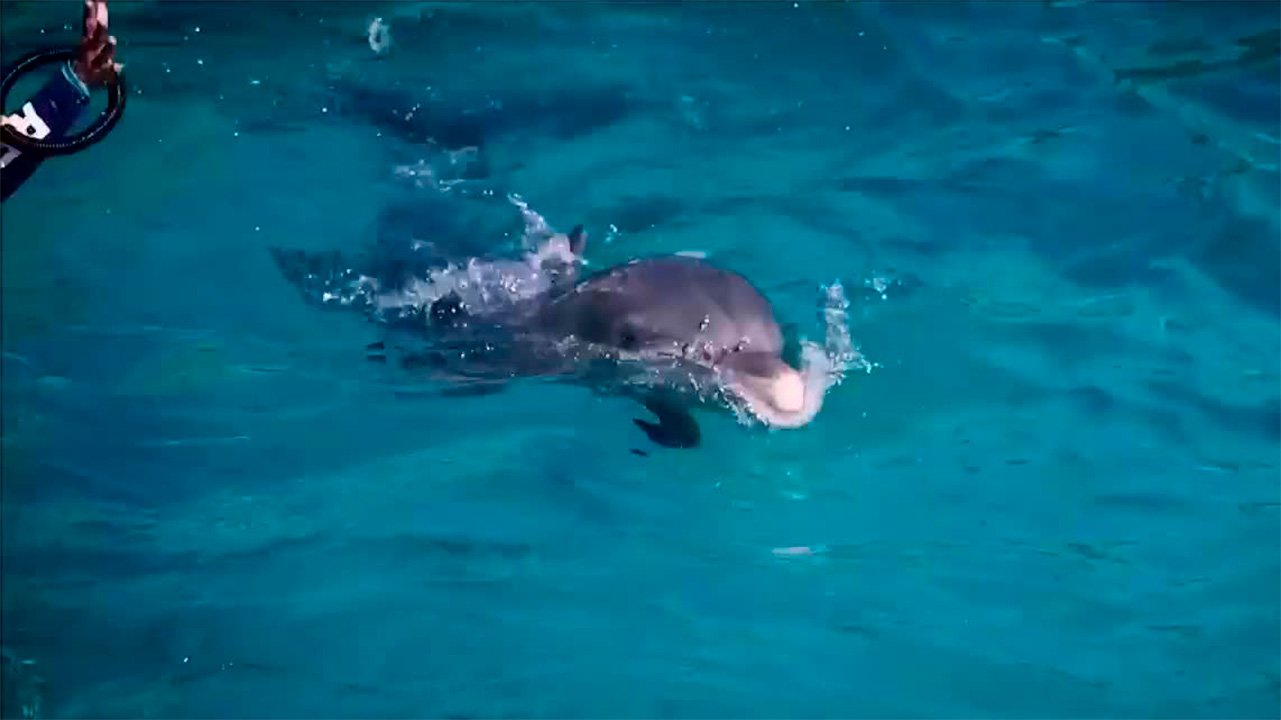
Cancún, Quintana Roo — Mincho, the blind dolphin whose mistreatment at a Cancún hotel pool turned him into a symbol of Mexico’s fight against animal abuse, has died at 37, the Federal Environmental Protection Agency (Profepa) announced.
Profepa said Dolphin Connection Cancún notified the agency of the animal’s death on Oct. 30 and that it immediately ordered the company to carry out a necropsy and complementary studies to establish the exact cause of death.
“We regret to inform that Dolphin Connection Cancún notified Profepa that the dolphin Mincho has just died. This dolphin, 37 years old, was suffering from a serious illness,” the agency said in a short message on social media.
Officials said the results and the circumstances of the death will be released once the technical reports are completed.
A life in captivity
Mincho spent most of his life in captivity after being captured in the Solomon Islands. His case drew widespread attention after he rammed the concrete wall of the pool at the Hotel Barceló, where he was forced to perform acrobatics while blind and suffering from cancer of the tongue.
The accident occurred in November 2020, but the images circulated widely in early 2025 and accelerated Mexico’s ban on marine mammal shows, known as the “Mincho Law.” Experts and dolphinarium operators have since debated the implications of the measure.
According to medical reports prepared for Profepa, the dolphin had damage to his oral cavity caused by squamous cell carcinoma — cancer affecting roughly 70 percent of his tongue. He also displayed stereotypies, repetitive behaviors that signal stress, which caused severe dental abrasion because he bit the concrete of the pool.
The agency has said that Mincho, Solei and Oceanía were in very critical health. It also noted that no authorized or proven protocols currently exist to treat cancer in marine mammals held in captivity, so a permanent medical and veterinary monitoring program was put in place.
Eight other dolphins remain at the facility
Mincho was one of nine dolphins held at the site, where he spent his final years under Profepa custody. The other eight all show some form of illness, according to the agency:
- Apolo and Flex: inflammation of the cornea in the right eye.
- Diego: inflammation of the cornea in both eyes, partial loss of the tail fin and chronic severe dental abrasion.
- Oceanía: chronic inflammation of the corneas and ulcers on the tongue, among other conditions.
- Satu and Squalo: chronic inflammation of the corneas; Satu has an ulcer on the tongue and severe dental abrasion, while Squalo shows dental wear and multifocal erosions.
- Solei: opacity in both eyes, plus ulceration and abrasion of the tongue.
- Solomon: inflammation of the corneas, ulceration of the tongue, lesions near the left eye and dental wear.
More Environment
- Fortaleza Energy Proposes 170 Million Peso Solar Park in Yucatán
- ECB Desarrollos Sells NATIVA Lots in Playa del Carmen While Environmental Permit Pending
- Mexico’s Conanp Deems Royal Caribbean’s Cozumel Beach Club Unviable
- Inside the New Guide to Mexican Caribbean Cave Diving
- Flamingo Named Víctor Flies 262 Kilometers Across Yucatán’s Coastal Wetlands
More Cancun
- US Embassy in Mexico Seeks Consular Agent in Cancún at $46,273 a Year
- Cancún’s Catrinas Parade Set for Friday Night at Puerto Juárez
- Cancún Authorities Investigate Death of 9-Year-Old Boy Found in Villas del Mar 3 Home
- Two Men Shot Outside Cancún Middle School in Región 228
- Cancún Police Arrest ‘La Comandanta,’ Notorious Paperwork Fixer, for Violating Restraining Order