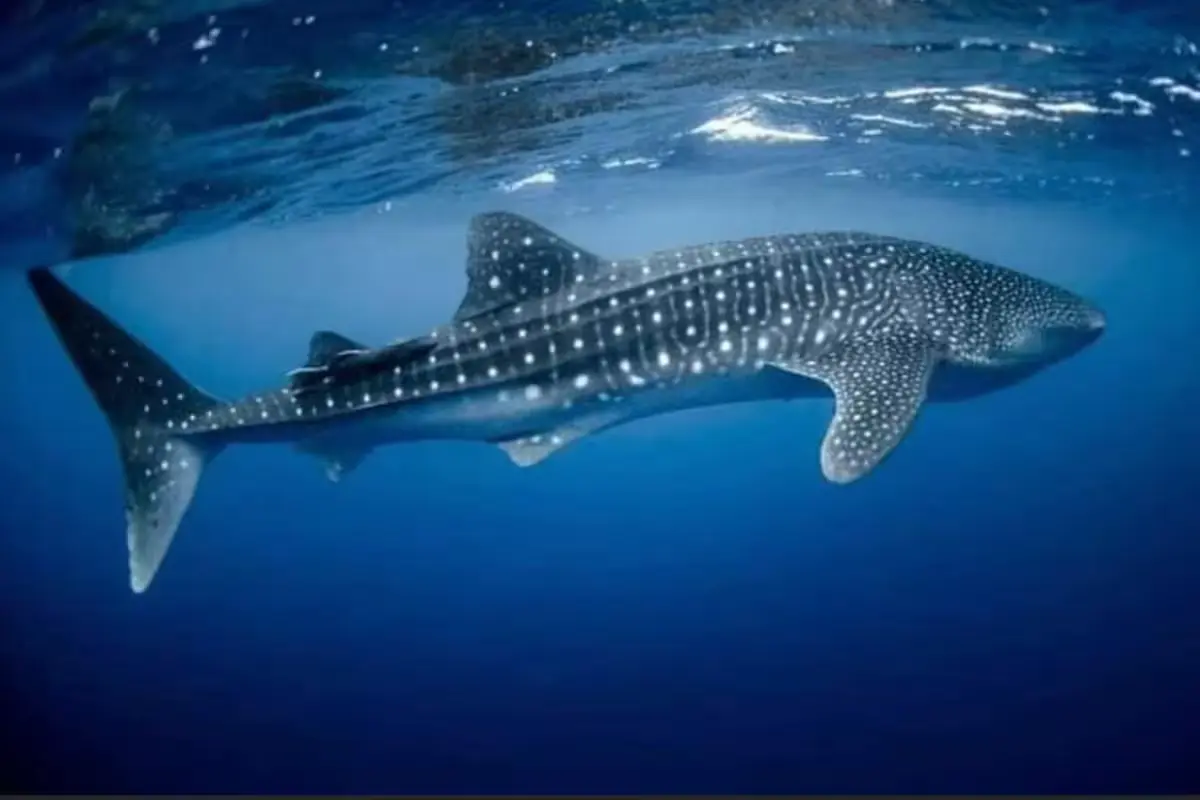
El Cuyo, Yucatan — The arrival of spring has brought whale sharks and basking sharks to the coasts of El Cuyo and Isla Holbox, a natural phenomenon that draws scientists, fishermen, and tourists each year.
Biologist Julian Rojas explained that these species migrate to the continental shelf off northern Yucatan and Quintana Roo to feed primarily on the eggs of the bonito fish.
Rojas noted that this region hosts the world’s largest concentration of whale sharks, along with large groups of manta rays, creating one of the planet’s most significant marine spectacles.
Each whale shark can consume more than 140 kilograms of eggs daily, he said, which is why many juveniles and sub-adults remain in the area to find enough food to support their growth.
The whale shark is the largest fish in the world. It belongs to the group of elasmobranchs, order Orectolobiformes, and is the only member of the family Rhincodontidae and genus Rhincodon. It can reach up to 12 meters in length and weigh nearly 19 tons.
Despite its imposing size, the species is docile and harmless to humans. It feeds by filter-feeding: it opens its wide jaws to absorb small marine organisms, then expels the water while retaining the food.
Rojas said the whale shark is distinguished by its flattened head, blunt snout, and unique pattern of white spots and light lines on a grayish or brown body. Its dorsal fins are oriented toward the rear, and it ends in a large forked tail.
Whale sharks inhabit tropical and subtropical seas worldwide, but each spring they migrate to this region due to the abundance of food generated by the bonito fish spawning.
The species is currently listed as vulnerable due to population decline and illegal hunting still occurring in some parts of the world. Its capture, commercialization, import, and export are prohibited under environmental protection laws.
In El Cuyo and Isla Holbox, a significant tourism industry has developed around whale shark watching and controlled swimming, conducted under strict safety and environmental regulations.
More Environment
- Judge Halts Trump Border Barrier in Big Bend National Park
- US Coast Guard Seizes Cargo Ship Accused of Smuggling Fuel to Cuba
- Playa del Carmen to Renew Eight Blue Flag Beach Certifications, Eyes Two More
- Cancún Sets October Dates for Free Dog and Cat Sterilization Clinics
- Sargassum Influx Triggers Two Types of Wildlife Die-Offs in Quintana Roo
More Quintana Roo
- Quintana Roo Remains Far from Electronic Voting, INE Official Says
- Experts Highlight Social Memory as Key to Disaster Prevention in Quintana Roo
- Quintana Roo to Launch World’s First Formal Sargassum Fishery With 840 Fishermen
- INE Opens 2026-2027 Federal Electoral Process in Quintana Roo, Vows to Tackle Voter Apathy
- Quintana Roo High School System Aims to Install Cameras at All 44 Campuses