Mexico City — Two days before the start of the 2026 FIFA World Cup, the U.S. State Department, through the U.S. Embassy in Mexico, issued updated travel advisories for American citizens visiting the country.
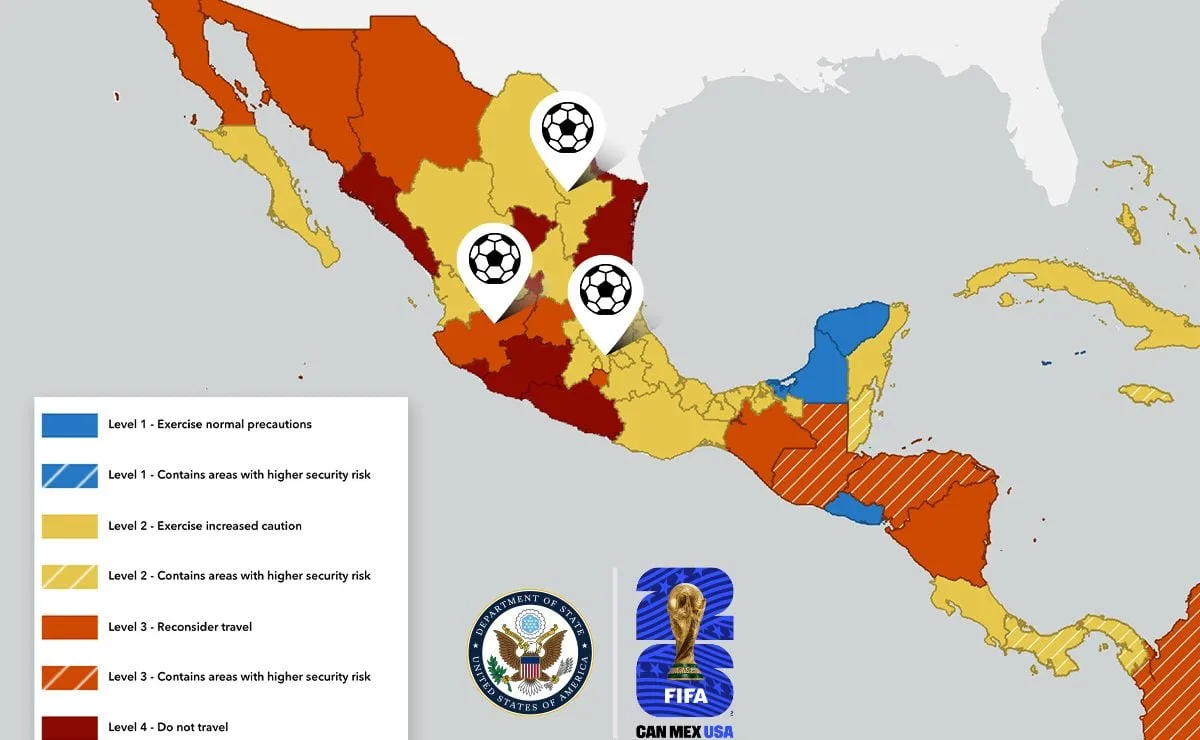
The embassy shared a map on social media showing all 31 Mexican states classified under one of four warning levels, based on security risks that vary widely by region.
“Mexico is a popular vacation destination, but security risks vary greatly by region, so we assign a travel advisory level for each Mexican state,” the embassy said in its post.
The advisory levels are:
- Level 1: Exercise Normal Precautions — Campeche, Yucatán
- Level 2: Exercise Increased Caution — Aguascalientes, Baja California Sur, Mexico City, Coahuila, Durango, State of Mexico, Hidalgo, Nayarit, Nuevo León, Oaxaca, Puebla, Querétaro, Quintana Roo, San Luis Potosí, Tabasco, Veracruz
- Level 3: Reconsider Travel — Baja California, Chiapas, Chihuahua, Guanajuato, Jalisco, Morelos, Sonora
- Level 4: Do Not Travel — Colima, Guerrero, Michoacán, Tamaulipas, Sinaloa, Zacatecas
“If you got tickets to a 2026 FIFA World Cup match in Mexico, check the latest travel advisory level,” the embassy advised.
The advisory warned of crimes including assault, car theft, sexual assault, kidnapping, homicide, and terrorism. It noted that the U.S. government, under President Donald Trump, has limited ability to provide assistance in many parts of Mexico, “a vast country where conditions vary considerably from one state to another and even within the same state.”
Emergency services are limited or nonexistent in remote or rural areas, the advisory said. “If you encounter a road checkpoint, you must obey. Fleeing or ignoring instructions can result in injury or death. Check maps of restricted areas.”
U.S. government employees were instructed not to travel between cities after dark, to use only regulated taxi stands or app-based services like Uber or Cabify, and not to hail taxis on the street. They were also told to avoid traveling alone, especially in remote areas, and are generally not permitted to drive between Mexican border cities and the interior.
The host cities for the World Cup — Mexico City and Nuevo León — fall under Level 2, while Jalisco is at Level 3 (Reconsider Travel).
The full map is available on the State Department’s travel maps website.
More Politics
- Quintana Roo Bill Would Jail Pet Owners Who Abandon or Neglect Animals
- Trump Prepares Aggressive New Offensive Against Mexican Cartels, US Report Reveals
- Mexico and US Race to Seal Trade Deal Before Midterms
- Trump Plan: H-1B Workers Must Leave After Layoffs
- Playa del Carmen Activists Blast Urban Sprawl in the Jungle