Playa del Carmen, Quintana Roo — The Tren Maya station in this resort town is immaculate. The floors are polished, the turnstiles shine and a shallow reflecting pool glints beside the entrance. What the terminal does not have is passengers.
On a recent weekday, eight people stood on the platform waiting for the train to the Tulum airport station. Fewer than 30 rode the convoy south, even though the standard configuration of four cars can carry 230 travelers; on this trip the train ran with three.
Taxi driver Fredy Cortés, who has worked the streets here for six years, says he is used to the swings of the tourist seasons, but this year has tested him. He now makes at most two trips a week to the station, and on this day he carried a couple heading south to catch the train and then a bus to the airport.
“We’re hoping the situation improves in mid-November,” he said as he dropped off his passengers.
A ride from downtown Playa del Carmen to the Tren Maya station costs between 120 and 150 pesos, Cortés said. What his passengers would pay for the train and the connecting bus in Tulum, he did not know.
Spotless, and silent
Leticia Herlinda Aguilar, the station’s head of cleaning, said 25 people keep the terminal clean and orderly. Maintenance crews move through the wide corridors, polishing floors, turnstiles and glass, past storefronts that sit empty. They are, for the most part, the only people moving.
The line to the ticket windows is empty. Two clerks staff the counter. One steps away within seconds because she is due on the platform to monitor the train’s arrival; the other greets visitors.
“In high season the best thing is to buy tickets in advance. Today you can just show up, ideally 45 minutes before departure,” the young ticket agent said. She also announced a promotion: for all of November, the return ticket is free — but only if the outbound ticket is purchased.
A loudspeaker announced the next departure. The eight passengers bound for the Tulum airport station gathered near the platform, complaining about the heat. There was no breeze and no ceiling fans, which people in the region call abanicos. As the train sounded its horn, a young passenger-service attendant reminded the group they could take photos and video but could not cross the yellow line.
Asked whether the station is always this quiet, he said no — the drop is seasonal.
Trading time for money
Emanuel Aguilar boarded the train with a relative who was flying from Tulum International Airport, also known as Felipe Carrillo Puerto, to Mexico City. Rather than take the traditional route, they chose the train because they calculated a significant saving.
“If you’re a local, the train ticket costs 165.50 pesos for a one-way trip to the airport station. It’s almost half of what you’d pay for the bus, though you have to add the taxi, around 150 pesos, and the second bus from the station to the airport, another 55 pesos. That’s 740 pesos round trip,” he said. “All told, it’s cheaper. My relative got a very cheap plane ticket out of Tulum. Of course, it takes much longer. You trade time for money.”
Other passengers had boarded in Mérida, among them a family traveling to Torreón. Katia Solís told the outlet this was their first time on the Tren Maya.
“I’m here with my husband and my two daughters, all of us on this adventure to ride the Tren Maya. We were looking for an excuse to get to know it. The service is very good. Everyone is making sure we’re comfortable and sitting in the right seats,” she said.
“I liked it — it’s very pretty, very clean and comfortable. And I do feel that later on, if I do this again, it will feel tiring. I left home at 7 in the morning, we’re arriving here in Playa del Carmen at 2 in the afternoon, and we still have to get to Tulum and then to our destination.”
Gabriel Herrera, who works in the train’s catering service, has been on the job for two months and runs the coffee shop. A native of Campeche who lives in Mérida, he said his experience has been a good one.
“People ask me what it’s like to work here, and I tell them it’s fun. We interact with people from everywhere, and it’s nice to see them get excited. They ask if it’s always like this, if it’s always full, or why sometimes it’s a bit full and sometimes emptier. So we explain that it depends on the season. People leave happy. They’re surprised to see the Tren Maya craft beer. A lot of people take it home as a souvenir.”
Waiting, and waiting again
The train reached Tulum in under an hour. Passengers then had to wait another hour for the bus that would take them to the airport. The shops at that station were also empty, with not one open — not even to buy water.
On the bus, two American women struck up a conversation. Beth Anne Darles was flying to Portland and Karen Greninger was headed to Kansas. Darles said she was coming off a wonderful vacation in Bacalar, where a friend from the United States owns a house on the lagoon. Greninger, who lives in Mahahual, was traveling with her family to her home state for a holiday.
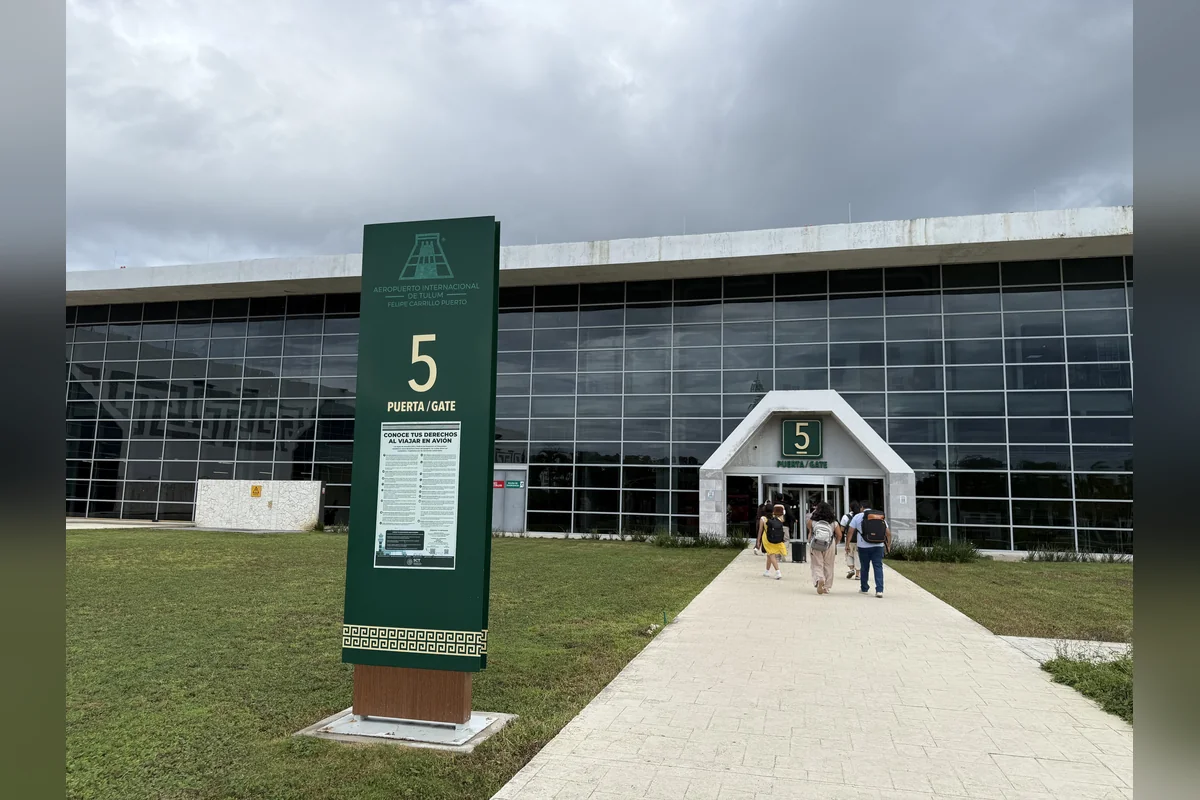
Fifteen minutes after boarding, the driver announced the airport. The terminal is large. Four flights appeared on the screens, and the small number of shops open matched them: a souvenir store, car rental desks, a GoMart, a Starbucks and one restaurant.
One tenant said the businesses can no longer cover their rent. They have been in talks with the airport administration to request a restructuring or a grace period, the tenant said, but have yet to receive an answer.
A flight was announced over the loudspeakers and the few travelers walked calmly toward the boarding gate. The terminal emptied out again — not entirely, though. The employees remained, counting the takings from the few sales they had made.
Emanuel Aguilar faced another wait of nearly three hours for the bus back to the Tren Maya station and the trip home to Playa del Carmen.
“I was able to make this trip because they gave me solidarity days,” he said, referring to the unpaid days off that hotels use to cut costs when occupancy falls. He will have to wait to be called back to work.
“The low season started to be felt in June, and we’re hoping it ends this November,” said Aguilar, who also founded a travel agency and says this has been the weakest season he can remember.
Record ridership on paper
Official figures show the Tren Maya set a single-day record of 7,875 passengers on Nov. 17, 2025, across its 1,554 kilometers of track. The annual target for 2025 was 1.2 million passengers; by November of that year it had carried 1,809,754.
In a statement issued Oct. 30, Tourism Secretary Josefina Rodríguez Zamora celebrated the system reaching 3 million passengers since it began operating.
By the time the train pulled back into Playa del Carmen it was night, and Aguilar was watching the speed display in the carriage.
“The trip back already felt extremely long,” he said. “It seems like we’re going slower, but it says 100 kilometers per hour.”
Passengers stepped off an empty train onto an empty platform, walked through an empty station and into an empty parking lot. Asked whether someone was coming to pick him up, Aguilar said no.
“I’m going to try Uber, which just arrived in Playa del Carmen,” he said, and set off a little more at ease.
More Tourism
- Uber Launches in Playa del Carmen Through Local Taxis, With Heavy Subsidies
- Cave Collapse in Tulum Revives Alerts Over Heavy Machinery Above Sac Actun
- Riviera Maya businesses pitch concerts for low season
- Quintana Roo Courts British Travelers at WTM London Trade Fair
- Quintana Roo Takes Its Seven Dive Destinations to DEMA Show in New Orleans
More Playa del Carmen
- IMSS Delivers Ultrasound and Heart Equipment to Hospitals in Cozumel and Playa del Carmen
- Xcaret Says Final Ruling on Maya Symbol Use Still Pending After Injunction Withdrawal
- Residents Report Constant Sewage Overflows at Playa del Carmen’s Colosio Crossing
- Playa del Carmen Business Leaders Seek Broader Tax Breaks for 2027
- Bus Crash Traps Driver in Wrecked Car on Playa del Carmen Boulevard