
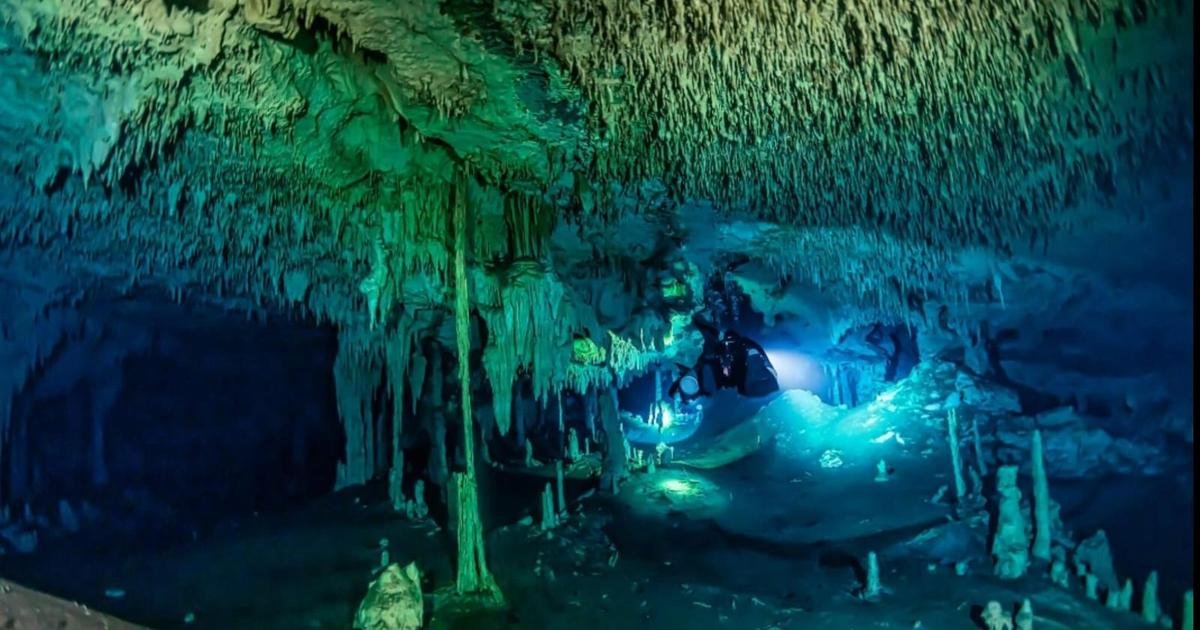
Tulum, Quintana Roo — A section of the roof of the flooded cavern known as Heaven’s Gate, or Puerta del Cielo, collapsed during a dive in the Sac Actun system, nearly causing an accident among a group of cave divers and reviving warnings that environmental groups issued months ago about heavy machinery working above the cave network.
The incident occurred during a dive in the Nohoch Nah Chich area, where part of the rocky structure gave way and sent up a thick cloud of sediment that sharply reduced visibility. The divers managed to leave the cavern without injuries, although the fallen material landed in a section they could have been passing through during the route.
The collapse carries weight because of the history of infrastructure work built over the Sac Actun system, in particular a highway project that environmental organizations have challenged given the fragility of the subsoil in Tulum.
Warnings first raised in June 2026
In June 2026, the Mexican Center for Environmental Law (CEMDA), Greenpeace México and Sélvame MX reported that work on the Jacinto Pat highway, carried out by federal agencies, posed a threat to the caverns and the underground flows of water.
Among the risks they flagged were precisely the collapse and sinking of limestone vaults caused by the weight of heavy machinery and the modifications made at surface level.
The groups questioned why the Secretariat of Environment and Natural Resources (SEMARNAT) had granted an exemption from the environmental impact statement on the grounds that the project was the rehabilitation of a rural road, when, according to the complainants, it was a new highway cut through jungle areas.
The work, carried out by the Mexican Army (SEDENA) and the Secretariat of Infrastructure, Communications and Transport (SICT), also drew criticism over land clearing and possible damage to the aquifer.
No technical link established yet
The collapse at Heaven’s Gate puts those warnings back on the table, although no technical study yet exists that would allow specialists to establish whether the highway work is directly linked to the incident.
Nor has it been confirmed that the stretch where the ceiling gave way lies exactly beneath the area worked by machinery — a question that would have to be settled through topographic and geological surveys.
A vast flooded system
The Sac Actun system, with roughly 368 kilometers of documented underwater passages, has been recognized by the International Union of Geological Sciences for its natural, paleontological and archaeological importance.
Its structure is made up of limestone that water has reshaped over thousands of years, creating cenotes, caverns and long underground conduits.
The Mexican Institute of Water Technology (IMTA) has explained that cavern roofs in karst terrain can give way both through natural processes and through external loads that exceed their capacity to resist.
For that reason, building infrastructure on this kind of ground requires studies to identify the location, depth and dimensions of the cavities before any additional weight is placed on them.
Questions over safety and further fractures
At Heaven’s Gate, the collapse is not only a hazard for those who dive in caverns; it also raises questions about the stability of other sections of the system and the possible consequences of activity carried out at the surface.
So far no official inspection has been announced to determine the size of the collapse, the safety conditions of the dive circuit or whether additional fractures exist.
An assessment by specialists would establish whether the collapse was natural or whether outside factors contributed to weakening the structure, particularly in light of the warnings raised months ago about road construction in this part of Tulum.
More Environment
- Quintana Roo Takes Its Seven Dive Destinations to DEMA Show in New Orleans
- Activists Demand Rescue of Eight Dolphins Still Captive After Mincho’s Death in Cancún
- Environmentalists Denounce Alleged Ecocide Over Royal Caribbean Work in Cozumel
- Residents Report Constant Sewage Overflows at Playa del Carmen’s Colosio Crossing
- Quintana Roo Opens November With 85 Beaches at Low or No Sargassum, but Nine Zones Flagged Red
More Tulum
- One Dead and a Woman Arrested After Shootout With Tulum Police in Francisco Uh May
- Michelin Guide Adds Five Quintana Roo Hotels to 2026 Keys Selection
- Conrad Tulum Staff Bus Crash on Highway 307 Injures Nearly 20 Workers; Car Driver Flees
- Tulum Archaeological Zone Loses 70% of Visitors as Tourism Crisis Deepens
- Project Mayas Maps Hidden Groundwater Routes Beneath the Yucatan Peninsula
