
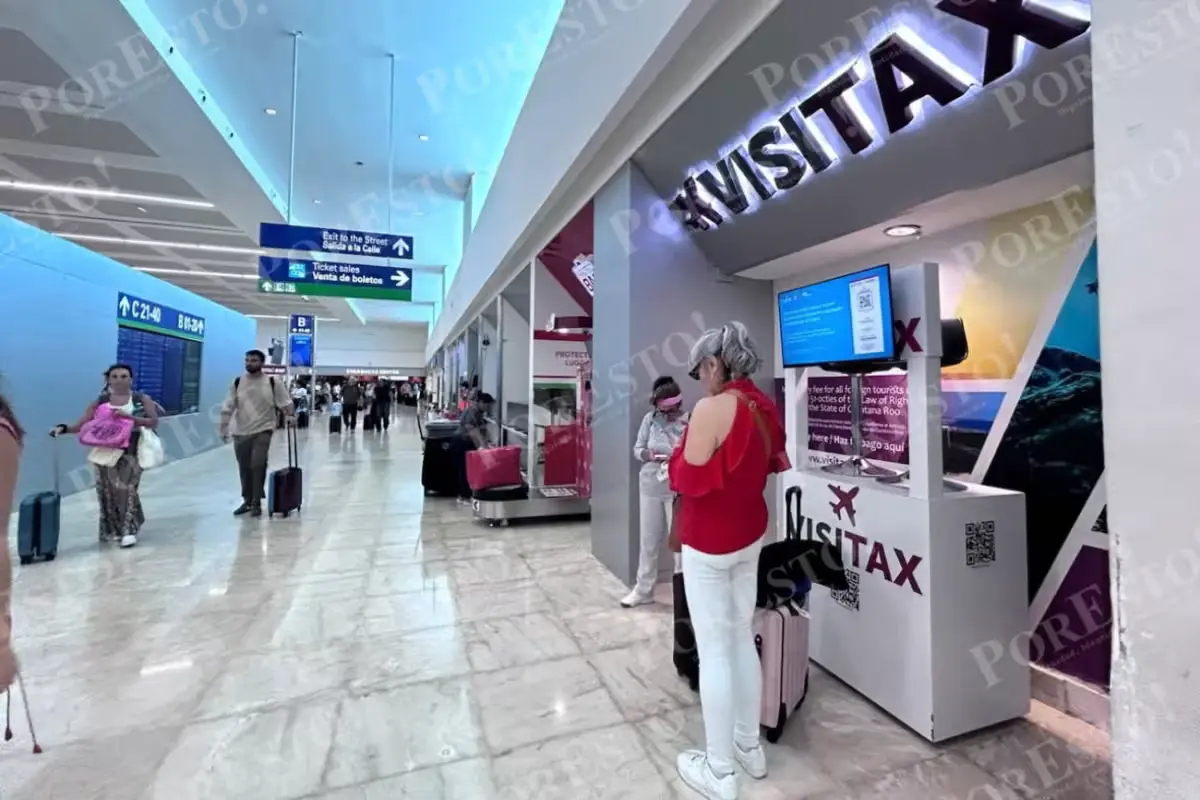
Cancún, Quintana Roo — Foreign tourists arriving at Cancún International Airport are being asked to pay as much as 550 pesos per person for the Visitax tourism tax at collection modules in Terminal 2, nearly double the 285-peso rate the Quintana Roo state government said would remain in place through 2026.
The charge has sown confusion among international visitors and contradicts the fee announced by state officials. The state government said through its General Communications Coordination that the Visitax would cost 285 pesos and would not rise during the year. The announcement came in December 2025, after Governor Mara Lezama Espinosa publicly rejected any increase — yet that same month the fee was raised to 525 pesos.
At modules inside Terminal 2, staff asked travelers for up to 550 pesos each, a difference of 265 pesos from the official rate. When questioned about the discrepancy, the personnel collecting the money declined to explain where the fee came from or who authorized it.
The issue goes beyond the price gap. Tourists encounter the charge inside facilities concessioned to Grupo Aeroportuario del Sureste (Asur), with no visible information explaining why the amount requested is roughly double the official tariff.
Airport employees interviewed said complaints about the Visitax are routine, with passengers arriving angry because they did not know about the payment or say no one informed them of the tax.
“We are the ones who take the complaint when we board; they tell us, ‘So-and-so told me they charged 550 for the Visitax at the airport and that nobody at my hotel warned me.’ We have to calm them down and explain that this is the airport’s doing, not ours,” one terminal employee said.
A baggage handler said the same grievances surface constantly in Terminal 2. “People arrive upset with the Visitax paper and ask us if it is mandatory. Even though the airlines should inform them, the lack of coordination inside the facilities leaves us facing the questions,” the worker said.
A federal transport driver said several passengers have told him they were intercepted by personnel from the State Tax Administration Service (SATQ) before boarding and pressed for payment. “They tell you, ‘They charged me 25 or 30 dollars per person on the spot, and I hadn’t budgeted for it.’ You just listen, but it does happen often,” he said.
The Visitax was created in 2021 and implemented in 2022 as a fee foreign tourists must pay when arriving in Quintana Roo. The state government says it works with private companies to make collection more efficient and that authorized firms are permitted to receive payments, but travelers lack clear information about the terms under which the airport modules operate.
The involvement of private parties also drew scrutiny during legislative hearings on the state government’s annual report. During the appearance of Martha Parraquí, head of the Finance and Planning Department (Sefiplan), a congressman asked her to clarify the collection mechanism, the role of a private company, the contracts involved and how the money is distributed. Parraquí acknowledged that a private firm participates but said 95 percent of the 300 million pesos collected came through the Sefiplan platform.
The state government says the Visitax helps fund beach maintenance and other tourism projects. Visitors arriving through the Mexican Caribbean’s busiest airport, however, are met with a charge different from the one announced publicly — and with staff who do not explain the difference.
Travelers have also raised the issue. Kim Sexsmith, visiting from Canada, said she normally pays the fee and noted that it is separate from the environmental tax charged at hotels. Grant Henry, who said he has traveled to Cancún for years, took a different view: “I have flown to and from Cancún for more than 30 years and I have never paid this tax.”
Travelers said Asur should clarify the conditions under which the collection activity is allowed, while tax authorities should disclose the participating companies, their authorizations, agreements and the fees they apply.
More Crime
- Two Men Arrested in Tulum With More Than 124 Drug Packets
- Aeroméxico Admits Hack Exposed Passenger Passport Data
- Gunmen Shoot Up BBVA Bank Branch in Puerto Aventuras, Quintana Roo
- Judge Orders Pretrial Detention for Man Accused of Extorting Cancún Mototaxi Drivers
- Former Tulum Treasurer Sentenced to Nearly 4 Years for Unlicensed Firearms
More Cancun
- Quintana Roo Wins SEMARNAT Approval to Restore 33.5 Km of Beaches
- Cancún Airport Flight Operations Rise 4.4% at Start of October
- Cancun’s Tourism Reset: Regenerative Travel Takes Center Stage
- Cinépolis at Plaza Las Américas in Cancún Closes Over Water Leaks
- Cancún Airport Receives First Deported Mexicans From the United States