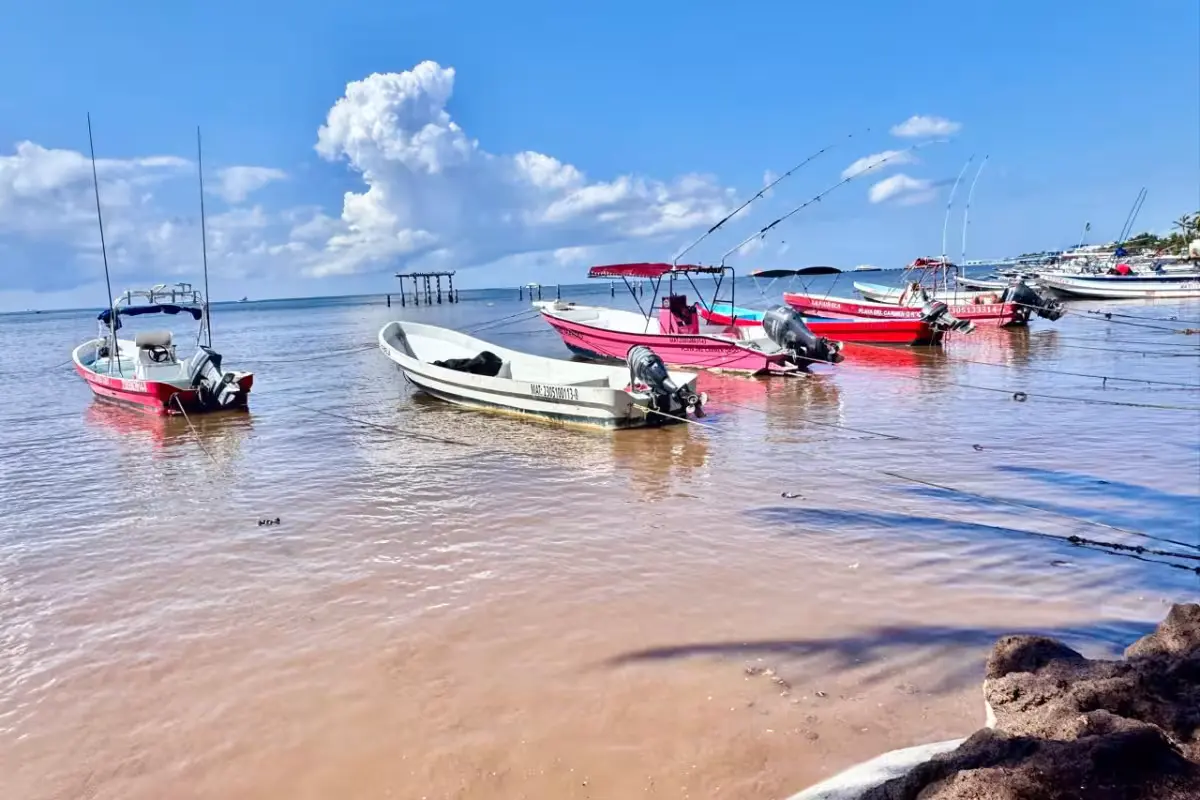
Playa del Carmen, Quintana Roo — Tourists are canceling boat tours in Playa del Carmen as sargassum buildup turns beaches into foul-smelling mud, and the lack of a proper pier makes boarding difficult, according to local boat operators.
José Gómez Burgos, president of the Mar Caribe Tourist Cooperative, said that about 60 boats operate from the area known as El Recodo. Before the sargassum problem, tourists could wade into the water to board. Now, the algae has decomposed into a muddy, smelly sludge that deters visitors.
“When there was no sargassum, tourists would get into the water to board the boats. But since sargassum hit the coast, it’s become complicated — it’s not just fresh algae, it’s foul-smelling mud. Under these circumstances, tourists cancel their reservations,” Gómez Burgos said.
He called for an urgent solution: a dock for the boats. “We cannot continue like this. Playa del Carmen is a tourist destination that has positioned itself in various markets for over 10 years, and it must meet international standards,” he added.
The cooperative first requested a dock from authorities in 2010, presenting an environmentally compliant project for a small boat pier. It was not approved. Similar efforts in 2013 and 2015 also failed.
“For reasons still unknown, the project — which is a priority — has not materialized. It could be a lack of resources or political will to make decisions to transform Playa del Carmen,” Gómez Burgos said.
He noted that authorities have funded other projects, such as a sculpture in the Natives Park and the City Theater, while the dock was postponed year after year until it was forgotten.
During the municipal administration of Román Quian Alcocer (2008–2011), a rustic pier was built, but it lacked environmental studies and was constructed in an unsuitable location. The current carried away more than 50% of the sand, and several coral patches were buried under sediment, leading to its dismantling.
“We need a dock that meets environmental standards so it doesn’t impact the reefs or sand patches on the seabed,” Gómez Burgos said.
More Business
- El 19, 3 Others Arrested in Puerto Morelos Extortion Case
- Chetumal Airport Customs Nears Full Operation Next Year
- Hotels in Cancún and Puerto Morelos Restore Coastal Dunes With Native Plants
- Quintana Roo Gains Power to Inspect Tourism Service Providers
- Quintana Roo Hoteliers Urge Action to Protect Mexican Caribbean Tourism Competitiveness
More Playa del Carmen
- Why Quintana Roo’s Sewer Gap Is Polluting Cenotes and Coasts
- Calica Mine Lands to Become Ecological Restoration Zone, Conanp Says
- Bull Shark Diving Hits Carrying Capacity in Playa del Carmen
- Playa del Carmen Plans to Restore 750 Meters of Beach in November Using Sand Recovered from Sargassum Cleanup
- Federal Court Halts Macondo Playacar Construction, Voids Building Permit