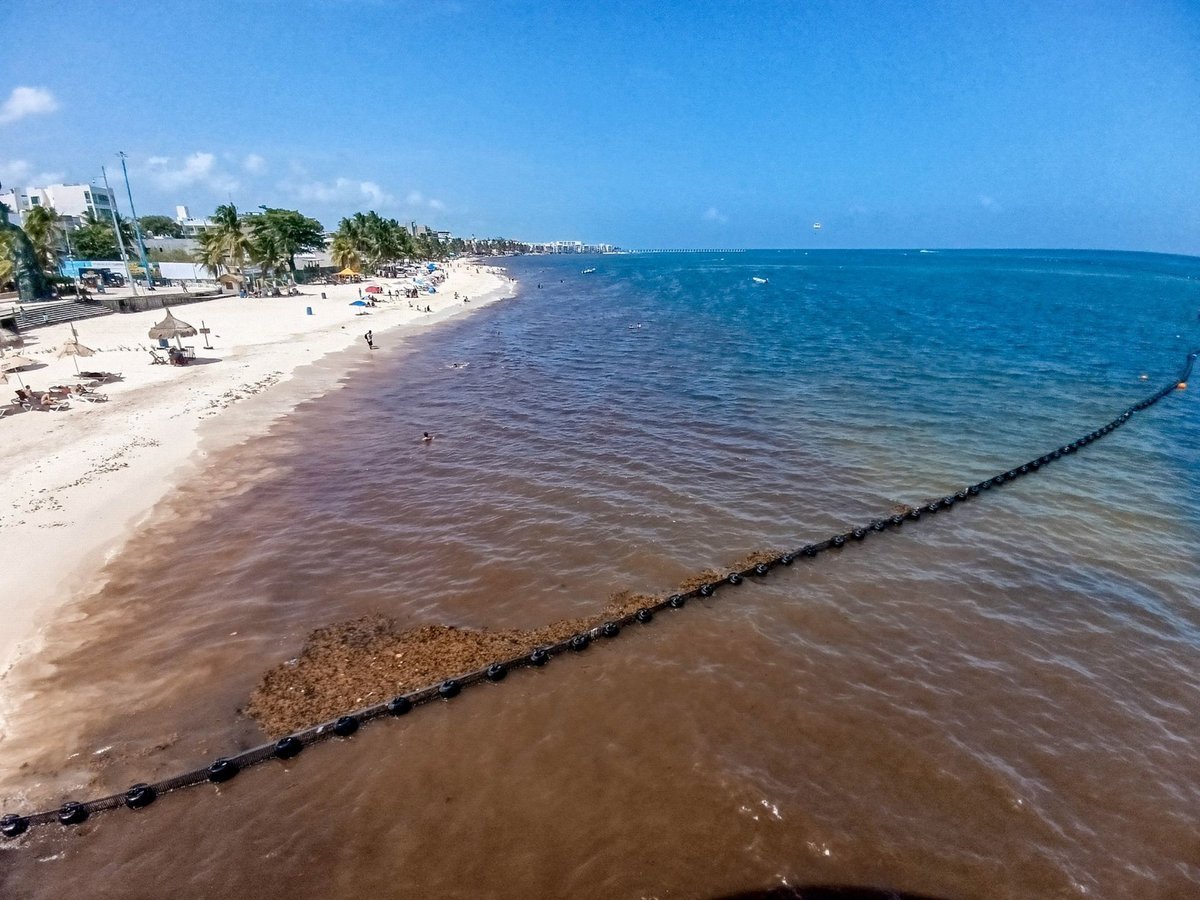
Cancun, Quintana Roo — Hoteliers in Cancun have ruled out investing in the collection of sargassum in open waters, saying that task belongs to the federal government.
Antonio Ortiz, president of the Sustainability Committee of the Association of Hotels of Cancun, Puerto Morelos and Isla Mujeres, said during a news conference that hoteliers already pay for their federally designated coastal zone and sanitation, but they are not responsible for purchasing vessels for offshore cleanup.
He recalled an agreed scheme with federal authorities: hoteliers pay for the Zofemat (Federal Maritime Terrestrial Zone), while the strategy reviewed with the federal government made clear that jurisdiction over open sea lies with the Secretariat of the Navy.
Association president Rodrigo de la Peña said hotels make significant investments to clean sargassum from beaches. He cited Jose Chapur, who invests 32 million pesos annually to clean 2.3 kilometers of beach, while the municipality of Benito Juarez has 32 kilometers of coastline.
Ortiz noted that about 1,870 tons of sargassum have been collected so far. Under a proposed 2027 strategy involving vessels that harvest sargassum at sea, the goal is to increase that to 4,000 tons per year, nearly doubling the current figure. Additional barrier kilometers would also be installed, requiring more than 2 billion pesos in federal investment.
De la Peña said the federal government “did hear our voice” after realizing the negative impact on the Mexican Caribbean’s image and on hotel occupancy. The new strategy will help both hoteliers and municipal governments, he added.
Turning to the tourism outlook for the second half of 2026, de la Peña described a challenging environment, with a 14.47 percent drop in international flights to Cancun. He attributed the decline to reduced air connectivity, economic and geopolitical factors, and lower-than-expected tourist spending during the World Cup.
The association reported that the three destinations currently have 239 hotels and 60,924 rooms. In 2026, eight hotels opened and three were renovated, adding 2,853 rooms compared with the previous year.
From January to July 2026, average occupancy was 74.6 percent in Cancun, 77.1 percent in Isla Mujeres’ mainland zone and 68.7 percent in Puerto Morelos.
According to airport group ASUR, national flights in July 2026 fell 5.7 percent from the same month in 2025, while international operations dropped 14.47 percent. The association attributed the decline partly to geopolitical tensions in Latin America, higher jet fuel costs from global conflicts, security perceptions, U.S. Immigration and Customs Enforcement operations and financial instability among some airlines.
The bankruptcy of Spirit Airlines reduced the number of seats and routes considered important for connectivity to the Mexican Caribbean.
On the World Cup, the sector acknowledged the sporting event did not generate the expected economic boost but said Mexico gained a positive image as a destination.
More Business
- Our Habitas Tulum Closes Abruptly, Leaving Workers Seeking Answers
- Cancun’s Tourism Reset: Regenerative Travel Takes Center Stage
- Cinépolis at Plaza Las Américas in Cancún Closes Over Water Leaks
- Playa del Carmen Weighs Scooter Limits and Zoned Mototaxi Operations
- Mexican Lettuce Not to Blame for US Salmonella Outbreak, Cofepris Says
More Cancun
- Cancún Airport Receives First Deported Mexicans From the United States
- Former Tulum Treasurer Sentenced to Nearly 4 Years for Unlicensed Firearms
- Judge Orders Pretrial Detention for Driver in Cancún Crash That Cost Motorcyclist a Leg
- Two Detained, Vehicles Seized After Woman Killed in Cancún Shooting
- Rain-Filled Trenches Trap Drivers on Cancún’s Avenida Colegios