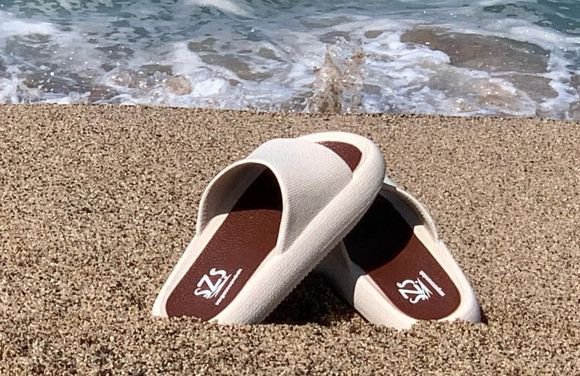
Playa del Carmen, Quintana Roo — A pilot project in Playa del Carmen is turning the region’s sargassum problem into a sustainable fashion solution, with plans to produce up to 100,000 pairs of eco-friendly sandals each month.
The initiative, led by the brand Sargasso Sandals, aims to combat the environmental crisis caused by massive seaweed arrivals while restoring coral reefs in the Mexican Caribbean. Founders Mario Alberto Robledo Garavito and María Alvarado have developed a circular economy model that transforms marine waste into footwear, already attracting interest from distributors.
“This was born from wanting to help with the sargassum problem. I’m a shoemaker from León, Guanajuato; I’ve always been in the footwear world, and it all started with a sole,” Robledo Garavito said. “From there we moved to sandals, and now we’ve developed more products with EVA, plastic, PET, and polypropylene, because practically everything can be combined with sargassum.”
The production process involves a partnership with Grupo Ensol. For every 5,000 kilograms of sargassum collected, 200 kilograms of pulp and powder are generated. The powder is incorporated into manufacturing formulas to create a ton of eco-friendly pellets, which yield between 700 and 1,300 pairs of shoes.
Currently, the sandals are sold in exclusive hotel boutiques, and a portion of the proceeds supports Oceanus A.C., a foundation dedicated to coral reef conservation.
More Environment
- Playa del Carmen Unveils Recycled-Plastic Lifeguard Tower at Playa 72
- Chankanaab Park Eyed as Site for Cozumel’s First Dolphin Sanctuary
- Tulum Launches Credentialing Program for Parque del Jaguar Tourism Workers
- Cancún to Host National Climate Change Colloquium in October
- Riviera Maya Hotels Offer Free Nights When Sargassum Blocks the Beach
More Playa del Carmen
- US Lawmakers Press Mexico to Resolve Vulcan Materials’ Calica Dispute
- Playa del Carmen Launches Survey Work to Legalize San Judas Tadeo Neighborhood
- Uxuxubi Seeks Spot in Mundo Sagrado Community Tourism Corridor
- Extortion Cases Hit Several Playa del Carmen Churches in 2026
- Gas Leak Near Playa del Carmen Elementary School Sickens 10 Students