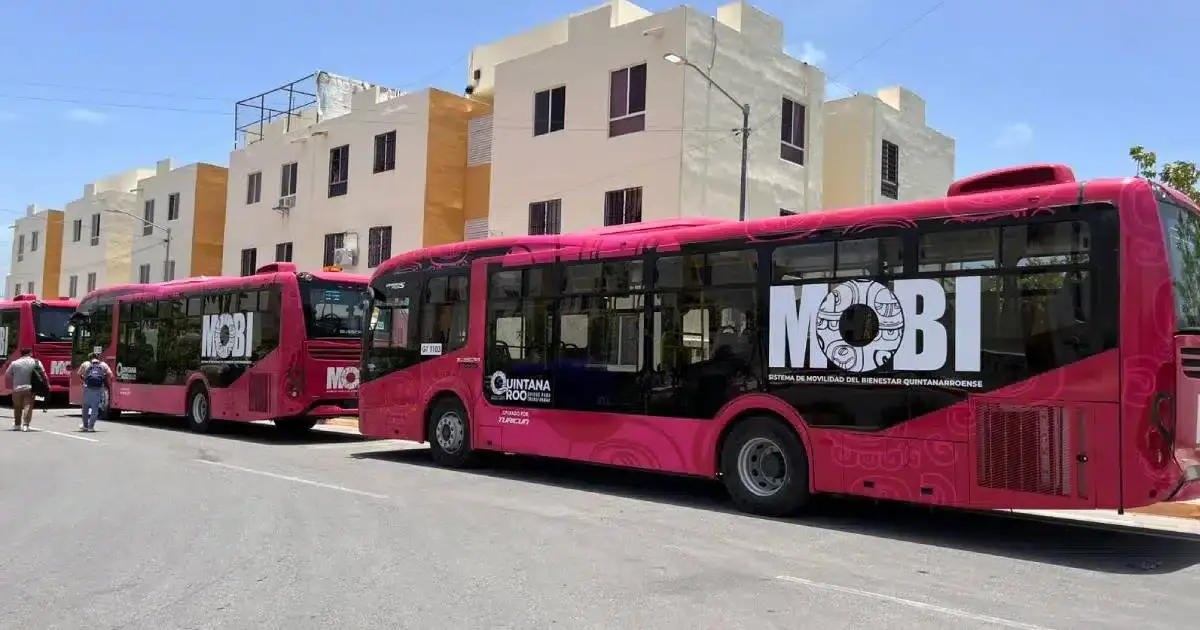
Playa del Carmen, Quintana Roo — Playa del Carmen is expected to join Quintana Roo’s new MOBI public transportation network in early 2027, bringing new routes, electronic payments, real-time bus information and reduced fares for qualifying residents.
Rafael Hernández Kotasek, director of the Quintana Roo Institute of Mobility, said a municipal mobility study has identified three routes considered priorities for the rapidly growing city. Operating them would require an estimated 70 to 80 vehicles.
The proposed corridors have not been published in full, but earlier planning documents pointed to Villas del Sol and communities in northern and northwestern Playa del Carmen, including La Guadalupana and El Petén. These are among the areas where population growth has outpaced the expansion of public transportation.
The routes are not yet final. Playa del Carmen’s government must review the technical proposal, and the necessary agreements will require municipal and state approval before service can begin.
That distinction is important for residents: MOBI is coming, but applications for Playa del Carmen fare cards have not opened, no local registration modules have been announced and final routes, stops, schedules and fares remain pending.
What MOBI would change for passengers
MOBI, short for Sistema de Movilidad del Bienestar Quintanarroense, is intended to replace disconnected routes and informal payment practices with a more organized public transportation network.
For Playa del Carmen residents, the most noticeable changes are expected to include newer vehicles, established stops, more predictable schedules and digital information about where buses are and when they will arrive.
The free MOBI app for Apple devices already advertises several functions:
- Maps and route planning
- Real-time vehicle locations
- Estimated arrival times
- Electronic balance checks and reloads
- Management of physical and virtual MOBI cards
- QR codes that can be scanned when boarding
An Android version has also been announced, although availability and functionality may depend on where MOBI service is operating.
For people who currently spend long periods waiting without knowing when a colectivo or bus will arrive, live tracking could be one of the system’s most practical improvements. More structured routes could also make it easier to travel between large residential areas, schools, workplaces, shopping centers and central Playa without relying on taxis or private vehicles.
State officials have previously estimated that the initial Playa del Carmen corridors could serve a substantial portion of the city’s daily journeys. That projection should be treated as a planning target, however, until the routes and service frequency are approved.
MOBI will not accept cash
MOBI is being developed as a fully digital system. Passengers will be able to pay using a reloadable MOBI card, the MOBI app or a compatible contactless bank card.
In Chetumal, where MOBI credentialing is already underway, cards can be reloaded through the app or at participating businesses including OXXO, SIX, Dunosusa and Super Willys. The same retailers have not yet been confirmed for Playa del Carmen.
The cashless system should make boarding faster and reduce arguments over change or inconsistent fares. It will also allow the government to record subsidized trips and reimburse operators for discounts provided to students, seniors and people with disabilities.
It may require some adjustment for passengers without bank cards or smartphones. The physical MOBI card is intended to provide an alternative, but Playa del Carmen distribution and reload locations have not been announced.
Who can receive a reduced fare?
MOBI includes a special credential for three groups:
- Students
- Adults 60 and older
- People with permanent disabilities
The card is different from a standard reloadable fare card because it identifies the passenger as eligible for a government-supported fare.
In Chetumal, people with permanent disabilities travel free, while students and seniors currently pay a preferential fare of 10 pesos. Those amounts apply to the Chetumal program and should not yet be assumed for Playa del Carmen. IMOVEQROO has not announced Playa’s regular or discounted fares.
Simply showing an INE, student card or INAPAM credential when boarding will not activate the discount. Eligible passengers must obtain the MOBI social-fare credential so the electronic reader can apply the correct fare.
How Playa del Carmen residents will apply
IMOVEQROO has not yet opened credentialing in Playa del Carmen. Residents therefore do not need to visit the city’s IMOVEQROO driver’s-license office or travel to Chetumal to apply.
Once local enrollment begins, the process is expected to resemble the one already operating in Chetumal. There, the MOBI card is free, issued the same day and available through permanent and temporary registration modules.
The requirements currently published by the Quintana Roo government are:
Students: current proof of enrollment, proof of address and an official ID or CURP, depending on the student’s age.
Older adults: official identification, proof of address and an INAPAM card.
People with disabilities: official identification, proof of address and documentation confirming a permanent disability.
Playa del Carmen’s exact requirements, module locations and opening dates will be announced closer to the launch. Credentialing is expected to remain open permanently, so eligible residents will not lose the benefit if they do not register on the first day.
Can foreign residents receive the discount?
The requirements published for the Chetumal program do not state that applicants must be Mexican citizens. They focus on age, student status, disability, identification and proof of residence.
That suggests foreign residents may be able to qualify if they meet the same eligibility requirements. A foreign resident over 60 with a valid INAPAM card, for example, may be eligible for the senior fare. A foreign student enrolled locally or a resident with documentation of a permanent disability may also qualify.
However, IMOVEQROO has not yet published Playa del Carmen-specific rules or confirmed which foreign identification documents its local modules will accept. Foreign residents should be prepared to present:
- A valid passport
- Temporary or permanent resident card
- CURP
- Recent proof of a Playa del Carmen address
- INAPAM card, school document or disability certification, as applicable
Foreign residents who do not qualify for a social fare will still be able to use MOBI by purchasing a standard card, paying through the app or using a supported contactless bank card.
What residents can do now
There is no Playa del Carmen application to complete yet. For now, residents can download the MOBI app, follow IMOVEQROO’s official communications and watch for the publication of routes, registration modules and fares.
Anyone planning to request a discounted credential can also begin gathering current documents, particularly proof of address, an INAPAM card, proof of enrollment or disability certification.
If the project proceeds on schedule, the first three routes should begin operating in early 2027. Until the municipal review is completed, however, the precise launch date and street-by-street routes remain proposals rather than confirmed service.
More Government
- INE Opens 2026-2027 Federal Electoral Process in Quintana Roo, Vows to Tackle Voter Apathy
- Mexico Edging Closer to New US Trade Deals, Ebrard Says
- Senate Gives Defense and Navy Vote on Reviewing Foreign Investment in Mexico
- Quintana Roo High School System Aims to Install Cameras at All 44 Campuses
- Biometric CURP in Quintana Roo: Where to Apply, What to Bring and Whether It’s Mandatory
More Playa del Carmen
- Playa Spice Returns With Six Weeks of Restaurant Offers in Playa del Carmen
- Maya Council and Xcaret Push Supreme Court to Drop Indigenous Symbols Case
- More Than 2,000 Workers Lose Jobs on Playa del Carmen’s Quinta Avenida in 2026
- Canadian Fugitive Wanted for Homicide Arrested in Playa del Carmen
- Playa del Carmen Unveils Recycled-Plastic Lifeguard Tower at Playa 72