
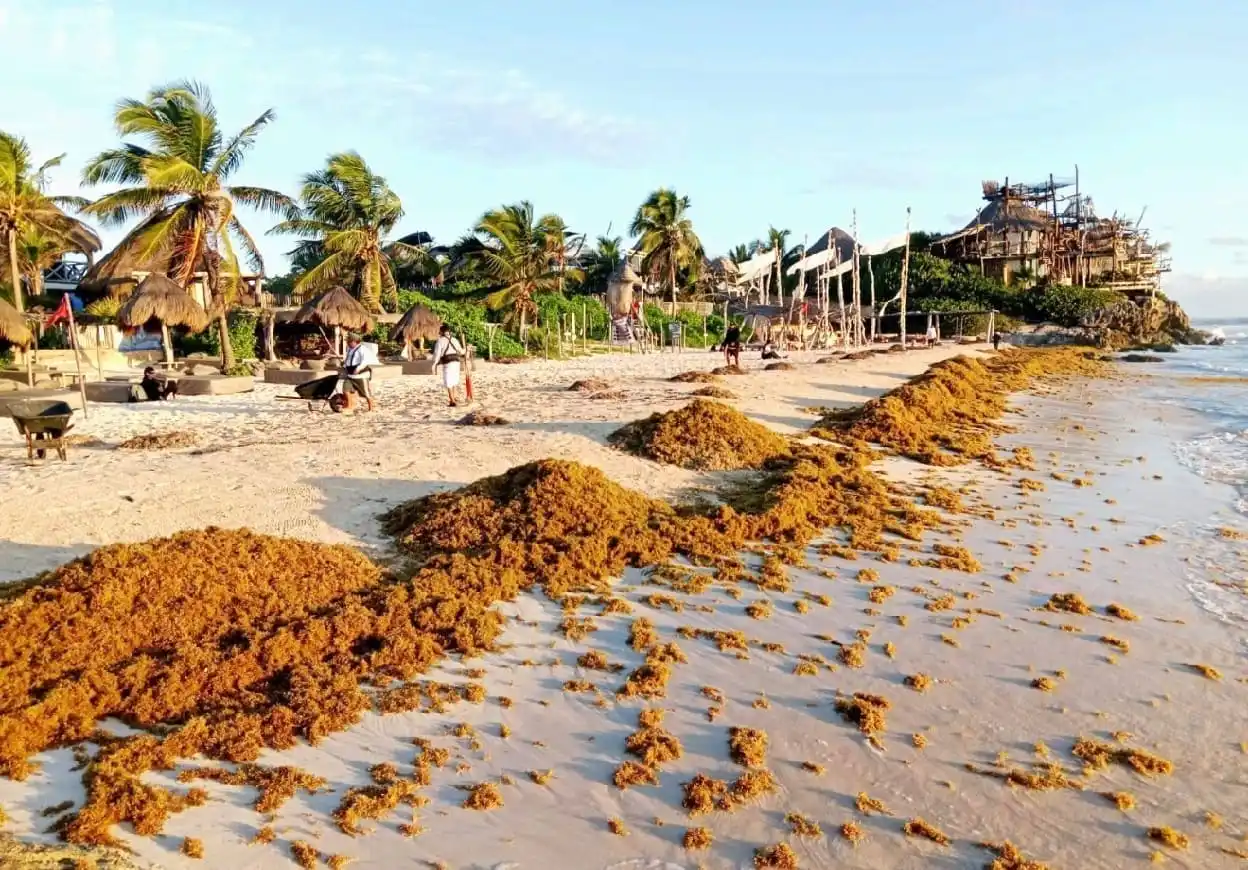
Sargassum is spoiling the romantic atmosphere of the Mexican Caribbean. According to local authorities and business organizations, beach weddings in Quintana Roo are experiencing an alarming decline.
Wedding Bookings and Civil Registry Data
Octavio de la Torre de Stéffano, president of the Confederation of National Chambers of Commerce, Services and Tourism (Concanaco Servytur), reported during a virtual press conference that at least 10,000 wedding reservations have been affected by the macroalgae. In a social media post after the conference, he wrote: “We have to stop seeing sargassum only as a seasonal problem and move towards permanent solutions that can even transform it into a productive opportunity.”
Between April and May 2023, the Tulum Civil Registry recorded 23 weddings per month; this year, a maximum of two have been performed. Clarisa Pat Maza, an official at the Civil Registry of Tulum, reported that this year, between April and May, a maximum of two weddings per month have been performed; in 2014, at least 80 were celebrated during those same dates, according to Reportur, a media outlet specializing in tourism.
Hotel Investments and Affected Municipalities
The high volume of sargassum has led the hotel sector in Quintana Roo to invest between $20 million and $30 million annually, approximately 500 million pesos, to contain the macroalgae and prevent sand loss during cleanup, according to Forbes. The investment by the Mexican Caribbean Hotel Council includes machinery, boats, barriers, specialized divers, and research to address its massive influx.
According to figures from the State Secretariat of Ecology and Environment, Playa del Carmen is the most affected municipality, with nearly 43,000 tons, followed by Benito Juárez, in Cancún, with just over 30,000 tons.
De Stéffano stated during the conference that one of the efforts should focus on maintaining the appeal of the beach and coastal area, as well as reducing the impact on tourism. He added that the Ministries of Finance and Environment, along with local governments, will seek to establish a dialogue with the hotel sector so that the burden “doesn't fall on the businesses that have lost customers.”
Record Arrivals and Government Response
Rosa Elisa Rodríguez Martínez, a member of the Academic Unit of Reef Systems of the Institute of Marine Sciences and Limnology (ICML) of the National Autonomous University of Mexico (UNAM), told the UNAM Gazette at the end of July 2026 that the arrival of sargassum reached record levels in the Mexican Caribbean.
Alicia Bárcena Ibarra, Secretary of Environment and Natural Resources (Semarnat), reported that 9,054 tons of sargassum have arrived daily in Quintana Roo, “four times more than in 2025 and 27 times higher than the historical average,” she said during a morning press conference of President Claudia Sheinbaum, at the end of July.
In June 2025, Bárcena announced the construction of a sargassum treatment plant to collect, treat, and generate biogas: the Comprehensive Center for Circular Economy (CISEC). The estimated investment for the project is around 2 billion pesos, more than $116 million, and it is expected to be completed by the end of 2026.
What Is Sargassum?
The United States Environmental Protection Agency (EPA) defines sargassum as a group of brown algae belonging to the genus Sargassum, which is widely distributed throughout tropical and temperate oceans, in shallow waters and coral reefs, as well as in the open ocean. Some species remain on the seabed. These algae serve as food, shelter, and breeding grounds for various animal species, such as turtles and squid. One of its main characteristics is the nauseating odor it emits.
More Business
- Cancún Airport Logs Just 286 Flights in a Day, Its Lowest Level in Two Decades
- Carnival Cuts Cruise Calls at Mahahual After 25 Years as Royal Caribbean Expands
- Heat Wave and Yucatan Blackout Nearly Double Mexico’s Wholesale Power Prices
- Mexico Weighs 140% Rail Fee Hike, Raising Fears of Costlier Freight
- Quintana Roo Business Group Seeks Public Dashboard for Sargassum Spending
More Quintana Roo
- Cancún Mayor Ana Paty Peralta Says She Will Finish Her Term and Skip ‘Gino’ Segura’s Campaign
- Tren Maya Finds Reshape Understanding of the Maya ‘Collapse’
- Quintana Roo Enacts ‘Ley Nicole’ Banning Cosmetic Surgery on Minors
- Drought Crisis Forces Quintana Roo Wildlife to Seek Water Near Roads and Towns
- Quintana Roo to Add 10,000 Hotel Rooms by 2028