
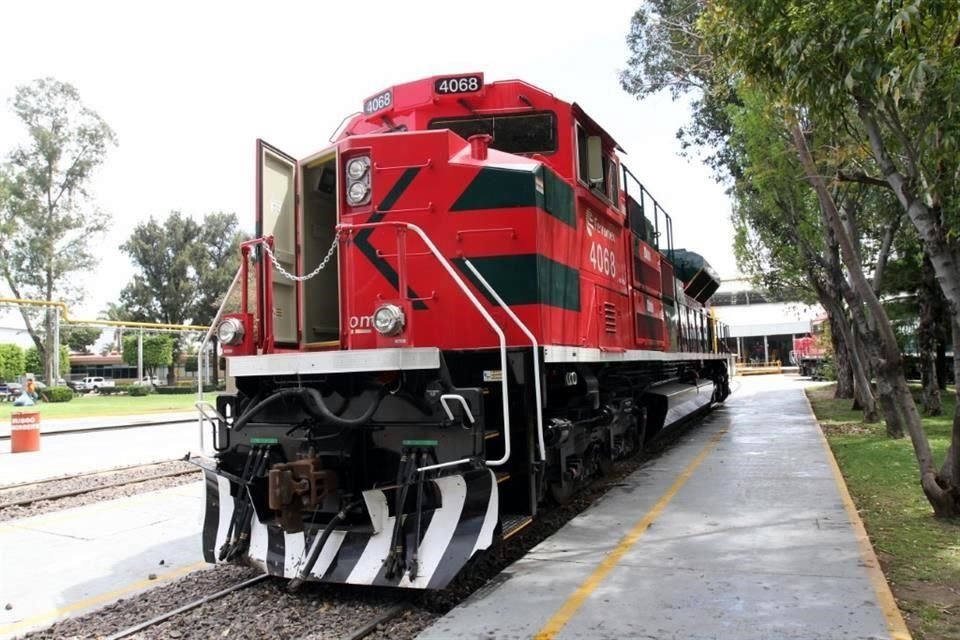
Mexico City — Mexico’s federal government wants to more than double the fee it charges railway companies for using the country’s tracks, a measure analysts warn could feed through to freight rates and the prices of goods carried by rail.
The proposal, included in President Claudia Sheinbaum’s 2027 economic package, would raise the duty on gross revenues of rail concessionaires that have operated for more than 15 years from 1.25 percent to 3.0 percent — an increase of 140 percent.
Carlos Barreda, a specialist in the rail sector, said the higher levy could ripple across the supply chain, stoke inflation and weaken rail’s competitiveness against trucking.
“There is a risk that this increase gets passed on to the end user as service rates are updated, and with that, to the prices of the goods moved by rail, which carry an implicit transport cost component,” he said.
Barreda said the companies most affected would be Ferromex and Canadian Pacific Kansas City (CPKC), Mexico’s two large private freight concessionaires, because the increase would apply starting in the 16th year of a concession title.
That means the adjustment would not apply to concessions younger than 15 years or to new ones, which would keep a rate of 0.5 percent. As a result, none of the current administration’s flagship rail projects — the Maya Train, the Interoceanic Corridor, the Mexico-Toluca “Insurgente” line or the train to the Felipe Ángeles International Airport — would be affected.
The scale of the impact is visible in Ferromex’s finances. In 2025, the company reported net revenues of 48.04 billion pesos and a net profit of 7.25 billion pesos.
Had the new rate applied to last year’s revenues, it would have added roughly 841 million pesos in annual costs — equivalent to 11.6 percent of net profit — before accounting for the tax effect of deducting the duty.
The company paid 521 million pesos under the duty in 2023, 576 million in 2024 and 626 million in 2025. Under the new rate, its payment could exceed 1.5 billion pesos a year, depending on revenues and the final shape of the reform.
Barreda cautioned that it is not yet possible to say by how much rail service rates would rise, since they are adjusted annually and the government authorizes the increases.
Óscar Cortés, a founding partner at the consulting firm Alttrac, also said that despite the change in the tax burden on concessionaires, it is too early to pin down the direct financial impact on the industry.
“We will have to review the fine print in the Law of Rights initiative, the transitional provisions and the statement of reasons,” he said.
More Economy
- Mexico’s Island Municipalities Push for Tax Relief to Boost Investment and Jobs
- Illegal Fishing Undercuts Lobster Prices for Tulum Cooperatives
- Quintana Roo Governor Announces Start of CFE Submarine Cable Works in Cozumel
- Cozumel Businesses Seek Clear Customs Rules, Question 35.8% Non-Resident Fee Hike
- Mexico City, Cancún and Puerto Vallarta Top Searches for Independence Day Weekend