
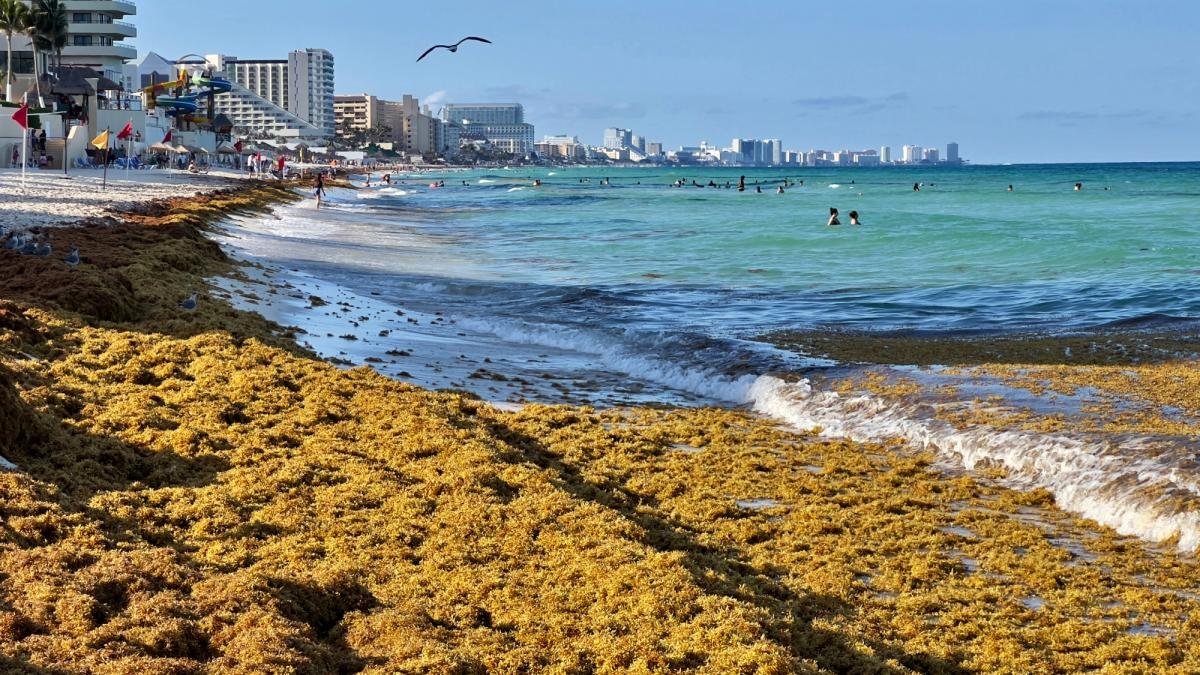
Cancún, Quintana Roo — Sargassum could cost Quintana Roo’s tourism industry nearly $11.5 billion a year, driven mainly by cancellations, rescheduled bookings and damage to the image of Mexican Caribbean destinations, according to estimates from the Inter-American Development Bank (IDB).
Enrique Lendo, Mexico coordinator for projects at the United Nations Environment Programme (UNEP), presented the figure during the fourth European Union-Caribbean Global Gateway Conference on sargassum, held in Cancún. Lendo said the seaweed also affects how hotels are recommended to travelers and how guests perceive the quality of resorts.
Beach cleanup costs add to those losses. Removing the seaweed from the hotel zone alone runs about $150 million a year, the conference heard. Combined, the economic effects tied to sargassum amount to roughly 17% of Quintana Roo’s gross domestic product.
Containment at Sea
One of the main strategies is to stop as much biomass as possible from reaching the coast. Mexico’s government has pushed measures through the Mexican Navy, including containment barriers and sargassum-collection vessels that gather the seaweed offshore.
The next challenge is deciding what to do with the huge volumes recovered. Lendo said there are two main options: dispose of the sargassum at suitable sites or process it into products. The second option includes fertilizers, biogas and other derivatives, though handling the material requires precautions because of the presence of arsenic and heavy metals.
The problem, he said, is that several available solutions have not yet proven profitable at commercial scale. Some fertilizer and energy projects still depend on subsidies from international organizations and governments. Turning them into financially viable businesses would require blended finance, risk reduction and mechanisms such as carbon credits.
Although regional cooperation already exists through the Cartagena Convention and an action plan covering 25 Greater Caribbean countries, Lendo said a continuous mechanism is needed to turn anti-sargassum projects into technically and economically sustainable solutions.
More Economy
- Mexico Extends Deadline for Electronic Customs Value Declaration to October 31
- Nacional Monte de Piedad to Reopen Chetumal Branches on October 7
- Quintana Roo Remains Far from Electronic Voting, INE Official Says
- Quintana Roo Development Agency Inherits Labor Disputes from Defunct Derimaya
- Rains and Port Restrictions Cut Cancún Nautical Tourism to 60%
More Cancun
- Boxer Marilyn Badillo Brings Message of Hope to Cancún Prison
- Cancún Raids Rescue Two Human Trafficking Victims, Seize Drugs
- Taco Social Run to Bring Recreation, Live Music and Street Tacos to Cancún’s Avenida Yaxchilán
- Cancún Sets October Dates for Free Dog and Cat Sterilization Clinics
- Quintana Roo Governor Urges Youth to Help Draft New Rights Law