
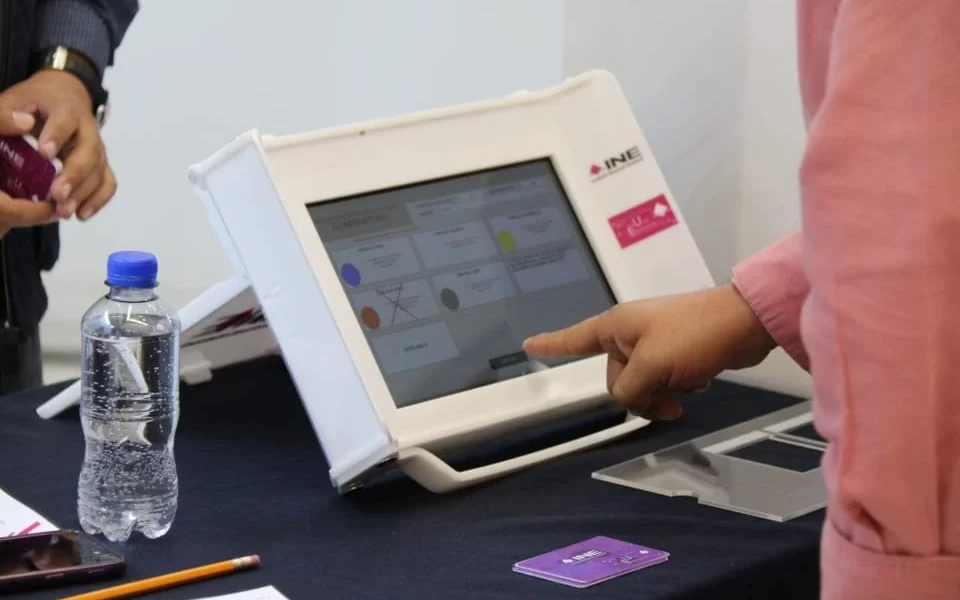
Chetumal, Quintana Roo — Quintana Roo remains far from adopting electronic voting across the state, even though the system has sharply cut polling-station costs in trials run by Mexico’s National Electoral Institute (INE), a senior official with the agency said.
Francisco Croce, executive director of the INE’s 02 District Board in Quintana Roo, said that while electronic voting has been used experimentally in elections elsewhere in Mexico, the state has no defined roadmap for broadly replacing paper ballots with electronic mechanisms.
Costs Fall Sharply in Trials
According to INE evaluations, the average cost of a polling station equipped with an electronic ballot box fell from 142,752 pesos in 2020 to 35,791 pesos in 2023, a reduction of nearly 75 percent over that period.
The INE has said electronic ballot boxes simplify vote scrutiny and counting and reduce the time needed to set up and close polling stations.
Obstacles to a Wider Rollout
The transition is not simple. Acquiring the equipment, storing, maintaining and transporting it, configuring the devices, training staff and auditing the systems are all factors that must be weighed before any large-scale rollout.
Views differ within the INE itself over the true cost of the model. In a recent discussion of the institute’s electronic-voting strategy, officials noted that upfront expenses and the required infrastructure could pose a significant challenge, while others pointed to the savings recorded in the trials.
A Gradual Strategy Through 2036
The INE is currently pursuing a gradual strategy for expanding electronic voting between 2026 and 2036. The plan envisions electronic systems coexisting with paper ballots rather than immediately replacing the traditional model.
The INE’s electronic ballot box includes a thermal printer that produces a paper receipt, allowing each voter to verify their selection.
Voters Respond Favorably
Trials have also recorded positive reactions from those who used the devices. In the 2023 evaluation, more than 70 percent of those surveyed said voting with an electronic ballot box was easy or very easy, and 83.7 percent of voters said they would like to use the system in future elections.
Even so, Quintana Roo would first have to define the operational, technological and budgetary framework needed to incorporate electronic voting into its elections.
More Government
- Cancún Sets October Dates for Free Dog and Cat Sterilization Clinics
- Quintana Roo Governor Urges Youth to Help Draft New Rights Law
- Experts Highlight Social Memory as Key to Disaster Prevention in Quintana Roo
- Quintana Roo Development Agency Inherits Labor Disputes from Defunct Derimaya
- New Power Outage Leaves Several Playa del Carmen Neighborhoods Without Electricity
More Quintana Roo
- Sargassum Influx Triggers Two Types of Wildlife Die-Offs in Quintana Roo
- Quintana Roo to Launch World’s First Formal Sargassum Fishery With 840 Fishermen
- INE Opens 2026-2027 Federal Electoral Process in Quintana Roo, Vows to Tackle Voter Apathy
- Quintana Roo High School System Aims to Install Cameras at All 44 Campuses
- Biometric CURP in Quintana Roo: Where to Apply, What to Bring and Whether It’s Mandatory