
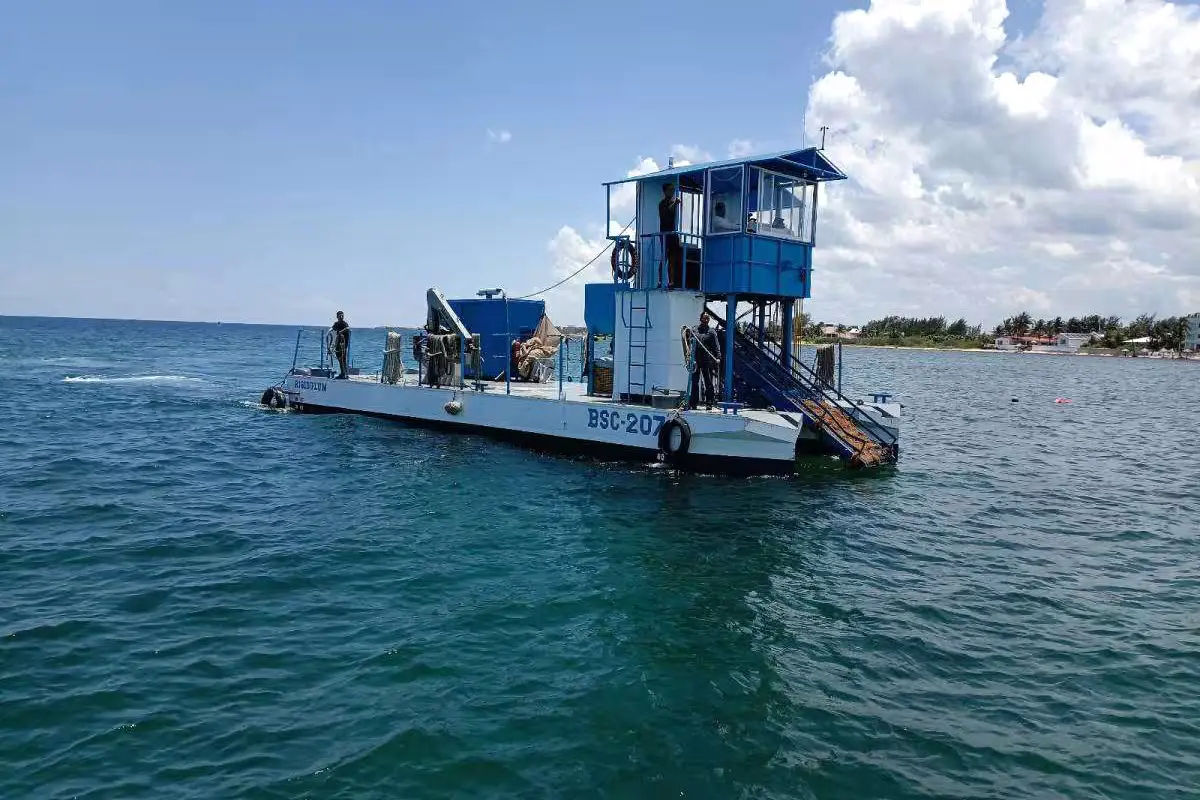
Cancún, Quintana Roo — The Mexican Navy is preparing a new strategy against sargassum for 2027 that will add 17 vessels and expand the use of mobile barriers able to drift with floating seaweed in open water, a senior officer said.
Rear Admiral Topiltzin Tlacaelel Flores Jaramillo, coordinator of the Navy’s sargassum response strategy in the Mexican Caribbean, said the dynamic barriers are already operating off Tulum and Playa del Carmen and have been in use for nearly a month.
“We already have them in operation. We have been working with them in Tulum and Playa del Carmen since the president authorized this resource,” Flores Jaramillo said.
Unlike the fixed structures anchored off the beach, the new devices are deployed from vessels and move along with the sargassum patch, steering it toward points where collection boats can gather it more efficiently.
Shift to Open-Water Collection
With the change, the Navy’s Comprehensive Sargassum Response Strategy is entering a new phase at sea. The central aim is to reverse the trend so that most of the seaweed is collected in open water rather than on the beach, Flores Jaramillo said.
To achieve that, the Navy is pursuing two tracks: expanding collection capacity and strengthening containment in areas where wind, currents and waves had previously made operations impossible.
The official acknowledged that Tulum, Cancún and Mahahual remain the most difficult locations for deploying the devices. Those are precisely the areas where the most sargassum washes ashore in Quintana Roo and where marine conditions make a fixed system hard to sustain. Authorities are now inviting companies capable of designing structures that can operate in extreme conditions.
17 New Vessels
The second part of the plan is fleet growth. In 2027 the strategy will add 17 vessels — four oceanic, six semi-oceanic and seven coastal — along with smaller boats for shallow water. The additions include both new purchases and replacements for existing units.
The Navy developed the model together with the fishing sector, combining operational experience and design. The goal is to stop collection boats from sailing in circles searching for the patch about half a mile off the coast.
The mobile device concentrates the sargassum and delivers it 500 meters from the pier, ready to be removed. Two dynamic barrier teams are currently operating, and the plan calls for extending the system across the Navy’s three operation zones in Quintana Roo — north, center and south — with two groups of structures per region. The rollout includes pilot tests and constant adjustments based on weather conditions.
With the expansion, open-water collection capacity, currently around 270 tons a day, will rise to 1,860 tons during the first stage, which involves an investment of 768 million pesos. The projection is to reach 3,000 tons a day once the full budget of more than 2 billion pesos announced by the federal government is spent.
Flores Jaramillo said the personnel assigned to operate the new vessels and devices will be defined as the equipment arrives, though for now the Navy will cover the work with the human resources it already has.
Asked about forecasts of a larger mass of floating sargassum in the Atlantic, the coordinator said he would not describe it as a severe scenario but rather as growth that has been expected for two years and is now being identified more precisely through monitoring. The strategy, he said, is designed to anticipate that increase and keep the sargassum off the coast.
More Environment
- Hurricane Season 2026: What Quintana Roo Faces Before It Ends Nov. 30
- New MARAP App Opens Anonymous Environmental Reporting in Playa del Carmen
- Judge Halts Trump Border Barrier in Big Bend National Park
- US Coast Guard Seizes Cargo Ship Accused of Smuggling Fuel to Cuba
- Playa del Carmen to Renew Eight Blue Flag Beach Certifications, Eyes Two More
More Quintana Roo
- Heavy Rains Flood Streets and Homes Across Quintana Roo, Cutting Power and Commerce
- INE Launches 2027 Elections in Quintana Roo Without Candidate Background Checks
- Quintana Roo Education and Training Chiefs Resign to Seek Morena’s Chetumal Nod
- Quintana Roo Remains Far from Electronic Voting, INE Official Says
- Sargassum Influx Triggers Two Types of Wildlife Die-Offs in Quintana Roo