
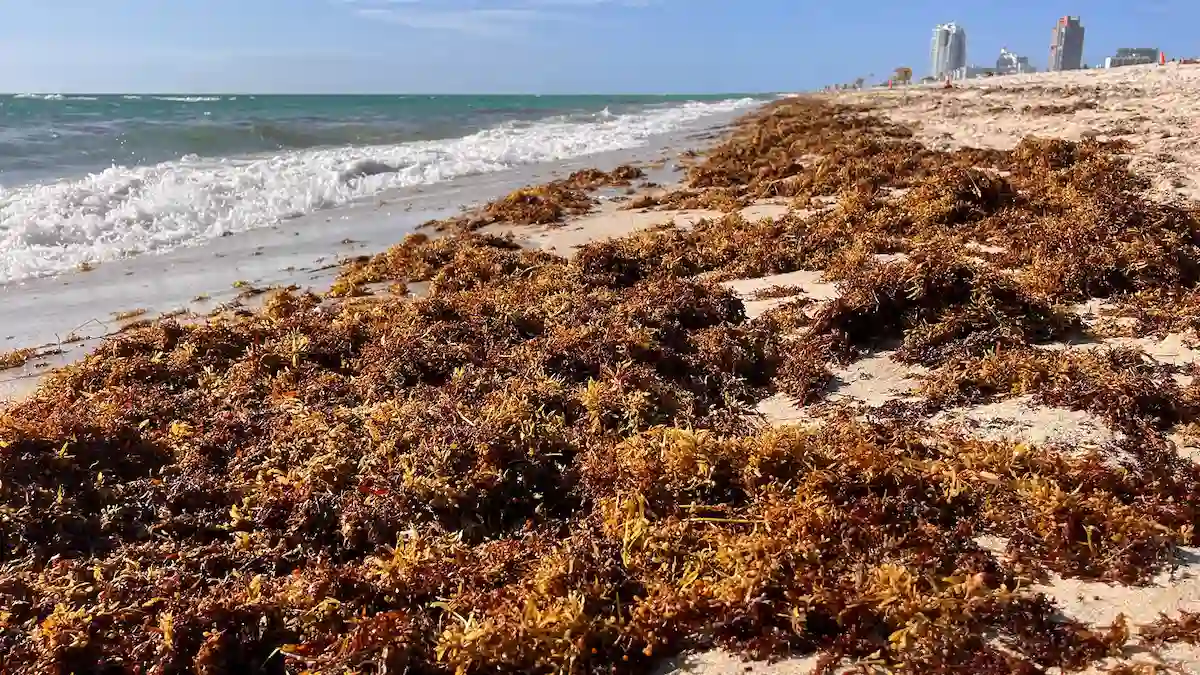
Chetumal, Quintana Roo — Quintana Roo has collected more than 121,000 metric tons of sargassum in 2026, according to the state’s Secretariat of Ecology and Environment (SEMA), as crews continue battling the seaweed before it piles up on Caribbean beaches.
Through Aug. 31, cleanup operations had removed 121,110.31 tons of sargassum across the state’s eight coastal municipalities. The effort relies on 37 vessels, 37 pieces of machinery and 400 personnel, including Mexican Navy members and state brigades.
Playa del Carmen has seen the most seaweed collected, with 41,306.65 tons, or 34.1% of the statewide total. Benito Juárez, the municipality that includes Cancún, is second with 29,050.51 tons — 24% of the total.
Rounding out the other municipalities:
- Puerto Morelos: 16,459.76 tons
- Tulum: 15,563.02 tons
- Othón P. Blanco: 13,576.22 tons
- Isla Mujeres: 3,771.30 tons
- Cozumel: 1,343.60 tons
- Lázaro Cárdenas: 39.25 tons
On the final day included in the report, crews removed 1,857.79 tons. Puerto Morelos had the largest daily haul at 827.87 tons, followed by Benito Juárez at 494.04 tons and Tulum at 248.17 tons.
The maritime fleet is made up of 37 vessels: one transoceanic vessel, 11 coastal sargassum collection vessels, 22 smaller boats and three AquaMarine shallow-water sargassum skimmers. Land operations use 37 machines, including dump trucks, backhoes, sweepers, ATVs with trailers and skid steer loaders.
There are 350 Mexican Navy personnel working on the beaches, supported by 50 members of state brigades, mainly deployed in Tulum.
Authorities are also installing containment barriers offshore. Through Aug. 31, 12,855 meters of barriers had been placed, out of 16,030 meters planned for the year.
The 2026 sargassum season continues to strain the coastline, especially in Playa del Carmen, Benito Juárez, Puerto Morelos and Tulum, which account for the bulk of the material collected.
More Environment
- Cancún Sends 30 Brigades to Clear Flooded Streets
- Leaks Flood Cancún Airport Terminal 2 as Heavy Rain Soaks Check-In Area
- Flamingos Banded in Yucatan Peninsula Travel as Far as Venezuela, Tracking Shows
- Cutaneous Leishmaniasis Cases Jump 387% in Mexico’s Yucatan Peninsula
- Sheinbaum Reviews Sargassum Monitoring in Cancún as Quintana Roo Shifts to Early Intervention
More Quintana Roo
- No GPS, No Renewal: Quintana Roo Taxi Rule Explained
- Quintana Roo Opens Supervised Family Visitation Center in Chetumal
- Quintana Roo Youth Institute Seeks 13 Million Peso Budget Boost for Scholarships
- 35% of Quintana Roo Tourism Businesses Plan Loans to Cover Year-End Costs
- Chetumal Business Chamber Urges Employers to Update Contracts Ahead of New Workweek