
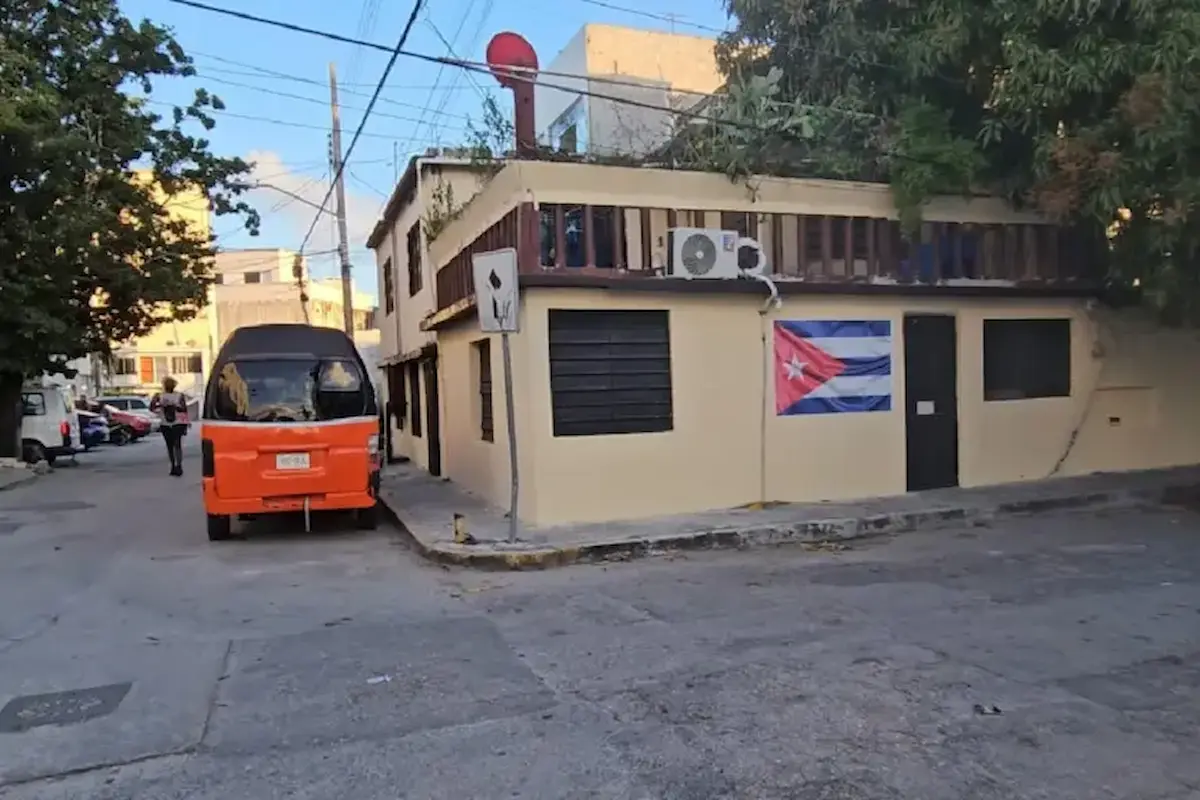
CANCÚN, Quintana Roo — The complaint of Elizabeth Ponte Zaldívar, a young woman of Cuban origin who recently obtained Mexican nationality, once again brings attention to discrimination against members of that community in Cancún, a problem that, according to her testimony, has also occurred in a public office. The accusation follows reports of job exclusion and rejection of Cuban families, and it rejects the idea that an entire community should pay for the actions of a few or that neighborhood conflicts and individual responsibilities justify discrimination based on nationality.
The content creator claimed that an employee of the Ministry of Foreign Affairs (SRE) changed her treatment upon learning of her country of birth and directed derogatory comments at her when she went to apply for her first Mexican passport.
Her story, shared through a video on Instagram and TikTok, adds to reports from civil organizations about difficulties in finding employment, renting housing, and carrying out daily activities simply because a person is Cuban.
“Another Cuban woman,” the comment that denounces
According to Ponte Zaldívar, the service was proceeding normally until the worker checked her documents and asked her where she was from.
“The lady treated me very normally until she asked me where I was from and saw from my papers that I was Cuban,” she recounted.
According to her account, the employee made a contemptuous expression, told her she was “just another Cuban” and maintained that Cubans were “invading this country.”
The young woman stated that the comments continued while the paperwork was being processed. The employee allegedly claimed that it used to be more difficult to obtain Mexican citizenship and that now it was being “given away.”
Ponte Zaldívar rejected that claim and maintained that her naturalization was the result of a legal procedure in which she fulfilled the corresponding requirements.
“I came to this country legally and I am a Mexican citizen because I met the requirements that this country asks of me and also because I worked hard to obtain it,” she said.
The complainant stated that she has been living in Mexico for more than three years and had never experienced such treatment. She clarified that the incident does not diminish her affection for the country and asked that people stop generalizing about others based on their nationality.
From a particular conflict to rejection against an entire community
The most visible precedent of these tensions occurred in May in Superblock 23, where a confrontation between a Cuban citizen and a Mexican citizen resulted in a gathering in front of a house and material damage.
After that episode, Marilyn Torres Leal, president of the migrant assistance organization CISVAC, denounced that the rejection was affecting people unrelated to the conflict.
The activist reported job refusals, difficulties renting housing, and insults in public; she also noted the existence of job postings that expressly excluded Cubans.
The problem thus goes beyond those who participate in an argument or are investigated for criminal conduct; it reaches families, workers, and residents who end up being singled out for sharing the same birthplace.
In June, the Secretary of Government of Quintana Roo, Cristina Torres Gómez, reported on meetings between authorities and residents to address the conflicts.
These meetings involved state and federal agencies, including the National Migration Institute, with the purpose of preventing differences from leading to confrontations and rejection of foreign communities.
The obligation of the authorities
Addressing neighborhood conflicts, investigating crimes, and enforcing immigration regulations are the responsibility of the institutions; each procedure must establish individual responsibilities without making national origin a presumption of guilt.
Article 1 of the Constitution prohibits discrimination based on ethnic or national origin and obligates authorities to promote, respect, protect, and guarantee human rights. Article 30, for its part, recognizes that Mexican nationality is acquired by birth or naturalization.
In the case of Ponte Zaldívar, her account places the alleged grievance in an office in charge of handling a Mexican documentation procedure, after, she claims, the State itself recognized her nationality.
The complaint circulated on social media does not, by itself, establish administrative responsibility on the part of the accused employee; however, it does raise specific facts that can be investigated, such as the treatment received, the comments attributed to the employee, and the circumstances in which the service occurred.
Cancún, between migration and the networks that take advantage of it
The Cuban presence in the Mexican Caribbean is part of a broader migration pattern involving diverse routes and legal statuses. There are records of maritime arrivals in Quintana Roo, as well as cases of individuals deported from the United States who subsequently settled in Cancún. These journeys should not be confused with those of people who already have legal residency or Mexican citizenship.
Human Rights Watch documented that between January 2025 and March 2026, the United States deported nearly 13,000 third-country nationals to Mexico, including more than 4,000 Cubans. Its report warns of the vulnerability of these individuals due to their lack of documentation, means of subsistence, and protection from crime.
There are also legal precedents of networks that profit from the transfers; a February 2026 ruling by the United States Court of Appeals for the Eleventh Circuit describes an organization that used stolen boats to transport migrants from Cuba to Mexico and extorted their relatives.
The file also includes evidence about vehicles used to bribe Mexican agents and facilitate the group’s operations; this is a specific case that shows the importance of investigating both criminal networks and the public officials who collaborate with them.
Combating these structures requires surveillance, investigation and sanctions; rejection of a nationality does not replace any of these tasks.
A community is not defined by its conflicts
The scale of Cuban migration can also be observed in the United States. According to an analysis by the Pew Research Center using 2024 data, approximately 1.2 million people of Cuban origin live in the Miami metropolitan area, equivalent to 42 percent of that population in the country. The figure includes both immigrants and people born in U.S. territory.
In Cancún, the discussion about coexistence, security, and immigration regulation requires distinguishing between those who commit crimes, those who are victims of criminal networks, and those who work or carry out procedures in accordance with the law.
Ponte Zaldívar closed her message with that request, that the behavior of some people not be used to disqualify all.
“Respect has no nationality,” she said. “I am proud to be Cuban, and now I am proud to be Cuban-Mexican.”
More Cancun
- Cancún Sends 30 Brigades to Clear Flooded Streets
- Leaks Flood Cancún Airport Terminal 2 as Heavy Rain Soaks Check-In Area
- Cancún to Host Charity Walk Supporting Women With Breast Cancer
- Sheinbaum Reviews Sargassum Monitoring in Cancún as Quintana Roo Shifts to Early Intervention
- Heavy Rain in Cancún Diverts Two Flights to Mérida Airport
