
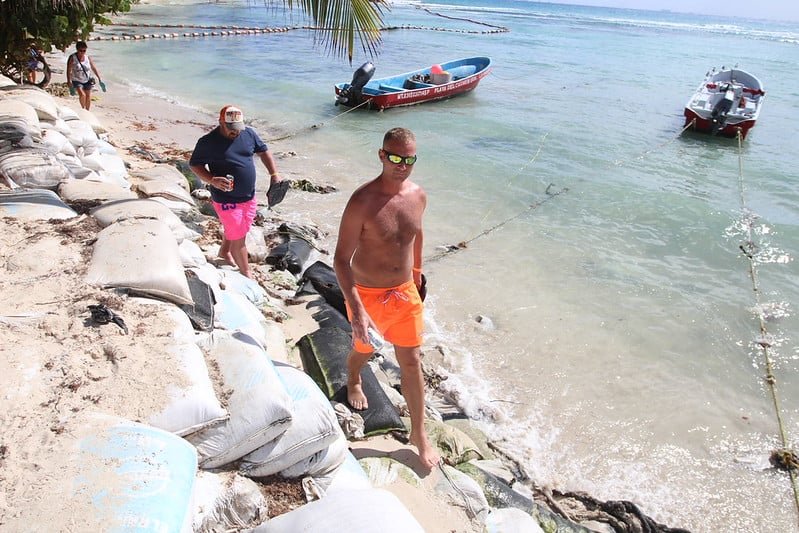
Coastal erosion in Quintana Roo has caused losses of up to 14 meters of beach per year in different areas, according to the Ministry of the Environment (Sema), which said it is continuing containment projects not only in the northern part of the state but also in Chetumal. The efforts combine emergency actions with an ecological ordinance of the territory.
Óscar Rébora, secretary of the agency, said: "We know that beach erosion is an issue not only in the south of the state, but throughout the Yucatán Peninsula, and this phenomenon is becoming increasingly common due to various factors. In some areas of the state, we have seen erosion of up to 14 meters of beach in a single year."
In response to this and to contain the advance of the sea, specifically in the capital of Quintana Roo, an Environmental Impact Statement (EIS) has already been requested for emergency and an investment of 1.5 million pesos.
In the north, Rébora noted, there is authorization to restore 33.5 kilometers of beach in four municipalities, with November 19 set as the deadline to deliver the conditional reports requested by the Federation.
Alongside coastal restoration efforts, the head of the Ministry of Environment (SEMA) announced that environmental management faces the challenge of urban development. Although federal policy seeks to restrict construction in areas such as Sian Ka'an and Tulum, the state authority warned that the lack of permits does not stop illegal construction, citing the case of Holbox, where no projects have been authorized in nine years, yet construction continues.
Therefore, he said, Local Ecological Zoning Programs (POEL) are being promoted to regulate land use with a vision for the future, defining the vocation of each municipality and allowing a formal response to development requests.
"That is why ecological planning and POELs are being done, precisely to have a roadmap for planning with a vision for the future, and also to understand the vocation of the territory," he added.
Finally, he confirmed that the National Association of Environmental Authorities has already presented the importance of considering the vision of state governments, who directly know the territorial vocation and conservation needs in their regions.
More Environment
- Rabies Found in Fox That Scratched Baby in Cancún
- Cozumel’s Reefs Get a 3D Map Divers Can Explore Before Entering the Water
- Documentary Exposes 30 Years of Pollution in Cancún’s Chacmuchuch Lagoon
- Crocodile Surprises Tourists Swimming at Cozumel’s El Cielo Sandbar
- Playa del Carmen Calls Volunteers to Clean More Than 7 Kilometers of Beach
More Playa del Carmen
- LIPU Bus Rear-Ends Van, Flipping It Off Highway 307 Near Playa del Carmen
- Woman Shot Dead on Motorcycle With Her Daughters in Playa del Carmen
- At Least Four Women Shot Dead Across Quintana Roo Over the Weekend
- Xcaret Says It Will Abide by Any Supreme Court Ruling on Use of Maya Culture
- Morena Launches 11 Municipal Races in Quintana Roo: Who’s In?