Cancún, Quintana Roo — A new documentary premiered in Cancún last Friday, accusing authorities of three decades of neglect and environmental damage at the Chacmuchuch lagoon system and chronicling the women who have fought to protect it.
“Chacmuchuch, sufre y calla” (“Chacmuchuch, It Suffers and Stays Silent”) is the second of three films produced with support from Blue Religion, Semillas Fuertes and the Silvicultores Association led by the three women known locally as “Las Claudias”: Claudia Canul, her daughter Claudia Hernández and Valeria Carrillo, Canul’s granddaughter. The screening took place at the Teatro 8 de Octubre.
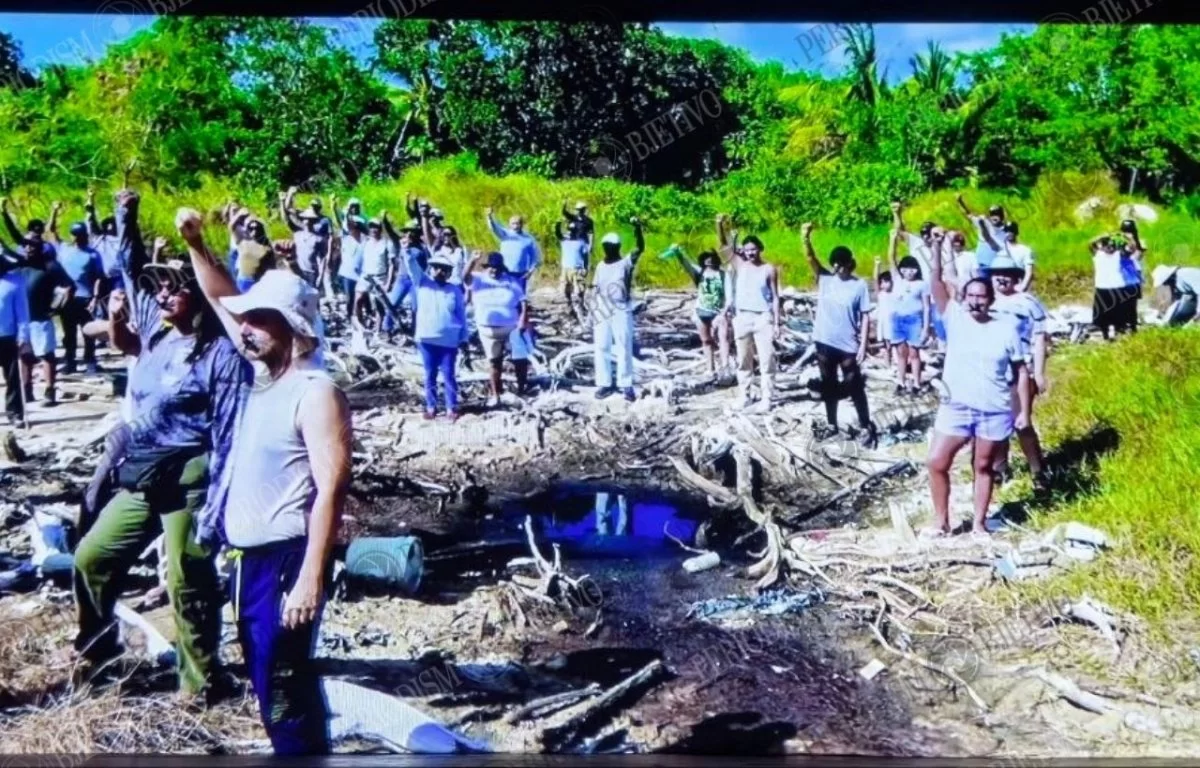
Directed by activist Bernardo Hautenne with videographer Alexis Alvarado, the film treats the camera as a “witness to the truth,” documenting both the area’s beauty and the women’s determination to find solutions for the pollution that runs off from pools of toxic liquid produced by decomposing waste at the former “Sufre y Calla” landfill.
What Is Chacmuchuch?
The 1,914.25-hectare Chacmuchuch Lagoon System, shared by the municipalities of Isla Mujeres and Benito Juárez, was decreed a state Natural Protected Area on Aug. 9, 1999, as an ecological conservation zone and a state refuge for flora and fauna.
It borders the Isla Contoy National Park, Costa Mujeres and Rancho Viejo, and forms part of the Mexican Caribbean Biosphere Reserve, decreed in 2016. Its lagoon is one of the largest bodies of water in northern Quintana Roo and a key breeding, nursery and refuge area for fish, mollusks and crustaceans of ecological and commercial importance.
For more than 20 years, the lagoon has absorbed every kind of environmental impact, above all water contamination from the old landfill on the plot known as “Sufre y Calla,” which received solid waste from 1994 to 2005 without adequate management. The mishandling caused leachate — toxic liquid from decomposing garbage — to spill into the soil, subsoil and aquifer, damaging the lagoon itself, according to the documentary.
The film also documents the loss of blue crab populations through poaching, the felling of mangroves and jungle, and pollution from open-air dumps run by private companies.
This second installment — which follows the first, released July 24, 2024 — addresses authorities’ omissions and the exclusion of community representatives living in the area. It records the opacity and lack of transparency with which governments have handled a problem that includes high-risk illegal activity, as well as irregularities in their actions.
The Women Who Stayed
Claudia Canul arrived in the area in the 1980s with her family. Her father, Lorenzo Canul Palomo, was looking for a place to settle at a time when Cancún was growing and families were arriving to claim land and build homes.
The transformation began when work on the landfill started. Canul recalls that her father saw machinery cutting a path through the dwarf mangrove, and that they later learned roughly 15 hectares next to their property had been designated for waste disposal.
“How was it possible that they had set aside that place for a dump when we knew that a few meters away was a lagoon that was home to so much biodiversity?” she says in the film.
Over time, the family noticed changes in the groundwater and the land. Canul says the plants they watered stopped surviving and that the water they bathed in caused physical irritation.
“We bathed with the water, it made our skin itch, it reddened our eyes, it burned. It caused infections,” she explains.
In 2005 the dump was abandoned and an emergency cell was built elsewhere. The facilities meant to contain wastewater stopped receiving maintenance and began to spill. The family also recalls bags and other waste scattered by the wind.
“That leachate would look light chocolate, then you would see how the grease came out, it piled up, that grease rose upward,” Canul describes.
Claudia Hernández, Canul’s daughter, remembers that the contamination put an end to the family’s ability to fish and farm the land. The defense of Chacmuchuch has now stretched across roughly 30 years, with the first generation represented by Lorenzo Canul Palomo, then his daughter, and now the newest generations.
After her father’s death in 2016, Canul decided to carry on. “Someone had to continue that fight, and that someone I decided would be me,” she says.
Along the way she has faced verbal attacks, blows, insults and discrimination. She says some have questioned her ability to lead the defense of the territory because she is a woman without formal schooling. “Because they know I don’t have studies, they think I don’t have that worth,” she says.
The family formed a civil association to defend the area and kept watch over the territory despite the difficulties. For years, she says, their complaints received little visibility.
In May 2024, Canul met Hautenne, who had come to investigate the leachate that had been spilling for years. That encounter produced the first documentary, “Chacmuchuch, un ecocidio quieto” (“Chacmuchuch, a Quiet Ecocide”). A Change.org petition launched after its release gathered about 14,000 signatures in roughly two weeks, the participants say.
The effort also brought in Dinorah Quintal, “the other Claudia,” who describes her bond with Chacmuchuch as something beyond nature. “It was a living root between women… The women I met here impressed me from the start. To know their story. To know everything they had lived, suffered and resisted,” she says.
Four Demands
The project produced four demands:
- Effective cleanup of the contaminated cells and facilities. The women argue the technology exists but is costly, and that the government should bear the responsibility.
- Clear institutional accountability and measures to prevent a repeat of the problem, including halting the spread of clandestine dumps and stopping leachate from further contaminating aquifers and lagoons.
- Recognition of the communities that have spent years defending and conserving the territory.
- A surveillance booth to control access to Chacmuchuch and stop trucks from illegally dumping waste.
The documentary identifies two main entry points: the south, near Universidad del Caribe (Unicaribe), where numerous dumps and collection centers operate with waste that the women say comes mainly from service companies and tourism; and the north, at the old “Sufre y Calla” landfill. Watching both is essential, they say.
In 2024 they submitted a project for the surveillance booths to Benito Juárez’s participatory budget competition. The film records their campaign for votes and the frustration and tears on Nov. 22 when they learned they had not been selected.
Undeterred, on Aug. 24, 2025, they protested at “Sufre y Calla” with tape over their mouths, marching through the vegetation, an action that drew the attention of authorities. Promises followed, but to the group’s surprise, actions were taken largely behind their backs, excluding them.
Authorities Respond
Officials announced construction of a leachate treatment plant. Work began last April and the plant opened in June without an official inauguration, and without public information on what studies backed its location, why the contractor was chosen, under what conditions it operates or whether environmental studies were carried out. Nor is it known when the permit process began or when it was authorized.
It was only during his appearance before Congress that Óscar Rébora, head of Quintana Roo’s Environment and Ecology Department (SEMA), publicly disclosed the existence of the reverse osmosis plant and that it cost 14.95 million pesos.
Rébora said the remediation process is 90 to 93 percent complete, and that the plant receives liquid with a high contaminant load and treats it to produce better-quality water.
Installation of the surveillance booths, which should have been inaugurated last August, has been postponed to 2028 without explanation.
On Sept. 24, a forum on the Chacmuchuch lagoon was held at Universidad del Caribe, but “Las Claudias,” Hautenne, Quintal and their team were excluded. The activists showed up anyway and protested the decision.
The documentary will continue screening elsewhere in the city and the state, Hautenne said. Despite the exclusion, obstacles and indifference they face, the third installment already has a title: “Chacmuchuc, vive” (“Chacmuchuc Lives”).
Claudia Canul also revealed at the screening that she has received death threats from an activist who has since entered public service and initially supported their cause. She said the man has shown an intimidating attitude and that she will file a formal complaint with the State Prosecutor’s Office, adding that she fears for her own life and those of her daughters.
More Environment
- Crocodile Surprises Tourists Swimming at Cozumel’s El Cielo Sandbar
- Playa del Carmen Calls Volunteers to Clean More Than 7 Kilometers of Beach
- Tulum Fishing Cooperative Seeks Funds to Expand Facilities and Sustain 70 Families
- Hurricane Simon Threatens Puerto Vallarta as Category 4
- Mexico’s Environment Agency Rejects Four Major Tourism Projects in Quintana Roo
More Cancun
- Canada Drives Mexican Caribbean Demand for Final Quarter of 2026
- Funeral Services in Cancún Can Top 100,000 Pesos, Workers Say
- Coparmex Quintana Roo Prepares Businesses for Shorter Workweek
- Amexme Quintana Roo Pushes Regional Integration to Bolster Local Businesses
- Morena Launches 11 Municipal Races in Quintana Roo: Who’s In?