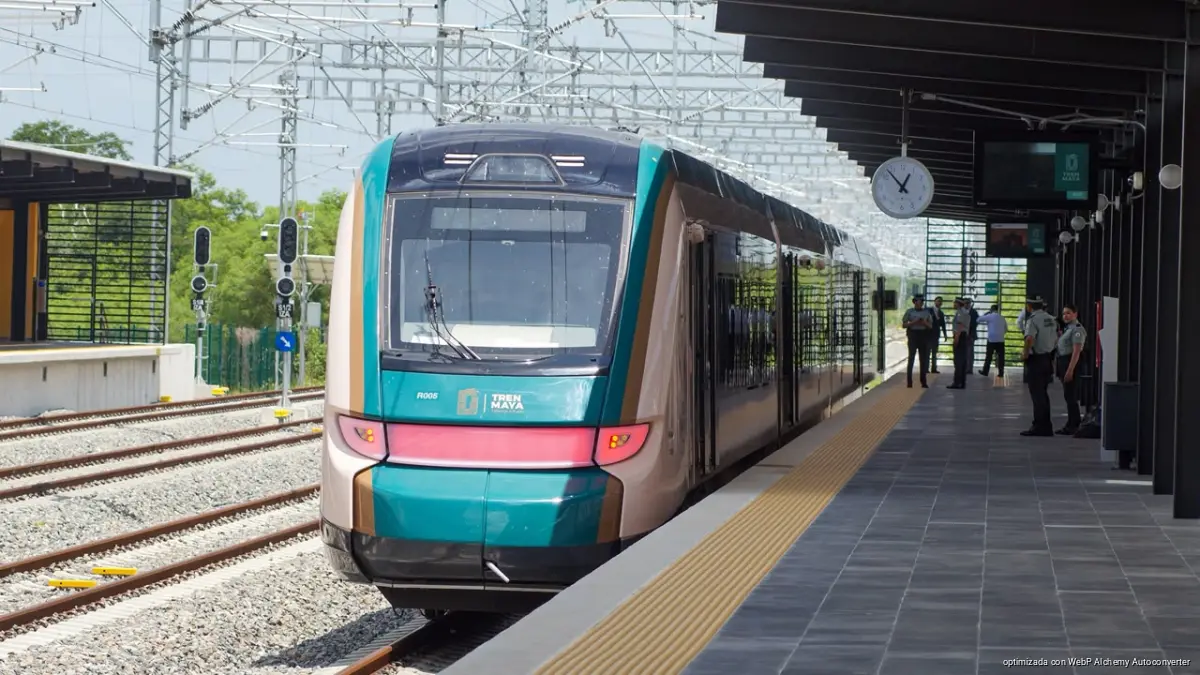
Mexico City — The Tren Maya’s financial losses ballooned in the first half of 2026, with the flagship railway project running 5.013 billion pesos in the red in just six months — more than the 4.810 billion pesos it lost in all of 2025. At that pace, the losses will double this year.
Spread across the 181 days of the reported six-month period, the Tren Maya has been losing 27.7 million pesos a day.
Since it opened and through June 2026, the railway has accumulated 14.104 billion pesos in expenses and losses, 11.878 billion of which stem from operations. Revenue from ticket sales and services over the same period totals just 1.06 billion pesos — only 7.5% of what it has cost to run.
When the 558.1 billion pesos in construction overruns, expenses and losses are divided among the 2,665,699 passengers carried between Dec. 15, 2023 and July 15, 2026, each rider has cost 209,365 pesos.
Army Awards 17.3 Million Peso Contract
Faced with the project’s heavy losses, the Mexican Army (SEDENA) handed the company Mextypsa, S.A. de C.V. a direct-award contract worth 17.347 million pesos to carry out a comprehensive diagnosis and a strategic plan to be implemented between 2026 and 2030.
The technical annex of contract TM-CGRMSG-SVS-0024/2026 states that the firm must analyze the structure of revenue, costs and expenses tied to each line of business — passengers, freight, complementary services and others — “to quantify its real profitability and its marginal contribution to consolidated results, identifying the business lines with the greatest value potential, as well as those with structural deficits.”
“In the current stage of operational and commercial consolidation, the Tren Maya faces the challenge of increasing its own revenues, optimizing its cost structure and consolidating complementary business models that improve the profitability of passenger and freight transport services,” the justification document states.
The contract runs through February 2027 and is the third Mextypsa has received from the Tren Maya without an open tender. In 2019 it was assigned a 59 million peso technical advisory contract, and in 2020 it collected 664 million pesos for “management office” services on the project.
40 Million Pesos for Promotion
In 2026 the Tren Maya spent 40.408 million pesos promoting its services and courting passengers through stands at national and international trade fairs and through radio, television, social media and streaming ads.
Earlier this year, SEDENA directly awarded Creatividad y Espectáculos, S.A. de C.V. 14.546 million pesos to design, produce, supply and install Tren Maya stands at fairs and events in Mexico and abroad.
Contract TM-CGRMSG-SVS-0017/2026 says the goal is to increase ticket sales in international markets, sell branded merchandise, promote passenger and freight services and build “commercial ties that contribute to the development and growth of its different lines of business.”
The first stand was set up at the FITUR tourism fair in Madrid, Spain, from Jan. 21 to 25, 2026; the second at the Tianguis Turístico in Acapulco from April 27 to 30.
A second effort began Aug. 1 and runs through Dec. 15, 2026, under the campaign “Tren Maya Contigo,” for which the state company paid 25.862 million pesos through direct awards and various budget lines to advertise on radio, television, streaming platforms and social media.
The Tren Maya’s advertising spots will appear on Facebook, Instagram, YouTube, TikTok, Netflix, Amazon, Disney and Warner platforms.
‘A Bottomless Barrel’
Leonardo Núñez, director of applied research at Mexicanos contra la Corrupción, said the advertising push is “insufficient and incapable of solving the project’s problems” because it is a poorly planned and poorly executed government venture where “the problems are about substance, not style.”
“It has to do with planning, with the location of the stations; everything has been the consequence of a rushed rollout in which many stations ended up far from the urban centers they were supposed to serve, and with all the problems that mean everyone on the peninsula knows the railway was built. It’s not a problem of awareness, it’s a problem with the planning and the execution of the project itself,” he said in an interview.
The specialist added that even if the federal government meets its projected passenger and freight targets once freight service begins, the Tren Maya will not balance its books.
“It’s still a bottomless barrel, because the project doesn’t have the increase in users and doesn’t get the ridership that would be expected. And even with that expected use, the numbers don’t point to any kind of return on investment — not even to breaking even or getting into the black,” he said.
The Tren Maya reported 1.3 million passengers in 2025 but would need to carry at least 10 times that number “for the numbers to start moving into the black,” Núñez said. Freight targets are no more encouraging, he added.
Five Years to Break Even, Analyst Says
Eduardo Bohórquez, director of Transparencia Mexicana, said freight operations will lift the Tren Maya’s revenue but will not be enough to offset construction and operating costs, which might be covered only within five years.
“It’s possible that the Tren Maya improves its numbers with freight transport, but given the investments made, the cost overruns and the additional injection of taxpayer resources — a kind of subsidy — it is hard to see it becoming sustainable in at least the next five years,” he said.
“The armed forces are not, it must be said, specialists in passenger transport, much less in tourism services. They are used to buying at high prices in non-competitive markets, such as military supplies. They are better at spending than investing, and that is very clear in the projects they build. That’s why the numbers don’t work for them. Operating trains and tourism services is neither their calling nor their strength.”
More Economy
- Quintana Roo Warns Against Unchecked Hotel Growth as It Courts Brazil and Colombia
- Cancun’s Night Bike Ride Returns to Avenida Bonampak on October 3
- Volaris to Suspend Tulum Airport Flights, Second Mexican Carrier to Pull Out
- Proposed 351.80-Peso Non-Resident Fee Hike Threatens Tulum Tourism Recovery in 2027
- Cancún and Tulum Lose Air Traffic as Mexican Beach Destinations Cool Off