
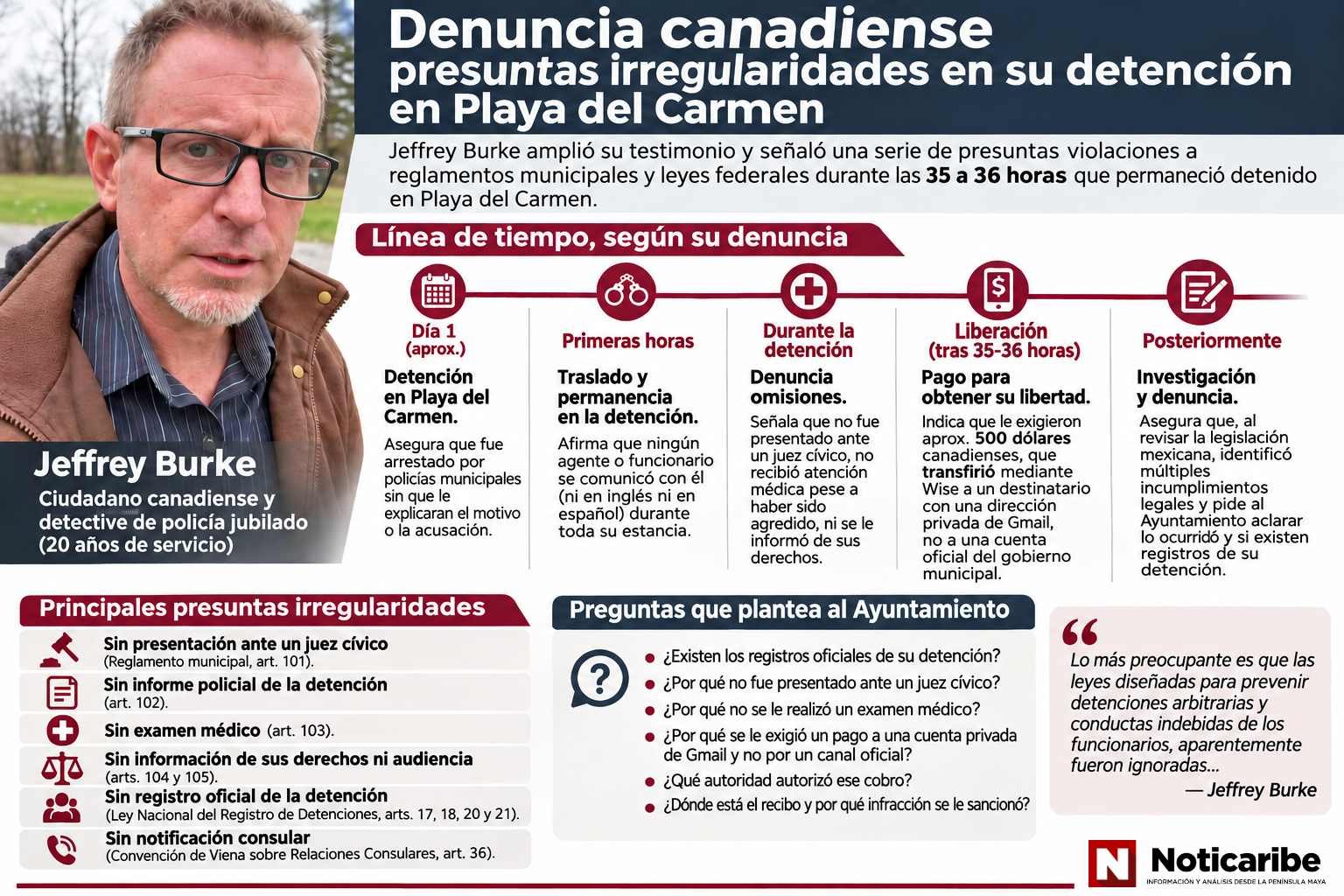
Playa del Carmen, Quintana Roo — A Canadian tourist says municipal police in this Caribbean resort town beat him, held him for more than 30 hours in a cell with about 30 other detainees and released him only after he paid roughly 500 Canadian dollars, following a dispute over a beach lounge chair.
Jeffrey Burke, who describes himself as a retired police detective with about 20 years of service in Canada, sent Noticaribe a lengthy written account and a video describing what happened during his visit in early November 2026.
He also filed a formal complaint with Salvador Contreras Mis, a senior inspector at the Quintana Roo State Human Rights Commission (Cdheqroo), asking the agency to investigate his arrest, the alleged assaults, the conditions of his detention and the payment he says he was required to make before he could leave.
From a 100-peso lounge chair to more than 30 hours in custody
According to Burke’s account, the episode began on a beach in Playa del Carmen when he sat down on a lounge chair that appeared to be unoccupied. He says he did not know the furniture cost about 100 pesos to use.
He says an employee approached him and, instead of explaining the charge, pulled the chair out from under him while he was still sitting on it. Burke says the worker then assaulted him, and that he only tried to push the man aside so he could leave the beach and keep the confrontation from escalating.
“All I did was try to move her out of my way so I could get away from the area and keep the situation from getting worse. I was not trying to start a fight, I was simply leaving after being assaulted,” he wrote.
Municipal police officers arrived shortly afterward and detained him, he says. Burke maintains the officers never told him what crime or infraction he had committed, or why he was being taken to municipal facilities.
During the arrest, he says, his prescription eyeglasses were damaged and ended up broken. He says he asked one of the officers to pick them up so he could keep them, and the officer refused. He was taken into custody without his glasses and without knowing the reason for his arrest.
A cell with 30 detainees, urine and excrement on the floor
Burke says he was booked into a municipal detention center, where he remained for more than 30 hours. He describes conditions he considers incompatible with the dignified treatment owed to anyone deprived of liberty.
He says he was locked in a cell with about 30 people, with no adequate facilities for a stay of that length.
“There was urine and human excrement on the floor, and those of us being held had to stay there, sitting or lying on the concrete, with no minimum hygiene conditions,” he said.
He says he received no clear information about his legal situation, how long he would be held or what he needed to do to regain his freedom. The uncertainty was compounded, he says, because he does not speak Spanish and none of the people guarding him explained anything in English.
“I didn’t know why I was there. I didn’t know what I was being accused of. I didn’t know how long they were going to keep me locked up or what I would have to do to get my freedom back,” he said.
Assault claims against fellow detainees and a guard
Among Burke’s most serious allegations are the physical attacks he says he suffered while in municipal custody.
According to his complaint, other inmates struck him repeatedly, mainly in the head. He attributes a perforated eardrum and a concussion to those blows.
He says the violence did not come only from other detainees. Burke alleges that one of the guards supervising the detention center also hit him.
“On two separate occasions, and without my having done anything to justify the use of force, this guard hit me in the head,” he said.
He argues that his roughly two decades as a police detective let him tell the difference between a legitimate use of authority and an attack on a person already in custody.
“I am a former police officer. I worked for two decades in the criminal justice system, I carried out criminal investigations and I know perfectly well the difference between the legitimate use of force and an unjustified assault on a person in custody,” he said.
The injuries he describes come solely from his own testimony and have not been corroborated by medical documentation submitted for publication.
Another Canadian helped him understand he had to pay
Burke says that for much of his detention he had no idea what he would have to do to be released. That changed, he says, when another Canadian citizen was brought into the same facility over an incident that also involved a beach lounge chair.
Unlike Burke, the second tourist spoke both English and Spanish and was able to help him follow the conversations with the authorities. Burke says that was when he learned he was supposedly required to hand over about 500 Canadian dollars to secure his release.
“It was thanks to this other Canadian that I finally understood that what the authorities wanted was for us to pay about 500 Canadian dollars to get our freedom back,” he said.
Burke says he left the municipal facilities after more than 30 hours, once the payment was made — a transfer through the Wise platform to a recipient identified only by a private Gmail address, not an official municipal account.
He asks why, if this were a legitimate fine, the payment was not made through official collection channels, who received the money, which authority authorized the charge and where the receipt is.
In his view, the sum demanded was not a lawful administrative penalty but an act of extortion.
“After more than 30 hours in detention, I was finally able to leave only once that amount of money had been paid. From my point of view, it was not a legitimate fine, it was a bribe or an act of extortion,” he said.
Burke says he never received a comprehensible explanation of the legal basis for the charge, the infraction he supposedly committed or the procedure used to decide on his release. He is asking municipal authorities to confirm whether records of his detention, police reports and any administrative ruling justifying the hours he spent in custody exist.
Complaint filed with state human rights commission
In his filing with the Cdheqroo, Burke asks that his account be registered as a complaint over alleged human rights violations by municipal police officers and detention center staff.
He requests a case or file number so he can follow the process from Ontario, Canada, where he now lives, and asks the commission to investigate the circumstances of his arrest, the conditions of his detention, the assaults he describes and the payment he says was demanded.
A central request is the urgent preservation of evidence held by municipal authorities: security camera footage from the detention center, records of detainees entering and leaving, police reports and any documents related to his arrest and release. He also wants copies of the official records of his detention and of any receipt tied to the payment.
Because he is back in Canada, he asks the commission to tell him how to complete and formally confirm his complaint remotely, and for guidance on filing further complaints over the alleged assaults and extortion. He says he is willing to give a more detailed statement and to provide medical records or other evidence.
“What I experienced in Playa del Carmen represents, from my point of view, a serious violation of the fundamental principles of a justice system and of the dignified treatment that every person deprived of liberty deserves,” he wrote.
Alleged procedural failures
Burke argues that his detention exposed serious gaps in local police procedure, including the absence of any appearance before a civic judge, no medical attention and no information about his rights.
He says the problem was not only the language barrier: no officer, guard or official tried to communicate with him in either English or Spanish during the entire time he was held, and no one explained the reasons for his arrest, the accusations against him or the steps to secure his release.
After studying Mexican law, Burke says his detention appeared to violate several provisions of the civic justice regulations of the former municipality of Solidaridad, published in April 2020 — particularly those requiring immediate presentation before a civic judge, the filing of police reports, medical examinations and the right to a hearing with legal assistance.
He also questions possible breaches of the National Law on the Registry of Detentions, which requires authorities to document the circumstances of every arrest and the identity of the officers involved. He says he cannot be certain such records do not exist, but that they were never shown or given to him.
He further argues that guarantees under the National Law on the Use of Force and the Vienna Convention on Consular Relations were violated, saying he was never told of his right to contact Canadian consular officials.
Similarities to an earlier case
Burke says he decided to make his experience public after returning to Canada and finding news reports about another Canadian who had denounced an arbitrary detention and alleged extortion by Playa del Carmen municipal police. He pointed in particular to coverage of a case reported in early November 2026, in which a Playa del Carmen municipal government official said the complaint of a tourist extorted by police would be addressed, and to later reporting that the Cdheqroo would try to contact that tourist.
That coverage noted 59 complaints filed during 2026 against the Playa del Carmen Public Security Department, according to the Cdheqroo inspector.
Burke says the similarities warrant an investigation into how foreign tourists are detained and processed.
“This raises an important question: how many more tourists are being detained, mistreated and forced to pay money to recover their freedom without their experiences ever coming to light?” he asked.
While the accounts overlap, there is so far not enough evidence to establish that both cases involved the same officers or that they reflect a systematic practice within the force.
More Law Enforcement
- Woman Seriously Injured After Playa del Carmen Taxi Crashes Into Wall on Highway 307
- Reported Snail Collection Raises New Concern for Bacalar Lagoon
- Cancún DIF Shelters Repatriated Families From US
- Four Armed Men Arrested After Attempting to Intercept Off-Duty Police Officer in Playa del Carmen
- Playa del Carmen Deploys Aerial Surveillance and Patrols for Buen Fin Shopping Season
More Playa del Carmen
- Playa del Carmen to Get 14,000 Wellbeing Homes
- Heavy Rain Floods Streets and Catches Pedestrians Off Guard in Playa del Carmen
- Playa del Carmen Marks 124th Anniversary by Honoring Its Founding Families
- Playa del Carmen Leads Quintana Roo Hotel Occupancy at 68.7%
- Playa del Carmen Tourism Chief to Draft 2027 Promotion Strategy With Industry