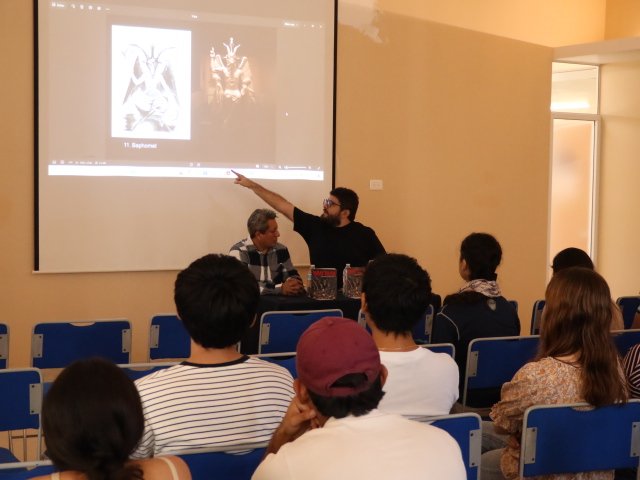
Mérida, Yucatán — The Autonomous University of Yucatán (UADY) presented Wáay Chivo, a graphic novel by Yucatecan illustrator Oswaldo Baqueiro Brito, as part of its activities marking National Book Day.
The presentation was organized by the university’s Institutional Program for the Study of Maya People and Culture (PROIMAYA) and held at the library of the Campus of Biological and Agricultural Sciences. The book was published by Kóokay Ediciones.
At the event, Baqueiro Brito walked attendees through the historical, cultural and artistic elements that shaped the project, with commentary from Luis Antonio Canché Briceño.
The work draws on one of Yucatán’s most unsettling legends and offers a visual interpretation of the Wáay Chivo, a figure tied to beliefs about transformation between the human and animal worlds and to the supernatural elements that run through Maya tradition.
From guardian spirit to witch
Baqueiro Brito said his approach to the concept of the waay starts from a broader understanding than that of a purely malevolent character. Originally, he explained, the term was also linked to a kind of cohesion that could appear in different forms of nature — animals or natural phenomena — and that accompanied people and deities.
The illustrator traced some of the representations that helped bind the figure of the goat to darkness and the supernatural, from classical mythology and demonology imagery to European art. Over time, he said, the concept of the waay took on negative connotations and came to be associated with witchcraft, shapeshifting and the power to bring illness or misfortune — beliefs that remain in the memory of Yucatecan communities.
A story told without words
On the creative process, Baqueiro Brito said the graphic novel grew out of his interest in telling a self-contained story set in the universe of Maya mythology while exploring the possibilities of visual narrative.
The 96-page book is drawn entirely in black and white and contains no text or dialogue, leaving each reader to interpret the images, imagine the sounds and reconstruct the story from their own language and cultural context.
That absence of words, he said, allows the work to reach a wide range of audiences, including Maya-speaking communities whose members can narrate what happens in the images in their own language. The illustrator cited influence from Frans Masereel and Lynd Ward, pioneers of the wordless novel, as well as from Francisco de Goya, Alberto Breccia, Junji Ito and Bernie Wrightson. He also credited Mexican engraving traditions and Yucatecan artists Fernando Castro Pacheco and Leopoldo Méndez.
Canché Briceño closed the session by highlighting Baqueiro Brito’s career in illustration and opening a dialogue with the audience, who raised questions about depictions of the waayo’ob, popular beliefs and the different forms of transformation found in Yucatecan oral tradition.
More Culture
- Cancún’s Tardes de Lucha Libre Wraps 2026 Season with 6,400 Fans
- Aurora, Andrómeda, Chapo Albury and 319 Take Top Honors at World Brahman Congress in Yucatán
- Isla Mujeres Vies to Keep Its Pueblo Mágico Status as Federal Review Nears
- Religious Divides Thwart Maya Traditions at Quintana Roo Intercultural University
- Quintana Roo Hands Out First Rural Sector Merit Awards to Three Workers
More Zona Maya
- Maya Women Bring Solar Power to 29 Communities in Quintana Roo
- Solar Project Near La Presumida Raises Deforestation Fears in José María Morelos
- Puerto Morelos to Host 10th Mesoamerican Ballgame Championship
- Farmer Warns Climate Shifts Are Making Agriculture Unviable in Tulum’s Maya Zone
- Mayan Legends Festival Brings Oral Tradition to Life in José María Morelos