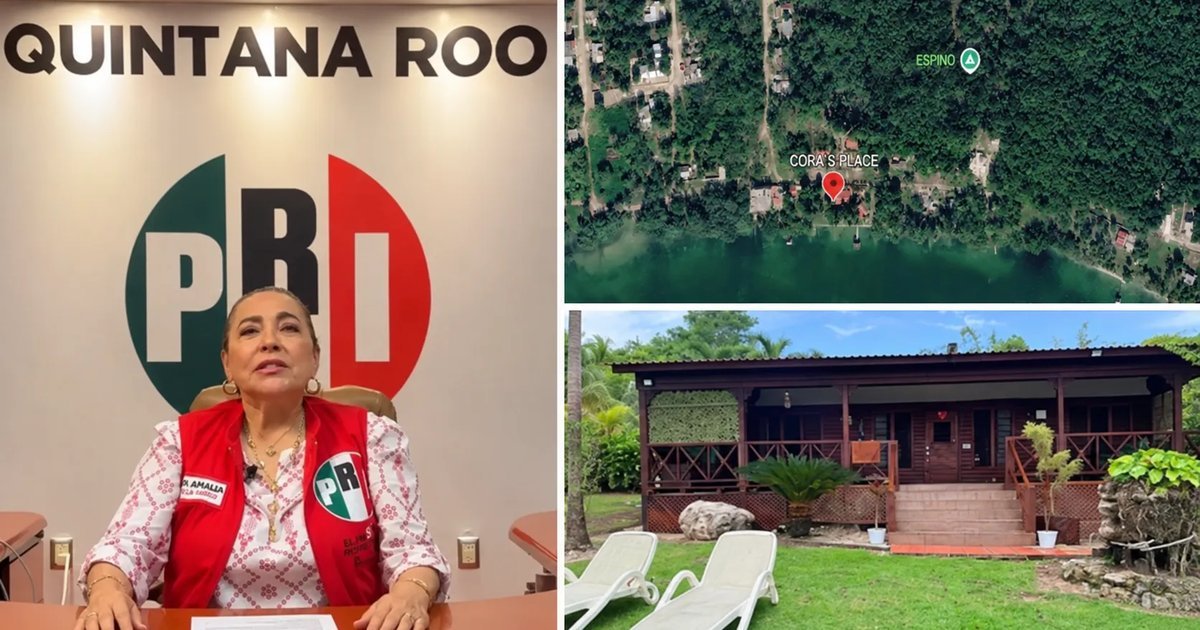
Bacalar, Quintana Roo — Cora Amalia Castilla Madrid, the president of the PRI in Quintana Roo, has filed an environmental impact statement with Semarnat to regularize and finish a vacation home beside the Bacalar lagoon system, a property where federal inspectors previously found construction carried out without environmental authorization.
The project, named Cora’s Place, is located in the community of Buenavista, on Calle Héroes de Nacozari, on a parcel formed by merging two lots. The filing asks the Environment and Natural Resources Department (Semarnat) to evaluate both the buildings already standing and the new installations the owner wants to add, including a swimming pool and a wooden deck.
The application carries the reference number 23QR2026UD078, and the executive summary of the statement is dated October 2026.
Profepa Inspected the Site in 2017
The property’s regulatory history dates to Oct. 4, 2017, when inspectors from the Federal Environmental Protection Agency (Profepa) visited the site next to the Bacalar lagoon. The inspection was logged as case PFPA/29.3/2C.27.5/0082-17.
On April 25, 2018, the agency issued administrative ruling 0071/2018 over works carried out without prior federal authorization on environmental impact grounds. According to the documents submitted to Semarnat, work was halted and the structures were left unfinished, in a bare-construction state.
The new application seeks to make use of that infrastructure and adapt it to complete the house. Filing an environmental impact statement, however, does not amount to a permit and does not by itself confirm that the obligations from the Profepa proceeding have been met.
Pool, Deck and Dock Among Planned Additions
The existing inventory listed in the filing includes two cabins, a warehouse, a terrace, a covered shed, a housing for a biodigester, a retaining wall, a ramp and a cement path. Also listed is a 48-square-meter T-shaped dock whose environmental status and position relative to the federal shoreline zone still need review.
In total, the document reports 506.425 square meters of existing infrastructure.
- A 24-square-meter swimming pool
- A 25-square-meter wooden deck
- An 11.20-square-meter supplementary bathroom
The three additions total 60.20 square meters, bringing the overall built or altered surface to 566.625 square meters, according to the filing. A definitive calculation would still have to separate structures on private property from those inside the federal zone or the lagoon system.
Records Differ by More Than 500 Square Meters
The paperwork also contains a discrepancy over the size of the lot. The environmental impact statement puts the parcel at 1,341.37 square meters, while the Profepa ruling cites an inspected area of 1,867 square meters — a difference of 525.63 square meters.
The study itself acknowledges that property records, site plans and the boundaries of the federal zone and the lagoon body will have to be reconciled. That clarification matters because several structures — the dock, the ramp and the retaining wall — stand close to the water.
The filing proposes a biodigester and an absorption well to handle the home’s wastewater. Given the proximity of Bacalar lagoon, technical studies would need to determine whether the system poses any risk of contamination.
Investment Amount Withheld
The cost of the development was not disclosed in the summary submitted to Semarnat. The project identification sheet states only: “Investment: reserved by the applicant.”
The document also offers no itemized budget for the existing structures, the new installations or the work required to finish the home, making it impossible to establish how much has been spent so far or what the final cost will be.
Who Is Cora Amalia Castilla?
Castilla Madrid is a longtime Quintana Roo politician who has held several posts within the Institutional Revolutionary Party and in state government.
She served as mayor of Othón P. Blanco from 2005 to 2008, later sat in the Quintana Roo Congress and headed the state Culture Commission during the 14th Legislature. She also served as state secretary of Education and Culture and as general secretary of government.
In March 2025 she returned to lead the PRI’s state committee for the 2025-2029 term. She named Sergio Roberto Góngora Chulim as the party’s organization secretary on Nov. 11, 2026.
Semarnat to Weigh Risks to the Lagoon
The executive summary identifies Bacalar lagoon as the project’s most environmentally sensitive element. The risks it lists include sediment runoff, construction debris, possible spills of materials and improper wastewater handling.
The study proposes preventive measures, water treatment, protection of vegetation and environmental monitoring at each stage of the work. Approval of the new construction will depend on Semarnat’s assessment and on any conditions the agency sets.
The legal and environmental status of the existing structures, particularly those near the shoreline or inside the federal zone, also remains to be settled. The executive summary does not include documentation showing that the obligations from the 2018 Profepa ruling have been fully resolved.
More Development
- Mexico Can Identify Climate Risk Zones but Has No Plan to Relocate Residents
- Cancún Could Add 500,000 Residents in 25 Years, IMPLAN Projects
- Tulum Mayor Inspects Progress on New Football Pitch
- Playa del Carmen Plans to Spend Environmental Sanitation Fee on Water Quality Monitoring in 2027
- Quintana Roo Launches Digital Procedures Platform With 11 Online Services